Nov 13, 2025
Productivity
What is an Ideal Customer Profile: A Guide to Driving Growth
An ideal customer profile (ICP) is the single most important document your revenue team will ever create. Forget vague descriptions; an ICP is a hyper-specific blueprint of the perfect company to sell to, not the person. It's built by analyzing the DNA of your absolute best customers—the ones who are wildly successful, stick around the longest, and sing your praises to anyone who will listen.
Your Blueprint for Finding High-Value Customers
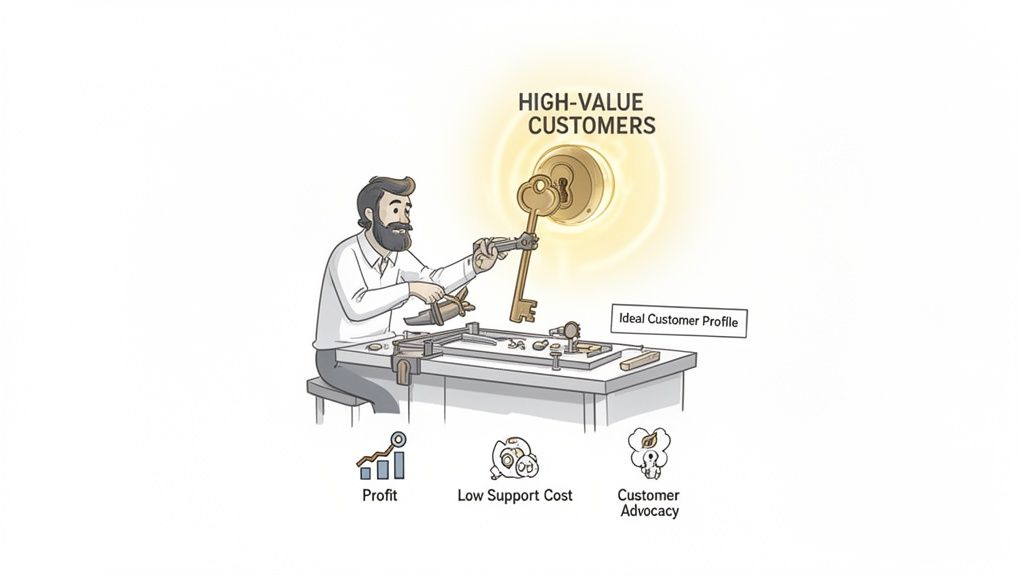
Let’s ditch the textbook definitions. Imagine you're a locksmith. You could make a master key that sort of works on a bunch of different locks—the one you have to jiggle just right. Or, you could forge one perfect key designed to slide effortlessly into your most valuable accounts, unlocking massive growth.
That’s your ICP. It isn’t a wish list. It’s a data-driven compass that points every single person in your company toward the accounts that will get the most value from what you do. This transforms your go-to-market motion from a spray-and-pray numbers game into a precision-guided strike.
From Guesswork to a Growth Multiplier
Operating without a defined ICP is like flying blind in a storm. Marketing ends up generating leads that sales can’t close. Sales closes deals with customers who churn within six months because they were never a good fit in the first place. It’s a recipe for wasted resources, internal friction, and stalled growth.
A sharp ICP acts as the strategic filter for your entire business. It gives everyone a common language and a shared target, making sure every team—from marketing to product to customer success—is aiming at the same high-value bullseye.
The results of this focus are staggering. Teams with a clearly defined ICP see up to 20% higher sales productivity and 15% shorter sales cycles. It’s the compound effect of everyone pulling in the same direction. When you move from gut feelings to a data-backed profile, you stop wasting time on dead-end prospects. In fact, companies that use customer behavioral insights outperform their competitors by a massive 85% in sales growth. You can see more on how this focus drives performance at Prospeo.io.
Key Benefits of a Well-Crafted ICP
When you commit to an ICP, a powerful sense of clarity ripples through your entire organization. Instead of spreading your efforts thin across the market, you concentrate your firepower where it will make the biggest impact.
Improved Sales Efficiency: Your sales reps stop chasing ghosts. They can finally focus their time and energy on accounts that have a real, high probability of closing and becoming top customers.
Higher Customer Retention: You start attracting the right customers from day one. This means they actually achieve their goals with your product, which leads directly to lower churn and much higher customer lifetime value (LTV).
More Effective Marketing: Your marketing team can create razor-sharp campaigns and messaging that speak directly to the specific pains and ambitions of your best-fit customers. The message finally lands.
Smarter Product Development: The needs of your most valuable customers start guiding your product roadmap. This ensures you’re building features that solve real problems for the people who pay the bills, not just adding noise.
Ultimately, an ICP isn't about excluding potential customers; it's about extreme focus. It empowers your company to aim all its energy at the opportunities that generate the most sustainable, profitable growth.
Why a Strong ICP Drives Company-Wide Success
Think of your Ideal Customer Profile as less of a sales document and more of the strategic glue holding your entire company together. It’s the shared language that gets everyone—from sales and marketing to customer success—pulling in the exact same direction.
Without it? Chaos. Marketing chases leads that will never close. Sales wastes energy on prospects who aren't a good fit. Customer Success is stuck battling churn with unhappy clients. A strong ICP stops the madness, aligning every department around a single mission: attracting and keeping the customers you were built to serve.
Sales Teams Close Smarter Deals, Faster
For any sales rep, a rock-solid ICP is the ultimate cheat code. It instantly flips the switch from a "spray and pray" volume game to one of surgical precision. Reps stop wasting cycles on accounts that will churn in six months and instead focus all their energy on companies that genuinely feel the pain your product solves.
This isn't just about feeling more productive; it's about a real impact on the numbers. With a clear ICP, reps can:
Build hyper-targeted lead lists packed with accounts that have a high probability of closing.
Dramatically shorten sales cycles because they’re talking to people who already get it.
Increase win rates by focusing exclusively on companies that are a perfect match for the solution.
For example, a SaaS company selling project management software to construction firms can use their ICP to immediately disqualify anyone in manufacturing or retail. This ensures every single outreach call is laser-focused on the real-world problems of that industry, like managing complex build schedules and subcontractor payments. The result is better conversations and faster deals.
Marketing Achieves Higher ROI and Deeper Resonance
When your marketing team knows exactly who they’re talking to, their entire strategy sharpens. They can ditch the generic corporate-speak and create content, ads, and campaigns that resonate deeply with the specific goals, pain points, and even the slang of their ideal customers.
The real power of an ICP for marketing isn't just about attracting leads; it's about respectfully disqualifying the wrong ones before they ever hit the sales pipeline. The goal shifts from more leads to the right leads.
This laser focus also leads to much smarter budget decisions. Instead of spreading ad spend thinly across broad, generic audiences, they can pour resources into the specific channels and platforms where their ideal customers live. This means higher conversion rates, a lower customer acquisition cost (CAC), and a return on investment that actually makes the CFO smile.
Customer Success Drives Retention and Expansion
Onboarding a customer who is a poor fit is a ticking time bomb for churn. For customer success teams, a strong ICP is a preventative measure, ensuring they work with clients who are wired for success from day one. These are the customers who will not only stick around but will get the most value from your product, making them your most loyal champions.
We dive deeper into this in our guide to customer success best practices.
When CS managers work with ideal clients, their job transforms from reactive fire-fighting to proactive, strategic guidance. They can focus on helping customers grow and identifying expansion opportunities instead of trying to save accounts that were never a good match to begin with. This doesn't just crush churn rates; it creates a powerful engine for referrals and advocacy.
To go even further, check out this comprehensive guide on Ideal Customer Profiles, which breaks down exactly how to define and deploy them for serious B2B growth.
How to Build Your Data-Driven ICP Framework
Building a truly effective Ideal Customer Profile isn't about throwing darts at a wall or sketching out a "dream client" on a whiteboard. It’s about being a detective. Your job is to turn raw data—the messy, scattered clues you already have—into a strategic weapon.
The goal here isn't to create a static PDF that gets filed away and forgotten. Think of it as building a living, breathing blueprint of your best customer. It's a model that gets smarter and more accurate over time.
Let's walk through exactly how to build this framework, step by step, using the goldmine of data you're already sitting on.
Start with Your Best Customers
The entire foundation of a killer ICP rests on your current customer base. But let's be honest, not all customers are created equal. The first and most critical step is to find your champions. These are the companies that not only drive revenue but are an absolute joy to partner with.
Pull together a list of your top 10-20 "champion" customers. You’re looking for specific, measurable signals that scream success. These often include:
High Lifetime Value (LTV): They stick around and spend more over time, proving they get consistent, compounding value from you.
Low Support Costs: They don’t drain your resources. They understand the product and don't constantly flood your support team with tickets.
High Net Promoter Score (NPS): These are your evangelists. They're the ones who would happily recommend you to their peers.
Strong Product Adoption: They're power users, diving deep into your features instead of just scratching the surface.
Expansion Revenue: They consistently upgrade their plans, add more seats, or buy new services. They're growing with you.
Once you have this list, you've isolated the DNA of your ideal customer. Now, it's time to figure out what makes them tick.
Uncover the "Why" with Qualitative Interviews
With your list of champions in hand, the next step is simple: talk to them. The numbers tell you what is happening, but it’s the real-world conversations that tell you why. This human element is where the magic happens, revealing the motivations and frustrations that data alone can't.
Schedule some quick, 30-minute chats with key people at these companies. The goal isn't to sell them anything—it's to listen. Ask open-ended questions that get them talking about their world:
"Before you found us, what was the biggest headache you were dealing with?"
"What are you ultimately trying to accomplish with our product?"
"In your world, what does a huge win look like for your team and for you personally?"
"Was there a specific 'aha!' moment that made you realize our solution was the one?"
These conversations give you the rich, narrative context that numbers will never capture. You'll hear their exact pain points, in their own words, which is pure gold for your marketing and sales messaging.
An ICP built on quantitative data alone is a skeleton. It’s the qualitative insights from real conversations that give it a soul, revealing the human fears, hopes, and ambitions that drive every buying decision.
Enrich with Quantitative Data to Find Patterns
Now it's time to connect the dots. Take those powerful stories and combine them with hard data. This is where you zoom out from individual customer journeys and start spotting the common threads that tie all your best customers together. You’re hunting for patterns in firmographics, technographics, and buying behaviors.
As the infographic below illustrates, a well-defined ICP gets your entire revenue engine—from sales and marketing to customer success—rowing in the same direction.
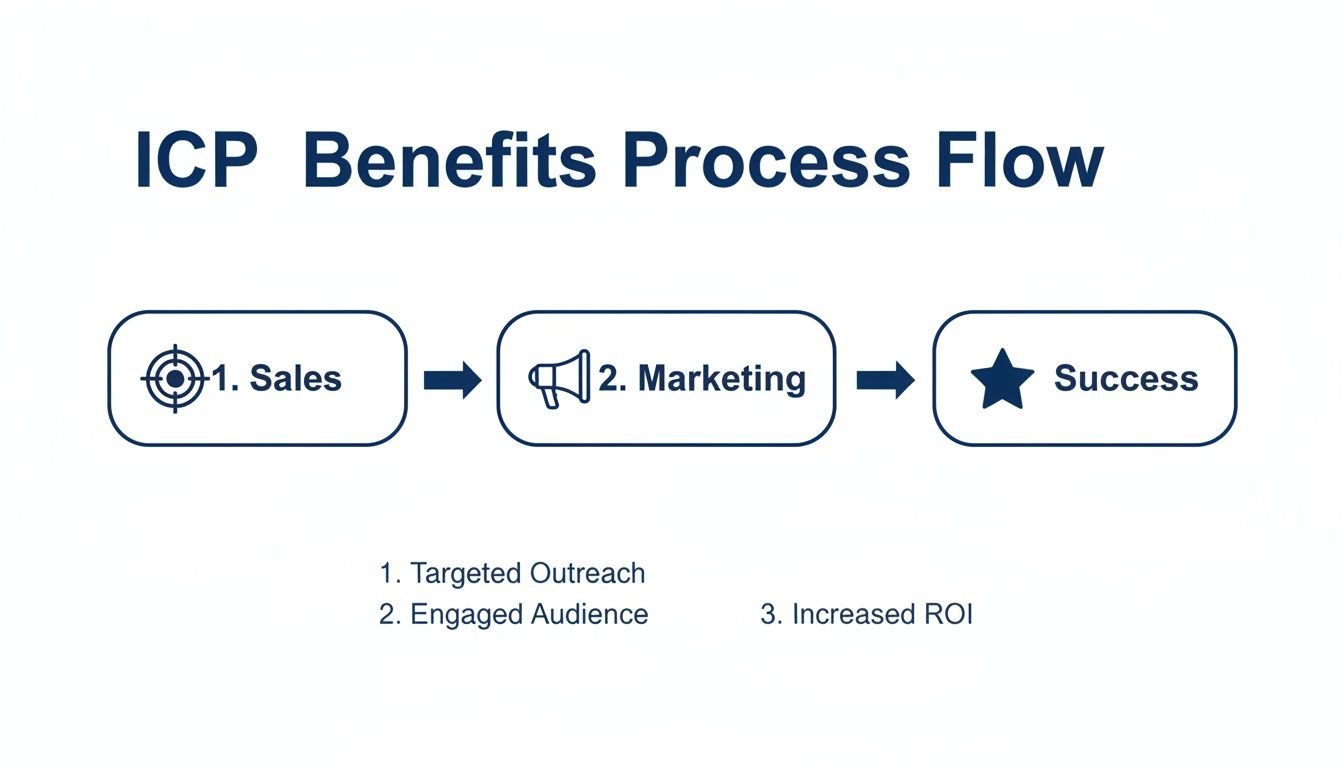
This alignment is everything. It ensures every team is laser-focused on attracting and delighting the highest-value accounts, creating a smooth and profitable customer journey from start to finish.
Start digging into your CRM and other business systems for your list of champion accounts. Look for the common ground:
Firmographics: What's their typical industry, company size, annual revenue, or geographic footprint?
Technographics: What other tools are in their tech stack? Does your product work especially well alongside certain software?
Buying Behaviors: How long was the sales cycle? Who was involved in the final decision? What blog posts or webinars did they engage with before buying?
By analyzing these data points, a clear picture will start to emerge. For example, you might discover that 80% of your best customers are B2B SaaS companies with 50-200 employees that use HubSpot. That’s a powerful, actionable insight you can immediately use for more precise outbound lead generation.
Build Your Living Data Model
The final step is to bring it all together. A modern ICP isn’t a static document; it’s what we call a “living data model.” It’s a dynamic resource that combines both the stories you’ve heard and the numbers you’ve crunched.
Sales teams know which deals close the fastest. Customer Success knows which customers adopt the product most deeply. When you merge these on-the-ground observations with hard metrics like win rates, deal size, and product usage, your ICP transforms from a simple description into a predictive, actionable tool.
Your ICP should be constantly evolving, fed with fresh data from every sales call, support ticket, and CRM update. This is where tools like GLINKY come in, designed to automatically capture insights from every customer conversation and sync them back to your systems. This creates a powerful feedback loop, ensuring your definition of "ideal" is always current, data-driven, and relentlessly focused on what truly works.
The Building Blocks of a Powerful ICP
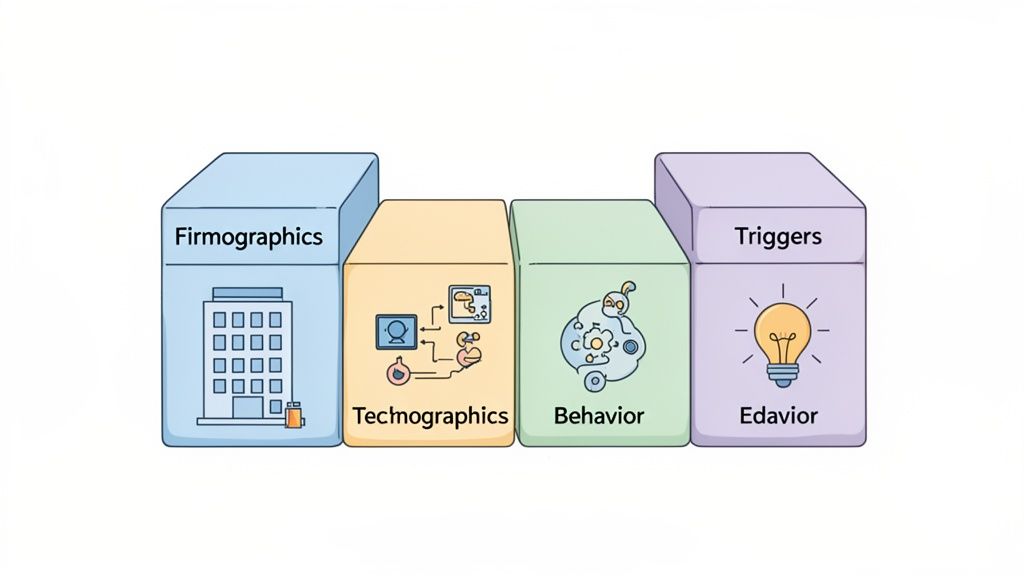
A truly game-changing Ideal Customer Profile isn’t just a vague hunch about who you sell to. It's a structured, data-backed blueprint of the companies that get the most value from you and give you the most value in return.
To get there, you need to break down your best customers into a few core dimensions. Think of them as the ingredients in a recipe—miss one, and the final dish just won't taste right. This framework moves you from guesswork to a practical guide that your entire go-to-market team can actually use.
Firmographics: The Lay of the Land
Firmographics are the non-negotiable, foundational facts about a company. This is your first, broadest filter, helping you instantly cut through the noise of the total addressable market to focus on accounts that have the right basic profile. It’s the answer to the simple question, "What kind of company are we even looking for?"
These data points are usually the easiest to find and are absolutely essential for segmenting your market and making sure your sales team isn't wasting time on dead ends.
Industry/Vertical: Do your best customers cluster in specific sectors like SaaS, healthcare, or e-commerce?
Company Size: Get specific about employee headcount. "SMB" is too vague; 50-250 employees is an actionable data point.
Annual Revenue: Is there a sweet spot for revenue, like companies in the $10M - $50M ARR range?
Geographic Location: Are they concentrated in certain countries, regions, or even cities where your solution has a proven track record?
Technographics: What’s Under the Hood
Technographics tell you what technologies a company is already using. This is a massive tell. A company's tech stack is a direct window into its priorities, its operational maturity, and—most importantly—its potential to integrate with your product.
If your solution plugs perfectly into their existing CRM or marketing platform, that's not just a nice-to-have; it's a huge buying signal. Knowing their stack lets you skip the generic pitch and talk directly about how you complement the tools they already rely on, like HubSpot.
An organization's technology choices are a direct reflection of its strategy and challenges. By analyzing their tech stack, you're not just looking at software; you're deciphering their business DNA and identifying where you can add immediate value.
Behavioral Attributes: How They Actually Behave
This is where your ICP gets a pulse. Behavioral attributes go beyond static facts to describe how your best accounts act and engage with you. This data is a goldmine for spotting intent and identifying companies that are already on the hunt for a solution like yours.
Think of these behaviors as leading indicators of a great future customer. What did your best accounts do right before they signed the contract?
Engagement Patterns: Did they binge-read your blog posts on a certain topic, download a specific whitepaper, or show up to every webinar you hosted?
Product Usage: If you have a PLG motion, this is critical. High feature adoption or frequent logins are powerful positive signals.
Buying Process: How long was their sales cycle? Who was in the room (or on the Zoom)? Knowing this helps your team navigate future deals with a proven playbook.
Trigger Events: The Perfect Moment to Strike
Timing is everything in sales. A trigger event is an observable change at a target company that suddenly creates an urgent need or frees up a new budget for a tool like yours.
Focusing on these events transforms prospecting from an annoying cold call into a relevant, timely conversation. You're not just another salesperson; you're a problem-solver showing up at the exact right moment. To get all these data points organized, a structured framework like this SaaS Ideal Customer Profile template can be incredibly helpful.
Keep an eye out for these common triggers:
New Executive Hires: A new VP of Sales or CMO isn't hired to maintain the status quo. They’re there to make changes and bring in new tools.
Funding Rounds: Fresh capital means new money for aggressive growth plans and the tools needed to execute them.
Company Expansion: A new office or entry into a new market always creates new operational headaches that need solving.
Negative Mentions of a Competitor: When a company gripes about their current provider on social media or G2, that's your cue to slide in with a better alternative.
How to Activate Your Ideal Customer Profile
Alright, let's be honest. Creating an Ideal Customer Profile document that just sits in a shared drive is a waste of everyone's time. The real magic happens when you take that ICP off the page and plug it directly into your daily operations.
An ICP isn't just a strategic concept; it's a tactical tool. It's the "now what?" that transforms how your entire company finds, wins, and keeps its best customers. When you get this right, you’re not just chasing leads—you're systematically building a more profitable business.
Activating Your ICP for Precision Sales
For any sales team, a sharp ICP is the ultimate filter. It stops reps from burning hours on dead-end leads and focuses their energy where it counts: on accounts that are actually a great fit. This isn't about working harder; it's about being ruthlessly efficient. The result? Shorter sales cycles and much higher win rates.
Here’s how to put it into play:
Build Laser-Focused Lead Lists: Stop generic prospecting. Use your ICP's firmographic and technographic DNA to slice and dice your lead sources. Think: "Show me all B2B SaaS companies in North America with 100-500 employees that use Salesforce and Marketo." Every name on that list is already pre-qualified.
Discover New ICP-Aligned Accounts: Your CRM isn't the whole world. Tools like GLINKY let you hunt for new accounts using plain English, based on your ICP. You can find verified contacts by role, industry, or company size, giving your team a fresh, high-quality pipeline on demand.
Score and Prioritize Everything: Not all leads are created equal. Build a lead scoring model based on your ICP attributes. The more boxes an account checks, the higher its score. This tells your reps exactly who to call first, ensuring they always focus on the hottest opportunities.
Tailoring Marketing for Maximum Resonance
Your marketing team can use the ICP to stop shouting into the void and start whispering directly to the people who matter. It sharpens your messaging, makes your ad spend work harder, and is the absolute bedrock of any account-based marketing (ABM) strategy. The ICP tells marketing who to talk to, so they can perfect the what and where.
Your ICP gives marketing the confidence to practice respectful disqualification. When you create content that’s hyper-relevant to a specific audience, you naturally push away poor-fit leads. This ensures sales only gets at-bats with prospects who have a real shot at becoming great customers.
For instance, if your ICP reveals your best customers are constantly fighting with clunky project handoffs, that’s your cue. Your marketing team can spin up a webinar, a blog post, and a LinkedIn ad campaign all centered on solving that one specific pain point. It’s infinitely more powerful than generic fluff about "boosting productivity."
A Mini Case Study in Putting the ICP to Work
Imagine a sales team at a mid-market software company. They’ve just locked in their ICP: logistics companies with $50M-$200M in revenue that are still stuck using outdated inventory systems.
Targeting: The team fires up their CRM and a lead discovery tool, quickly building a list of 200 companies that perfectly match these firmographics. No guesswork involved.
Personalization: A sales rep starts researching a target account and spots a trigger event—they just hired a new VP of Operations. The rep uses an AI email writer to draft a killer message that references this change and ties it directly to the headaches new ops leaders usually face with old tech.
Interaction Capture: During the discovery call, the rep uses a tool like GLINKY to capture every important detail and outcome. All the notes, pain points, and action items are automatically synced to the CRM, enriching that account record with fresh, ground-truth intelligence.
This is what a single source of truth looks like for an account—a unified timeline of every interaction.
This unified view means the entire revenue team—sales, marketing, CS—is on the same page. No more blind handoffs or lost context.
This process creates a powerful feedback loop. The data captured from that one call doesn't just help close a single deal; it flows back into the system, constantly sharpening the ICP with real-world insights. The market is waking up to this. Smart companies are breaking down data silos to build a central brain for all customer knowledge, with some reporting up to a 2.9x revenue improvement by using their first-party data this way. For teams juggling dozens of accounts, this unified view makes your ICP smarter and more dynamic with every conversation. You can explore more 2026 consumer marketing trends to see just how big this shift is becoming.
Your Ideal Customer Profile Questions Answered
So you’ve got a framework. But turning that ICP document from a strategic exercise into a real-world weapon always brings up a few tricky questions. Getting your ICP right isn’t a one-and-done task you check off a list; it’s a constant process of listening, refining, and making smarter bets.
Let's dig into the most common sticking points and give you the answers you need to make your ICP a true growth engine, not just another file in your shared drive.
How Often Should I Update My ICP?
Your ICP is a living, breathing guide, not a stone carving. The bare minimum? You should be doing a serious deep-dive and review of your customer profiles quarterly. This cadence keeps your strategy tethered to what's happening right now, not what you assumed was true six months ago.
But forget the calendar for a second. Certain business earthquakes should trigger an immediate ICP huddle:
You launch a major new product or feature. This could solve a totally new pain point, attracting a different breed of customer and instantly shifting who your "ideal" really is.
A new competitor crashes the party. Their moves can reset customer expectations or force you to sharpen your positioning, which directly impacts your target.
You see churn suddenly spike. This is a massive red flag. It’s a sign you’re landing the wrong fish, and you need to re-evaluate your bait and where you’re casting your line, fast.
Your win rates start to tank. If your sales team is grinding through longer cycles and deals are stalling out, it’s a sign your message isn't hitting home with your target market anymore.
Treating your ICP as a dynamic asset is what separates the companies that adapt and win from those that get left behind. Using AI tools that constantly analyze customer conversations is a game-changer here, feeding your profile with fresh intel on sentiment and pain points in near real-time.
What Is a Negative ICP and Why Is It Important?
While your ICP defines the bullseye you’re aiming for, a negative ICP draws a hard line around who you should actively run away from. Think of it as an exclusionary profile—the customers who, even though they have a credit card, will ultimately bleed your business dry.
A negative ICP calls out companies with a predictable set of toxic traits:
High Churn Rates: They sign up, get a little value, and ghost you because the product was never the right long-term fit.
Excessive Support Tickets: They monopolize your support team's time, usually because of mismatched expectations or a fundamental lack of technical fit.
Low Product Adoption: They barely scratch the surface of your product, meaning they never see the real value and are almost guaranteed not to renew or expand.
Constant Out-of-Scope Feature Requests: They try to hijack your product roadmap, pulling you in a direction that alienates your actual ideal customers.
A negative ICP is your guardrail against bad-fit revenue. It gives your sales and marketing teams the confidence to disqualify leads that will cost you more in support hours and team morale than they’re worth, keeping everyone focused on profitable, sustainable growth.
How Can a Startup with Few Customers Build Its First ICP?
Building an ICP when your customer list fits on a sticky note feels like a paradox. But it's not impossible; you just have to trade a big dataset for sharp hypotheses and qualitative gold. Your early ICP is more of an educated guess than a statistical certainty.
Forget the data you don't have and start with the one thing you know better than anyone: the problem you solve.
Define the Core Pain: Get brutally specific. Who feels this problem so acutely they'd run through a wall for a solution? What roles, in what industries, are losing sleep over the exact issue your product was built to fix?
Lean on Your Expertise: Do you or your founding team have deep insider knowledge of a particular industry? Start there. Your domain expertise is your single biggest advantage when you're just starting out.
Run Discovery Calls (Not Sales Pitches): Get on the phone with people who fit your hypothesized profile. The goal isn't to sell them anything. It's to listen. Shut up and let them talk. Do their eyes light up? Do they validate your assumptions? Would they actually pay for what you're building?
Even with just two or three paying customers, you have breadcrumbs. Which one was the easiest to close? Who’s already logging in every day? These early champions are your first real clues on the trail to a powerful, data-driven ICP.
Ready to stop guessing and start building a smarter, data-driven customer strategy? GLINKY turns every sales call and meeting into actionable intelligence. Discover ICP-aligned leads, capture critical insights without taking notes, and automatically sync everything to your CRM. See how you can build a living, breathing ICP with https://www.glinky.ai today.
People also read
10 Sales Enablement Best Practices to Unify Your Revenue Engine in 2026
Productivity
Mar 13, 2026
How to Manage Sales Pipeline for Predictable Revenue Growth
Productivity
Mar 14, 2026
How to Qualify Leads in Sales Without Wasting Time
Productivity
Mar 17, 2026

What is Conversation Intelligence? A Practical Guide for Sales Teams
Productivity
Mar 18, 2026
Top 10 Sales Discovery Questions That Close More Deals
Productivity
Mar 25, 2026

Taking Minutes of Meeting: A Guide to Transforming Chaos into Action
Productivity
Feb 16, 2026
Action Items List: A Practical Guide to Drive Real Results
Productivity
Feb 19, 2026
Master the summary of a meeting for clear decisions and follow-ups
Productivity
Feb 22, 2026

Track Action Items: A Practical Guide to Using AI for Flawless Follow-Up
Productivity
Feb 17, 2026

Unlock: How to Take Notes on a Computer for Peak Productivity in 2026
Productivity
Feb 26, 2026
How to Record Google Meet: A Complete Guide for 2026
Productivity
Mar 4, 2026

12 Best AI Note Taking App Choices for 2026: The Definitive Guide
Productivity
Mar 6, 2026
How to Improve Customer Retention: Practical Tips to Boost Loyalty
Productivity
Mar 8, 2026

10 Client Communication Best Practices to Master in 2026
Productivity
Mar 7, 2026
The 12 Best AI Meeting Assistant Tools for 2026: A Deep Dive
Productivity
Mar 15, 2026
Your Guide to the Ultimate AI Email Writer
Productivity
Feb 27, 2026
10 Essential Customer Success Best Practices for 2026
Productivity
Mar 1, 2026
Your Guide to Sales Call Recording Software in 2026
Productivity
Mar 2, 2026

How to Take Better Meeting Notes and Drive Real Results
Productivity
Mar 5, 2026
Top 10 Picks for best crm for small business
Productivity
Mar 3, 2026

Automated meeting minutes: Turn talks into actionable notes
Productivity
Mar 11, 2026
The Top 12 AI Powered Sales Tools to Boost Revenue in 2026
Productivity
Mar 16, 2026

AI Note Taking For Meetings: Fast, Smart AI Notes That Drive Collaboration
Productivity
Mar 19, 2026
Understanding Transcription Service Cost: A 2026 Guide
Productivity
Mar 20, 2026
Master Your Meetings With The Note Taking Charting Method
Productivity
Feb 18, 2026
The Ultimate 2026 Guide: 8 Meeting Follow Up Email Template Scenarios
Productivity
Feb 20, 2026
Master the Art of Taking Meeting Notes for Actionable Outcomes
Productivity
Feb 25, 2026
12 Best Sales Lead Generation Tools to Boost Your Pipeline in 2026
Productivity
Mar 10, 2026

Translation Vs Transcription: Which Service Do You Really Need?
Productivity
Mar 12, 2026
Mastering the goals of a meeting to drive decisions and boost team alignment
Productivity
Mar 23, 2026
The 12 Best Free AI Email Writer Tools for 2026
Productivity
Mar 22, 2026
A Guide to AI Sales Enablement Platforms in 2026
Productivity
Mar 21, 2026
Automate Follow Up Emails: Actionable Insights for Boosting Sales & Efficiency
Productivity
Mar 26, 2026

Follow Up Email Subjects That Convert: Increase Opens and Replies
Productivity
Feb 17, 2026

Your Playbook for Outbound Lead Generation in 2026
Productivity
Feb 28, 2026
Your Essential Meeting Action Items Template to Drive Results
Productivity
Feb 23, 2026

Your Guide to Using an Email Writer AI for Maximum Impact
Productivity
Feb 23, 2026
8 Essential Ground Rules at Meetings to Maximize Productivity in 2026
Productivity
Mar 24, 2026

Otter.ai vs Glinky
Productivity
Feb 5, 2026
AI Tools for Startup Founders [2026]
Productivity
Feb 4, 2026
Best AI Tools for Startups [2026]
Tools
Feb 3, 2026
Sales Call Notes: How to Capture Every Detail Without Losing the Deal
How to
Feb 2, 2026
How to Take Meeting Notes: 7 Methods That Actually Work [2026]
How to
Jan 14, 2026
![AI Meeting Minutes | Free Forever [2026]](https://framerusercontent.com/images/zYQGRjgLX63tiouLTK65LvCcjK8.png?width=402&height=263)
AI Meeting Minutes | Free Forever [2026]
How to
Jan 13, 2026
![How to Record Zoom Meetings Without a Bot [2026] 3 Easy Methods](https://framerusercontent.com/images/gGoQV8bPb9zR5weVruinbjaxO0.png?width=402&height=263)
How to Record Zoom Meetings Without a Bot [2026]
How to
Jan 9, 2026
Bot-Free AI Meeting Notes: We Tested the 6 Best Tools in 2026
Tools
Jan 8, 2026
Glinky vs Fireflies.ai
Tools
Jan 7, 2026
15 Best AI Tools to Boost Your Productivity in 2026
Productivity
Jan 6, 2026