Nov 13, 2025
Productivity
Top 10 Sales Discovery Questions That Close More Deals
Great sales conversations aren't about pitching; they're about diagnosing. In today's market, asking generic questions is a fast track to a 'no thanks.' The difference between a stalled deal and a closed-won opportunity often comes down to the quality of your sales discovery questions. Effective discovery uncovers deep-seated pain points, aligns your solution with the prospect's goals, and builds the urgency needed to drive action.
For lean teams at startups and SMEs, mastering discovery is non-negotiable. It's how you outmaneuver larger competitors who rely on brute force. A strong discovery process ensures you spend time on deals you can actually win. To truly master sales discovery, it helps to first understand the fundamental types of Lead Qualification Questions. This foundational knowledge sets the stage for the more advanced diagnostic questioning we'll cover here.
This article is more than just a list; it's a strategic framework for your sales process. We'll break down the 10 most impactful sales discovery questions, complete with:
Actionable phrasing for different scenarios.
Smart follow-up prompts to dig deeper.
Guidance on how to capture and act on the answers you receive.
We'll show you how to move beyond surface-level chats and conduct discovery that genuinely qualifies, persuades, and closes. You'll also see how unifying your revenue workflow with a tool like Glinky can automate the capture and analysis of these critical insights. This frees you to focus on what matters most: building relationships and solving real problems for your customers. Let's get started.
1. What problems is your prospect currently experiencing?
This is the quintessential starting point for any meaningful sales conversation. Asking about current problems moves the discussion from a generic pitch to a focused, diagnostic session. It is one of the most fundamental sales discovery questions because it directly uncovers the "why" behind a potential purchase. Without a clear problem, there is no need for a solution, making this question critical for establishing a genuine business case.
This approach immediately centers the conversation on the prospect, not your product. It shows you're there to help, not just to sell. By understanding their specific challenges, you can begin to frame your product as the direct answer to their pain. Uncovering these challenges is the first step towards defining a compelling value proposition that converts. This initial step is vital; it sets the stage for the entire qualification process.
Actionable Tips for Implementation
Use Open-Ended Phrasing: Avoid simple yes/no questions. Instead of "Is your current software slow?" ask, "Can you walk me through the challenges your team faces with your current software?"
Listen for Implied Problems: Sometimes the biggest issues are not stated directly. A prospect might mention, "We spend a lot of time on manual data entry." This implies a problem with efficiency, data accuracy, and operational costs.
Dig Deeper with Follow-Ups: Once a problem is identified, don't stop there. Use follow-up questions like, "How long has that been an issue?" or "What’s the impact of that on your team’s daily work?" This helps you understand the true business impact and urgency.
Document Everything: Use a tool like Glinky's meeting intelligence to automatically capture and transcribe these pain points. This creates a detailed record you can reference to tailor your follow-ups and build a stronger business case. For more details on this, see our complete guide on how to properly qualify sales leads.
2. How are you currently solving or managing this problem?
Once you've identified a pain point, the logical next step is to understand the prospect's current coping mechanism. This question is one of the most revealing sales discovery questions because it uncovers their existing solution stack, internal processes, and any workarounds they have built. It provides a direct look into their operational reality, showing you precisely what you are competing against, which often isn't another vendor but their own status quo.
Understanding their current approach allows you to identify critical gaps, inefficiencies, and frustrations. For instance, a prospect might describe a fragmented workflow using separate tools like Calendly for scheduling, Slack for notes, Salesforce for CRM, and Excel for tracking leads. This admission highlights the exact disconnected process your integrated solution is designed to fix. This insight is essential for building a targeted business case that contrasts their current struggle with the streamlined efficiency you offer.
Actionable Tips for Implementation
Ask for a Walkthrough: Instead of a direct question, ask, "Could you walk me through your current process for [specific task]?" This encourages a narrative response that reveals more detail than a simple answer.
Listen for Key Indicators: Pay close attention to words like "manual," "workaround," "copy and paste," or "we use multiple tools." These are red flags that signal inefficiency and an opportunity for improvement. For example, a prospect admitting they manually copy meeting notes from Zoom into their CRM reveals a data entry burden your solution can eliminate.
Avoid Criticism: Never attack their current solution or process directly. Instead, frame your observations with empathy by saying something like, "That's a very common setup; many companies we talk to face similar challenges with managing data across different platforms."
Map Their Toolset: Use Glinky’s meeting intelligence to automatically capture and tag every tool they mention during the call. This creates an organized record of their tech stack, giving you a clear map of integration and replacement opportunities to discuss in your proposal and follow-up communication.
3. What would an ideal solution look like for you?
This question shifts the conversation from current pains to future gains. By asking about the prospect's vision of success, you move from a diagnostic role to a collaborative one, helping them build their ideal outcome. This is one of the most effective sales discovery questions because it uncovers their core desires and success criteria, allowing you to map your solution directly to their aspirational state. It encourages prospects to articulate their needs in their own words, revealing what matters most.
This approach gives you a blueprint for the perfect solution from the prospect's point of view. For example, a prospect might describe their ideal as, "one platform where my SDR team can see call notes, lead data, and automatically log everything to our CRM." This perfectly matches your unified system. Understanding this vision is a critical step in defining a compelling solution that resonates on a personal level and aligns with their business goals.
Actionable Tips for Implementation
Use “Magic Wand” Phrasing: Frame the question creatively to encourage open-ended thinking. Ask, "If you could wave a magic wand and design the perfect tool for this, what would it do?"
Probe for Long-Term Success: Tie their ideal state to measurable outcomes. Ask follow-up questions like, "What would success with a new solution look like six months from now?" or "What specific results would you expect to see?"
Mirror Their Language: Pay close attention to the specific features, workflows, and terminology they use. When you later present your solution, use their exact language to demonstrate clear alignment and show you were listening. This builds powerful rapport.
Map to Your Strengths: As they describe their ideal state, mentally connect their desires to your product's features. If a CEO says, "I want to see my entire revenue pipeline and every customer interaction in one place," you can later position your unified timeline as the direct fulfillment of that vision. This knowledge is essential for building an ideal customer profile to find similar prospects.
4. Who else needs to be involved in this decision?
This is a critical question for navigating the complexities of any B2B sale. Deals rarely hinge on a single person; they involve a committee of stakeholders with different priorities and levels of influence. Asking who else is involved in the decision-making process is one of the most practical sales discovery questions because it uncovers the full buying committee, preventing late-stage surprises and stalled deals. By understanding the entire cast of characters, you can move a deal forward efficiently.
Mapping the decision-making unit allows you to tailor your messaging for each key player. For example, a RevOps Manager might need to involve the CRO and Head of Sales. This knowledge lets you shift the conversation from operational efficiency to high-level pipeline visibility and revenue growth. Similarly, if an SDR learns the CEO gives final approval on all software, the focus must include executive-level ROI, not just daily user benefits. This strategic mapping is fundamental to managing a successful sales cycle.
Actionable Tips for Implementation
Ask Directly and Clearly: Start with a straightforward question like, "Besides you, who else will be involved in evaluating this and making the final decision?"
Probe for Different Roles: Follow up by asking about specific functions. For instance, "Who holds the budget for this project?" or "Is there a technical team that will need to vet this?" This helps identify economic, technical, and user buyers.
Understand Individual Motivations: Once you identify a stakeholder, ask, "What is most important to them in a solution like this?" This helps you prepare for future conversations and address each person's specific concerns.
Document Stakeholder Priorities: Use a tool like Glinky to capture notes on each stakeholder, their role, and what matters to them. This creates a shared source of truth for your entire team to reference, ensuring everyone tailors their communication effectively. For more on this, check out our guide on how to improve team collaboration in sales.
5. What's your timeline for making a decision?
Timing is a critical component of any sales process. Asking about the decision timeline is one of the most practical sales discovery questions because it separates active buyers from passive researchers. This question helps you understand the prospect's urgency, which is essential for accurate pipeline forecasting, resource allocation, and managing your own sales cadence. Without a timeline, even the most qualified lead is just a "maybe someday."
Understanding the prospect’s schedule allows you to align your follow-up activities with their internal processes. A founder who admits, "We need this solved before next quarter when we're bringing on more SDRs," gives you a clear closing window. Similarly, if a RevOps Manager reveals, "The budget for this is approved for Q2," you know exactly when to increase your engagement. This information prevents you from pushing too hard too soon or, conversely, letting a deal go cold.
Actionable Tips for Implementation
Ask for a "Need-By" Date: Instead of a vague "when are you deciding," phrase it as, "When do you need to have a solution in place by?" This frames the conversation around their operational needs rather than your sales cycle.
Probe for the "Why" Behind the Date: Once you have a date, ask, "What is driving that particular timeline?" This uncovers external pressures or internal events (like a product launch, hiring spree, or new quarter) that add real urgency to the deal.
Identify Potential Blockers: Gently probe for obstacles that could derail their timeline. Ask, "What needs to happen on your end before you can officially move forward?" This helps you anticipate and address legal reviews, security audits, or executive sign-offs.
Document and Track Timelines: Use a unified platform like Glinky to capture timeline commitments directly from your call notes. You can then set reminders and track progress against your forecast, ensuring no opportunity slips through the cracks due to poor timing.
6. What's your budget for solving this problem?
Talking about money can feel awkward, but it's a critical part of the qualification process. This question directly addresses the financial viability of the deal, making it one of the most practical sales discovery questions you can ask. It helps you understand if the prospect is serious, has the necessary resources, and whether their expectations align with your pricing. Ignoring the budget conversation early on often leads to wasted time and resources on deals that were never going to close.
This question moves the conversation from a theoretical discussion about problems to a concrete evaluation of a potential partnership. For example, a startup founder might reveal, "We have $500 per month allocated for new tools." This allows you to immediately position your solution within their financial reality. Conversely, a COO might state, "The budget was approved, but I need to justify the ROI," signaling that your focus should be on building a strong business case rather than simply discussing price points.
Actionable Tips for Implementation
Ask for a Range: If a direct question feels too confrontational, offer a range. Ask, "To make sure we're on the same page, are you thinking more in the $500 or $5,000 monthly range for a solution?" This gives the prospect an easier entry point into the financial discussion.
Frame it as a Planning Question: Position the question as a way to help them. You could say, "To help me understand if this is even in your realm of possibility, what budget range have you allocated for this initiative?" This shows respect for their time and resources.
Discuss Budget Cycles: Understanding their internal process is key. Ask, "How does your company typically budget for new software investments?" This can reveal timelines and the key stakeholders involved in financial approval.
Document for Forecasting: Accurately capturing budget details is crucial for pipeline management. Using a tool like Glinky to record these figures ensures your sales forecasts are based on solid data, not guesswork. This information helps build a more predictable and reliable revenue pipeline.
7. What would success look like after implementing our solution?
This forward-looking question moves the conversation from problems to positive outcomes. By asking about success, you prompt the prospect to visualize a better future with your solution, effectively co-creating the business case with them. It is one of the most powerful sales discovery questions because it establishes measurable criteria and aligns both parties on a shared definition of 'winning.' This creates clear accountability and a roadmap for demonstrating value.
Instead of just solving a problem, you are now building a partnership focused on achieving a specific goal. This question helps translate vague desires like "improved efficiency" into concrete, quantifiable metrics. Defining success upfront is critical for not only closing the deal but also for ensuring long-term customer satisfaction and retention. It sets the stage for a strong relationship built on delivering promised results.
Actionable Tips for Implementation
Push for Specificity: When a prospect says they want "better efficiency," ask for numbers. A great follow-up is, "What does improved efficiency look like to you in numbers? Is it a reduction in hours, an increase in output, or something else?"
Define Success for Each Stakeholder: A Founder's definition of success (e.g., "close 20% more deals") might differ from a Sales Leader's (e.g., "cut my team's manual data entry from 2 hours to 30 minutes daily"). Ask each person involved what their ideal outcome is.
Translate Goals into Capabilities: Once you have their success metrics, connect them directly to your product's features. For example, if they want to reduce data entry time, you can say, "Our automation feature is designed to deliver exactly that outcome, freeing up your team for more selling time."
Document and Track Success Metrics: Use a tool like Glinky to record these specific success criteria directly in your meeting notes. This creates a documented benchmark that you can reference throughout the sales process and later in customer success check-ins to prove ROI. You can find more strategies for demonstrating ROI in our guide to building a powerful sales process.
8. What have you already tried that didn't work?
Understanding a prospect’s history with other solutions is like getting a map of their past journey, complete with roadblocks and dead ends. This question moves beyond surface-level problems to uncover their experience, frustrations, and potential skepticism. As one of the most insightful sales discovery questions, it reveals what they value, what they reject, and what's required for a new initiative to succeed. It builds credibility by showing you are invested in their context, not just pushing your product.
Learning about failed attempts prevents you from unknowingly suggesting an approach they’ve already found ineffective. This question shows respect for their experience and positions you as a partner looking to build on their knowledge, rather than starting from scratch. For example, if a prospect says, "We tried using Slack for meeting notes, but the sales team just ignored it," you immediately learn that manual adoption is a major hurdle. This insight is crucial for framing a solution that offers automation.
Actionable Tips for Implementation
Open the Door Gently: Start with a non-judgmental question like, "To avoid covering old ground, could you share any previous solutions you've explored to tackle this?"
Investigate the 'Why': Once they name a solution, follow up with, "That's helpful to know. What were the main reasons that approach didn't work out for your team?" Listen for gaps in capability, poor user adoption, or integration problems.
Avoid Criticism: Never criticize their previous choices. Instead, frame it as a learning experience by saying something like, "It sounds like that solution wasn't the right fit for your workflow at the time." This validates their effort and keeps the conversation positive.
Highlight the Difference: After you understand why past efforts failed, you can explain how your approach is fundamentally different. For instance, if a CEO mentions, "We attempted three different CRMs, but the team refused to use them," you can pinpoint the need for a unified workflow rather than another standalone tool.
9. How is this challenge currently impacting your business?
After identifying a prospect's problem, this question connects that pain to tangible business consequences. It’s one of the most powerful sales discovery questions because it shifts the conversation from an abstract issue to a concrete, quantifiable business impact. This step is crucial for building urgency and justifying the investment in a solution, as it highlights the real-world costs of inaction.
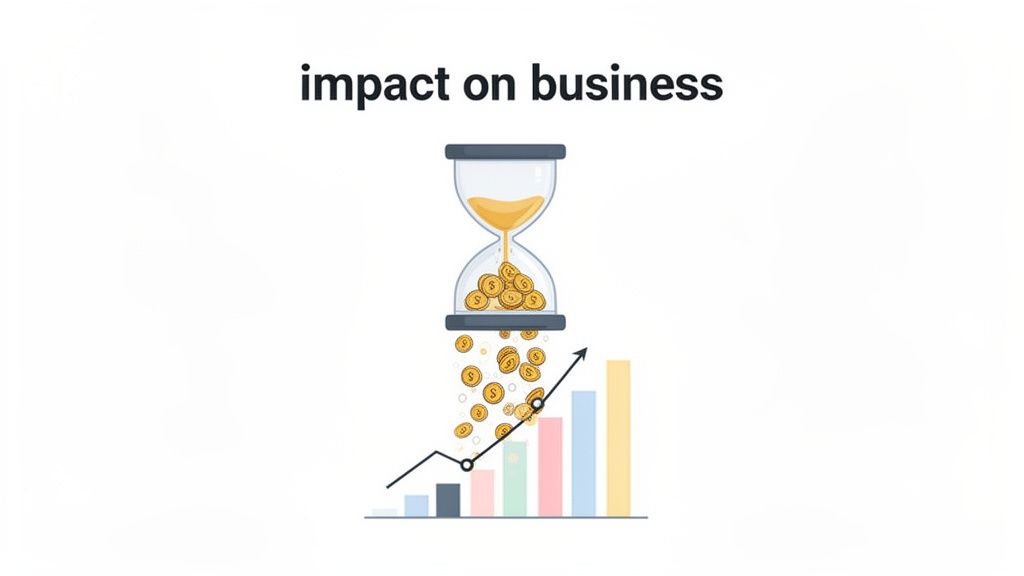
By asking about the business impact, you prompt the prospect to calculate the problem in terms of revenue loss, opportunity costs, team inefficiency, or wasted resources. For example, a founder might calculate, "My team spends 10 hours weekly on manual CRM entry at $25/hour; that's $1,000 a week in wasted capacity." This immediately frames the ROI for your solution and moves the discussion from a "nice-to-have" to a "must-have." Understanding these metrics is the foundation of building a compelling business case.
Actionable Tips for Implementation
Ask for Specifics: Push beyond vague answers. If a prospect says a problem is "costing us," follow up with, "Can you help me understand what that looks like in terms of revenue or time lost each month?"
Explore Team and Emotional Impact: Quantify the human cost. Ask, "How does this affect your team’s morale and ability to perform their best work?" or "How frustrating is this situation for you and your team?" This uncovers the emotional drivers behind a purchase.
Connect Problems to Metrics: Guide the prospect to do the math with you. An SDR manager might say, "We're losing leads." You can ask, "If you had to guess, how many opportunities did you miss last month because of poor lead handoffs?"
Document for ROI Calculation: Use a tool to capture these metrics directly. With Glinky, you can record these specific figures, which provides the data needed for your proposal and ROI calculations. Gathering these details is a core principle of modern sales, as explained by the insights from what is conversation intelligence.
10. What information or capabilities would help you make this decision faster?
This consultative question shifts the dynamic from a sales pitch to a collaborative partnership. It is one of the most effective sales discovery questions for later-stage conversations because it directly addresses and removes the final barriers to a decision. By asking what they need to proceed, you position yourself as an ally dedicated to their success, not just a vendor pushing for a close. This question reveals the last few objections or information gaps preventing them from moving forward.
Asking this shows you respect the prospect's process and are genuinely interested in helping them make the right choice, even if it requires more work from you. For example, a prospect might say, “I need to see how my team would actually use this on a call.” This is your cue to offer a live usage walkthrough. Another might request, “Can you show how this integrates with our existing Salesforce setup?” which allows you to schedule a targeted technical demo, building confidence and momentum.
Actionable Tips for Implementation
Ask Confidently: Frame the question to empower the prospect. Try, "What would help you feel confident moving forward with this?" or "What's the one thing that, if you saw it, would make this an easy decision?"
Listen for Specific Needs: Pay close attention to whether they need information (a case study), proof (a reference call), or a specific capability (a custom demo). Their request tells you exactly what they value most.
Provide Tangible Resources: Don't just promise; deliver. Offer specific, relevant resources like a trial period, a detailed security document, or a call with a customer success manager. This demonstrates your commitment.
Set Clear Next Steps: After they answer, create a timeline. For instance, "Great. If I can provide that integration schematic by Friday, can we schedule a call for next Tuesday to make a final decision?" This builds accountability and maintains momentum.
10-Point Sales Discovery Comparison
Question | 🔄 Complexity | ⚡ Resource requirements | 📊 Expected outcomes | 💡 Ideal use cases | ⭐ Key advantages |
|---|---|---|---|---|---|
What problems is your prospect currently experiencing? | Low — open-ended discovery | Low — time & active listening | High — identifies core pain points for qualification | Early-stage discovery & qualification | Builds rapport; establishes baseline understanding |
How are you currently solving or managing this problem? | Medium — requires workflow probing | Low–Medium — familiarity with tools | High — exposes tool gaps and switching costs | Differentiation vs. competitors; process optimization | Reveals tool stack and manual workarounds |
What would an ideal solution look like for you? | Medium — elicits vision and priorities | Low — note-taking and probing | High — aligns on success criteria and features | Solution fit, proposal tailoring, roadmap alignment | Clarifies priorities and decision criteria |
Who else needs to be involved in this decision? | Medium–High — org mapping & stakeholder identification | Medium — stakeholder outreach and tracking | High — maps approval chain and objection sources | Enterprise deals; multi-stakeholder purchases | Prevents surprises; enables targeted messaging |
What's your timeline for making a decision? | Low–Medium — timing & drivers | Low — scheduling follow-up | Medium–High — clarifies urgency and sales cadence | Prioritization and forecasting | Improves prioritization and forecast accuracy |
What's your budget for solving this problem? | Medium — sensitive, probing required | Low — structured questioning | High — qualifies fit and pricing alignment | Pricing conversations; early qualification | Avoids time wasted on budget mismatches |
What would success look like after implementing our solution? | Medium — requires metric-focused probing | Medium — captures measurable goals | High — creates measurable ROI and CS alignment | Closing, onboarding, customer success planning | Sets measurable targets; supports upsell/expansion |
What have you already tried that didn't work? | Low–Medium — retrospective questioning | Low — listening and documentation | Medium — unveils objections and adoption issues | Overcoming skepticism; competitive differentiation | Reveals past failures and adoption barriers |
How is this challenge currently impacting your business? | Medium — requires quantification | Low–Medium — probing for metrics | High — builds business case and urgency | ROI justification; executive buy-in | Quantifies cost of inaction; creates urgency |
What information or capabilities would help you make this decision faster? | Low–Medium — asks for specific requests | Medium — deliver demos, case studies, trials | High — removes blockers and accelerates close | Late-stage deals; objection resolution | Accelerates decisions; positions seller as partner |
Turn Your Answers Into Revenue with a Unified Platform
Throughout this guide, we've explored the architecture of a winning discovery call, moving far beyond a simple checklist of questions. We’ve dissected the core categories of inquiry, from identifying deep-seated pain points and understanding the real business impact to mapping out the decision-making process and defining what success actually looks like for your prospect. The goal is to evolve your conversations from a transactional pitch into a strategic consultation.
Mastering the art of asking powerful sales discovery questions is the foundation. You now have a framework for understanding not just what to ask, but why you're asking it. This distinction is critical. A novice asks about budget; an expert uncovers the financial consequences of inaction. A beginner asks about timelines; a seasoned professional investigates the strategic drivers behind that timeline.
From Insight to Action: The Real Challenge
The most skilled questioning in the world becomes a wasted effort if the answers disappear into a void. This is the moment where most sales processes falter. Insights from a fantastic call get lost in messy notes, key stakeholders are forgotten, and crucial follow-up actions never get scheduled. The friction between gathering intelligence and acting on it is where deals die.
Consider the information you gather from just a few key questions:
Impact Questions ("How is this challenge currently impacting your business?"): The answer to this is pure gold. It gives you the exact language to use in your proposals, ROI calculations, and follow-up emails, directly linking your solution to their pain.
Decision-Maker Questions ("Who else needs to be involved?"): This isn't just about collecting names. It's about building a map of the political landscape within the organization and planning a multi-threaded outreach strategy.
Success Metric Questions ("What would success look like?"): These answers become the foundation of your implementation plan and the key performance indicators you will be measured against, ensuring alignment from day one.
When this data is scattered across a notepad, a separate call recording tool, and a manually updated CRM, you create immense friction. You force your team to spend more time on administrative data entry and less time building relationships and closing deals.
Unifying Your Workflow for Maximum Impact
The ultimate goal is to create a seamless flow from conversation to conversion. The answers you get from your sales discovery questions should automatically inform every subsequent step of your sales motion. Imagine a world where a prospect mentioning a key competitor automatically triggers a task to send a tailored comparison guide. Or where identifying a new stakeholder during a call instantly adds them to your CRM with a note to connect on LinkedIn.
This is not about simply working faster; it's about working smarter by connecting the dots. It’s about ensuring that the momentum you build during a great discovery call translates directly into targeted, effective follow-up and a faster sales cycle. The true power of sales discovery questions is only realized when the answers are captured, understood, and acted upon with precision and speed. Your process must support this, not hinder it. By moving beyond isolated tools and adopting a unified platform, you transform conversational data into your most valuable asset: revenue.
Ready to stop losing deals in the gaps between your tools? Glinky is the AI-native revenue engine that automatically transcribes your calls, captures key insights, updates your pipeline, and drafts follow-up emails, all in one place. See how you can turn your sales discovery questions into closed deals by trying Glinky today.
People also read

10 Sales Enablement Best Practices to Unify Your Revenue Engine in 2026
Productivity
Mar 13, 2026
How to Manage Sales Pipeline for Predictable Revenue Growth
Productivity
Mar 14, 2026

How to Qualify Leads in Sales Without Wasting Time
Productivity
Mar 17, 2026

What is Conversation Intelligence? A Practical Guide for Sales Teams
Productivity
Mar 18, 2026

Taking Minutes of Meeting: A Guide to Transforming Chaos into Action
Productivity
Feb 16, 2026
Action Items List: A Practical Guide to Drive Real Results
Productivity
Feb 19, 2026
Master the summary of a meeting for clear decisions and follow-ups
Productivity
Feb 22, 2026

Track Action Items: A Practical Guide to Using AI for Flawless Follow-Up
Productivity
Feb 17, 2026

Unlock: How to Take Notes on a Computer for Peak Productivity in 2026
Productivity
Feb 26, 2026
How to Record Google Meet: A Complete Guide for 2026
Productivity
Mar 4, 2026

12 Best AI Note Taking App Choices for 2026: The Definitive Guide
Productivity
Mar 6, 2026
How to Improve Customer Retention: Practical Tips to Boost Loyalty
Productivity
Mar 8, 2026

10 Client Communication Best Practices to Master in 2026
Productivity
Mar 7, 2026

The 12 Best AI Meeting Assistant Tools for 2026: A Deep Dive
Productivity
Mar 15, 2026

Your Guide to the Ultimate AI Email Writer
Productivity
Feb 27, 2026

10 Essential Customer Success Best Practices for 2026
Productivity
Mar 1, 2026

Your Guide to Sales Call Recording Software in 2026
Productivity
Mar 2, 2026
How to Take Better Meeting Notes and Drive Real Results
Productivity
Mar 5, 2026
Top 10 Picks for best crm for small business
Productivity
Mar 3, 2026

What is an Ideal Customer Profile: A Guide to Driving Growth
Productivity
Mar 9, 2026

Automated meeting minutes: Turn talks into actionable notes
Productivity
Mar 11, 2026

The Top 12 AI Powered Sales Tools to Boost Revenue in 2026
Productivity
Mar 16, 2026

AI Note Taking For Meetings: Fast, Smart AI Notes That Drive Collaboration
Productivity
Mar 19, 2026
Understanding Transcription Service Cost: A 2026 Guide
Productivity
Mar 20, 2026

Master Your Meetings With The Note Taking Charting Method
Productivity
Feb 18, 2026
The Ultimate 2026 Guide: 8 Meeting Follow Up Email Template Scenarios
Productivity
Feb 20, 2026
Master the Art of Taking Meeting Notes for Actionable Outcomes
Productivity
Feb 25, 2026

12 Best Sales Lead Generation Tools to Boost Your Pipeline in 2026
Productivity
Mar 10, 2026

Translation Vs Transcription: Which Service Do You Really Need?
Productivity
Mar 12, 2026
Mastering the goals of a meeting to drive decisions and boost team alignment
Productivity
Mar 23, 2026

The 12 Best Free AI Email Writer Tools for 2026
Productivity
Mar 22, 2026

A Guide to AI Sales Enablement Platforms in 2026
Productivity
Mar 21, 2026

Automate Follow Up Emails: Actionable Insights for Boosting Sales & Efficiency
Productivity
Mar 26, 2026

Follow Up Email Subjects That Convert: Increase Opens and Replies
Productivity
Feb 17, 2026

Your Playbook for Outbound Lead Generation in 2026
Productivity
Feb 28, 2026
Your Essential Meeting Action Items Template to Drive Results
Productivity
Feb 23, 2026

Your Guide to Using an Email Writer AI for Maximum Impact
Productivity
Feb 23, 2026
8 Essential Ground Rules at Meetings to Maximize Productivity in 2026
Productivity
Mar 24, 2026

Otter.ai vs Glinky
Productivity
Feb 5, 2026
AI Tools for Startup Founders [2026]
Productivity
Feb 4, 2026
Best AI Tools for Startups [2026]
Tools
Feb 3, 2026
Sales Call Notes: How to Capture Every Detail Without Losing the Deal
How to
Feb 2, 2026
How to Take Meeting Notes: 7 Methods That Actually Work [2026]
How to
Jan 14, 2026
![AI Meeting Minutes | Free Forever [2026]](https://framerusercontent.com/images/zYQGRjgLX63tiouLTK65LvCcjK8.png?width=402&height=263)
AI Meeting Minutes | Free Forever [2026]
How to
Jan 13, 2026
![How to Record Zoom Meetings Without a Bot [2026] 3 Easy Methods](https://framerusercontent.com/images/gGoQV8bPb9zR5weVruinbjaxO0.png?width=402&height=263)
How to Record Zoom Meetings Without a Bot [2026]
How to
Jan 9, 2026
Bot-Free AI Meeting Notes: We Tested the 6 Best Tools in 2026
Tools
Jan 8, 2026

Glinky vs Fireflies.ai
Tools
Jan 7, 2026
15 Best AI Tools to Boost Your Productivity in 2026
Productivity
Jan 6, 2026