Nov 13, 2025
Productivity
How to Improve Customer Retention: Practical Tips to Boost Loyalty
If you want to grow, you have to stop obsessing over acquiring new customers and start obsessing over the ones you already have. This means creating an onboarding experience that hooks them, building proactive relationships that show you care, and using smart automation to deliver value without fail.
The goal? Make your service so essential they can't imagine leaving. This guide provides a step-by-step playbook to make that happen.
Why Customer Retention Is Your Biggest Growth Lever
Let's kill a sacred cow. For decades, the gospel of growth has been all about customer acquisition—cramming the top of the funnel with as many leads as humanly possible. But focusing only on acquisition creates a "leaky bucket." You're pouring new customers in while your existing ones are quietly slipping out the back door.
That kind of churn isn't just exhausting; it's a financial black hole.
Real, sustainable growth isn’t built on a revolving door of one-time buyers. It comes from a solid base of loyal customers who stick around, buy more over time, and tell their friends about you. This is why learning how to improve customer retention is the most powerful move you can make for long-term profit.
The Sobering Economics of a Leaky Bucket
The numbers don't lie, and they paint a pretty stark picture. Chasing new customers is expensive. In some cases, businesses are losing an average of $29 per new customer they bring on.
Now, compare that to keeping a customer you already have. It costs 5 to 25 times less to retain an existing customer than to acquire a new one. The impact on your bottom line is massive. Research from Harvard Business Review has shown that even a small 5% increase in customer retention can boost your profits by a staggering 25-95%.
The data is clear: pouring your budget into acquisition while ignoring retention is like trying to fill a bathtub with the drain wide open. Every customer who churns takes their lifetime value with them, forcing you to spend even more just to stand still.
The most overlooked growth secret is hiding in plain sight: your existing customer base. Focusing on them isn't just about damage control; it's the single best investment you can make for profitable, predictable, and sustainable growth.
Before we dive into the "how," it's critical to know what you're measuring. You can't fix what you can't see.
Essential Customer Retention Metrics and Industry Benchmarks for 2026
This table gives you a quick-glance reference for the metrics that truly matter for retention, along with some typical benchmarks to see how you stack up.
Metric | Description | Industry Benchmark (Average) |
|---|---|---|
Customer Churn Rate | The percentage of customers who stop doing business with you over a period. | SaaS: 4-7% (monthly), Retail: 20-30% (annual) |
Revenue Churn Rate | The percentage of monthly recurring revenue (MRR) lost from existing customers. | SaaS: 1-2% (monthly) |
Customer Lifetime Value (CLV) | The total revenue you can expect from a single customer account. | Varies widely; should be at least 3x CAC (Customer Acquisition Cost) |
Net Promoter Score (NPS) | Measures customer loyalty and satisfaction on a scale of -100 to 100. | +30 is good, +50 is excellent, +70 is world-class |
Repeat Purchase Rate | The percentage of customers who have made more than one purchase. | Ecommerce: 25-30% |
Tracking these numbers gives you a clear, data-backed view of your customer health. It turns vague feelings about "customer happiness" into hard data you can act on.
The Three Pillars of Modern Retention
To plug the leaks for good and build a fiercely loyal customer base, your strategy needs to stand on three core pillars. We’ll break each one down in this playbook, but here’s the high-level view.
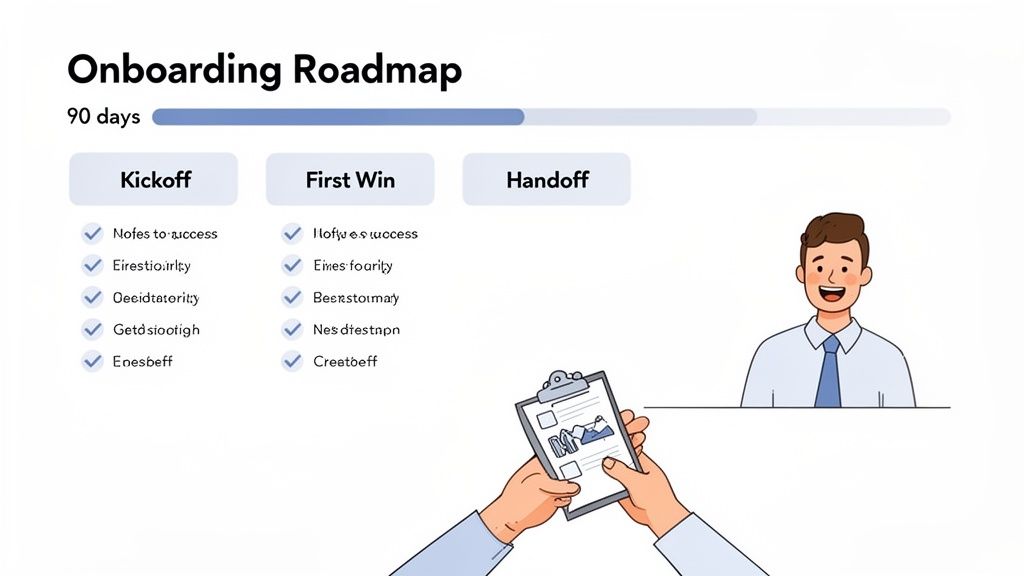
An Unforgettable Onboarding Experience: The first 90 days are everything. A killer onboarding process doesn't just show users where the buttons are; it guides them to their first "aha!" moment fast, proving they made the right choice.
Proactive Customer Relationships: Stop waiting for support tickets. Proactive customer success means getting ahead of problems, monitoring health scores, and engaging customers to make sure they're consistently winning with your product.
Smart Automation and Follow-Through: You can't be everywhere at once, especially as you scale. Smart automation takes care of the repetitive, but crucial, tasks like meeting summaries and follow-ups. This frees up your team for the high-value, strategic conversations that build real relationships.
For a deeper look into a wide range of proven methods, exploring these actionable customer retention strategies is a great next step. By mastering these pillars, you’ll shift from a reactive, firefighting mode to a proactive, value-driven approach that turns one-time customers into partners for life.
Using Data to Diagnose Your Customer Churn Problem
Before you can fix your retention problem, you have to play detective. Your business data is a treasure trove of clues, pointing directly to where, when, and why customers are walking out the door. The real work isn't just reporting on churn; it's using that data to diagnose the root cause.
This is where you turn abstract numbers into a clear story about your customer’s journey. It’s how you find the exact friction points that are pushing people away, giving you a precise target for your retention efforts.
Moving Beyond Basic Churn Rates
Just knowing your overall churn rate is like knowing you have a fever but not what's causing it. Sure, it tells you there's a problem, but it gives you zero direction on how to solve it. To get insights you can actually act on, you have to dig deeper.
For instance, your Customer Lifetime Value (CLV) isn't just a metric; it's a direct reflection of how well you're keeping customers happy over the long haul. If your CLV is trending down, that’s a massive red flag that the value you deliver over time is fading.
A 5% increase in customer retention can boost profits by 25-95%. This makes understanding the "why" behind your churn one of the highest-impact things you can possibly do.
And don't just look at customer churn. Revenue Churn Rate often tells a more important story. Losing ten tiny accounts might sting less than losing one major client. This metric helps you figure out which customer segments are bleeding the most cash and need your immediate attention.
Pinpointing When and Why Customers Leave
Getting to the root cause means blending the quantitative (the "what") with the qualitative (the "why"). This two-pronged approach gives you the full picture of customer behavior.
Two of the most powerful tools for this are cohort analysis and Net Promoter Score surveys.
Cohort Analysis: This is where you group customers by their sign-up date—say, everyone who joined in January. By tracking each cohort's retention over time, you can spot critical trends. Are customers from March churning way faster than those from February? That might point to a buggy feature you released or a broken onboarding flow during that specific month.
Net Promoter Score (NPS): NPS is famous for asking how likely customers are to recommend you, sorting them into Promoters, Passives, and Detractors. But don't get hung up on the score itself. The real gold is in the open-ended feedback. Your Detractors will tell you exactly what’s broken, while your Promoters will tell you what you need to double down on.
The process below shows how foundational pillars—like a killer onboarding experience—are essential for building those lasting relationships that crush churn.
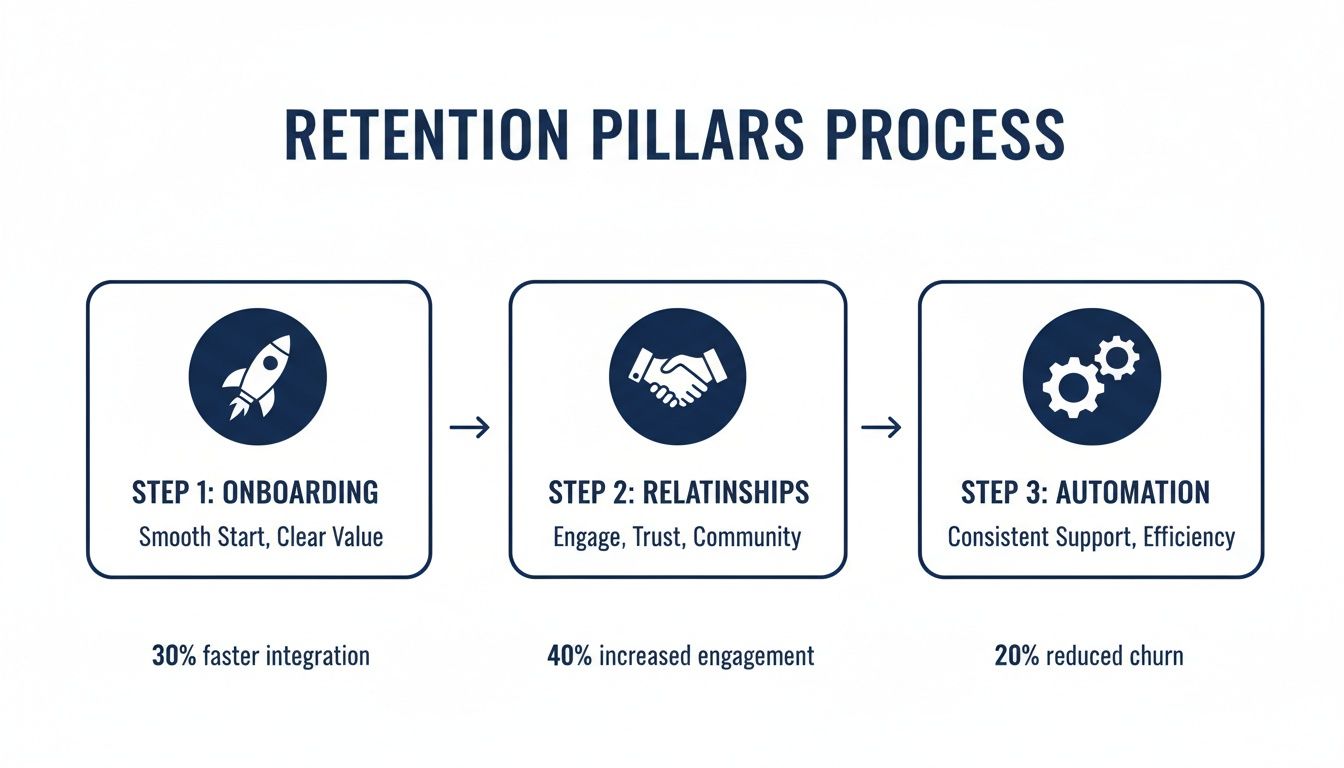
As you can see, great onboarding flows directly into proactive relationship building and smart automation. These aren't separate tasks; they're interconnected stages that form the bedrock of a solid retention framework.
Building Your Retention Dashboard
You don’t need a complicated, expensive BI platform to get started. You can build a surprisingly powerful retention dashboard right in a spreadsheet or your existing CRM. The goal is to monitor a handful of critical red flags that scream "this customer is about to churn."
Key Metrics for Your Diagnostic Dashboard:
Metric | What It Tells You | Red Flag to Watch For |
|---|---|---|
Product Usage Frequency | How often customers are actually using your product. | A steady decline in logins or key feature usage over 30 days. |
Repeat Purchase Rate | The percentage of customers coming back for a second, third, or fourth purchase. | A significant drop in the rate of customers moving from their first to second purchase. |
Support Ticket Volume | The number of support tickets from a customer or segment. | A sudden spike in tickets, especially if they're about the same frustrating issue. |
Time to First Value | How long it takes a new customer to get their first real "win." | An increasing average time to first value for new cohorts. |
By keeping an eye on these indicators, you stop being reactive—finding out about churn after it’s too late—and start being proactive. When you see a red flag pop up, you can jump in with a targeted email, extra training, or a quick check-in call to get ahead of the problem. This is how you stop guessing and start systematically improving customer retention.
Crafting an Onboarding Experience That Hooks Customers for Life
You get one shot at a first impression. A clunky, confusing, or impersonal onboarding experience is the fastest way to see a new customer walk out the virtual door. In stark contrast, a smooth, guided journey that delivers immediate value is where customer loyalty truly begins.
Your job isn't just to show off features. It's to race your customer to their "first win"—that "aha!" moment where they experience the exact value you promised. Get this wrong, and you’re fighting an uphill battle. A Gartner survey revealed a painful truth: a staggering 3 out of 5 software buyers feel regret after a purchase, mostly because of a slow, frustrating path to seeing any real value.
Tailor the Journey from Day One
A one-size-fits-all onboarding flow is a recipe for failure. Your customers aren't all the same, and your first mission is to figure out what success actually looks like for them. This is what kickoff calls were made for.
Forget the generic product tour. Use that critical first meeting to dig in with targeted questions:
What specific problem made you seek out a solution like ours?
What does a "win" look like for your team in the first 30 days?
How will you be measuring the success of this project?
These answers are gold. They let you build a personalized onboarding plan that zeros in on the features and workflows they actually care about. You cut through the noise and slash their time-to-value. For a deeper look at this crucial first step, there are great resources available to help you improve the onboarding of clients with proven strategies.
Guide Customers with Proactive Nudges
Once you know their destination, you can map out the path. This isn’t about hand-holding; it’s about providing the right support at the right time.
Implement a smart mix of high-tech automation and high-touch human connection:
Interactive In-App Tutorials: Ditch the passive videos. Use guided walk-throughs that make users click the buttons and perform the key actions themselves. This builds muscle memory and real confidence.
Behavior-Based Email Sequences: Send tips based on what users are actually doing in the app. If someone activates a new feature, send a follow-up email with an advanced tip for it.
Proactive Check-in Calls: Schedule a quick call around the 14 or 30-day mark. The goal is simple: review their progress, answer questions, and smash any roadblocks before they become deal-breakers.
The best onboarding programs don't just show customers how to use the product. They show them why it matters for their specific goals. This is the pivot from feature-dumping to value-delivery that turns new users into evangelists.
Stop Information from Falling Through the Cracks
One of the most common onboarding failures is the disastrous handoff from sales to customer success. All the goals, promises, and context discussed during the sales process vanish, forcing the customer to repeat themselves. It’s a frustrating start to what should be a great relationship.
A unified system is non-negotiable here. You have to capture the outcomes from kickoff calls, key decisions, and stated objectives. For instance, a tool like GLINKY can automatically capture and structure the notes from your initial calls. This makes the customer's goals and agreed-upon action items instantly visible to the entire team.
This seamless transfer of intel means the customer success manager can pick up the conversation exactly where sales left off. They can reference specific objectives, creating a smooth, professional experience that proves you were listening from the very start. For anyone managing these handoffs, knowing how to track action items from meetings is an absolutely essential skill.
When you design an onboarding experience that is personal, guided, and seamlessly connected, you're not just plugging a leaky bucket. You're building the foundation for a loyal, long-term partnership.
Building Proactive Relationships That Prevent Churn
If your customer relationships are driven by support tickets, you’re already behind. You're playing a losing game of damage control, constantly putting out fires instead of preventing them in the first place.
To truly lock in retention, you have to flip the script. It's about a fundamental shift in mindset—moving from reacting to problems to proactively delivering value. This isn’t just a nice idea; it's the core of any modern customer success strategy that actually works.
You stop being just another vendor they call when something breaks and become an indispensable partner in their growth. By anticipating their needs and proving your value before they even have to ask, you build relationships that are naturally resilient to churn.
Identify At-Risk Accounts with Customer Health Scores
You can't get ahead of churn if you can't see it coming. This is where a customer health score becomes your early-warning system. It’s a metric you create to turn those vague gut feelings about an account into a concrete, data-driven score, letting you spot at-risk customers long before they go dark.
Think of it like a credit score for each customer relationship. A high score means they’re healthy, engaged, and getting real value. A dropping score is a massive red flag that demands immediate, proactive outreach.
To build a basic health score, start by weighing a few key data points:
Product Usage: How often are they logging in? Are they using the "sticky" features that you know correlate with long-term success? A sudden drop here is a major warning.
Support Tickets: Is there a recent spike in tickets, especially unresolved ones? This signals mounting frustration that can quickly boil over.
NPS & CSAT Scores: Are they a Promoter or a Detractor? Low satisfaction scores are a screamingly obvious indicator of risk.
Last Meaningful Contact: When was the last time you actually had a real conversation with them? Radio silence is often the first step toward churn.
Monitoring these scores lets your team stop guessing and start prioritizing their efforts on the accounts that need attention the most.
Create a Unified View to Demolish Information Silos
A proactive strategy is dead on arrival if your customer information is scattered across a dozen different tools and departments. When your sales, support, and success teams don't share a single source of truth, the customer is forced to repeat themselves constantly, and critical context gets lost in the shuffle. It's a recipe for a disjointed, frustrating experience.
This is why a unified customer view isn't a "nice-to-have"—it's non-negotiable. The numbers don't lie. Businesses that deliver integrated, seamless experiences retain 89% of their customers, a stark contrast to the abysmal 33% retention rate for companies with weak, siloed strategies, as highlighted in retail customer retention statistics.
This is precisely the problem tools like GLINKY were built to solve. It creates a unified contact timeline where every call, note, decision, and next step is centralized in one workspace. Any team member can instantly get up to speed on the entire history of a relationship, allowing them to jump in and have a meaningful, contextual conversation without missing a beat.
Drive Value with Proactive Check-Ins and QBRs
Now that your health scores are telling you who to talk to and a unified timeline is providing the what, your next move is proactive outreach. I'm not talking about those lazy "just checking in" emails. This is about structuring conversations to relentlessly prove your value and align with their business goals.
The Quarterly Business Review (QBR) is your most powerful weapon for this. It’s a formal meeting where you review progress, demonstrate tangible ROI, and strategically plan for the quarter ahead.
Your QBR agenda should never be a product demo. It needs to be a strategic conversation focused entirely on the customer's business outcomes, using their data to prove how your solution is helping them win.
A simple but killer QBR agenda looks like this:
Review of Goals: Revisit the specific objectives they set out to achieve during onboarding.
Performance Analysis: Show them the data. How has your product directly impacted their key metrics?
Wins & Challenges: Celebrate what's working and be brave enough to openly discuss any roadblocks.
Future Roadmap: Align on new goals for the upcoming quarter and introduce relevant features that will help them get there.
These proactive touchpoints transform your relationship from a simple transaction into a strategic partnership. For a deeper dive into structuring these efforts, check out our complete guide on customer success best practices. When you consistently demonstrate your value, you make your solution indispensable.
Using Automation to Scale Your Retention Efforts
As you grow, that high-touch, personal service you gave your first fifty customers just won't scale to five hundred. It's a classic growing pain. But scaling your retention strategy doesn't mean you have to become a faceless corporation. The real secret is using smart automation to enhance those critical human connections, not replace them.
One of the biggest black holes in any customer relationship is what happens after a meeting. A fantastic strategic call can completely fall apart if the follow-through is slow, sloppy, or just plain forgotten. This is precisely where you can use automation to systematically improve customer retention by making sure nothing ever falls through the cracks.
Automating Your Post-Meeting Workflow
Just think about all the manual grunt work that follows a typical client check-in. Someone has to decipher messy notes, figure out what was promised, create tasks for the right people, write a follow-up email, and then painstakingly log every detail in the CRM. It’s a recipe for human error and dropped balls.
This is where automation becomes your unfair advantage. It takes over the repetitive, administrative tasks and executes them with perfect consistency, freeing up your team to do what they do best: build relationships and think strategically.
A well-oiled, automated workflow handles key tasks:
Capture Key Outcomes: Instead of furiously typing, an AI can pinpoint the important decisions, customer pain points, and action items that came up in the conversation.
Draft Follow-Up Emails: The AI can instantly generate a sharp, professional follow-up email that summarizes the discussion and outlines the next steps. It's ready for you to quickly review and hit send. You can learn more about how this works by reading our guide on using an email writer AI effectively.
Assign Action Items: The system can automatically create and assign tasks in your project management tool, complete with owners and due dates.
Sync to CRM: All notes, outcomes, and communications get pushed directly into your CRM, building a perfect, accurate history of the relationship without any manual data entry.
A Gartner survey found that 73% of sales leaders are prioritizing growth from existing customers. Automation is what makes this possible at scale, guaranteeing every customer gets consistent, professional follow-through. Every single time.
A Real-World Automation Scenario
Let's say you just wrapped up a Quarterly Business Review (QBR) with a major client. The conversation was great, but a few critical action items were discussed. This is where a tool like GLINKY turns that post-meeting chaos into a smooth, automated process.
While you're on the call, GLINKY is working silently in the background, capturing every commitment and detail. The moment the meeting ends, it gives you a clean summary, structured notes, and a list of all the action items it identified.
This diagram shows exactly how that messy post-meeting reality gets transformed into concrete, organized action.
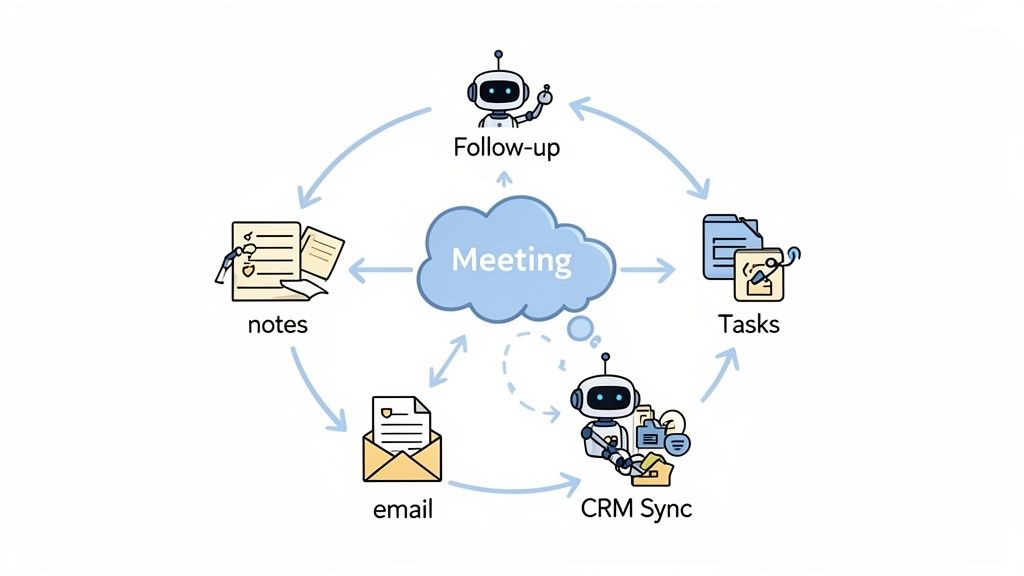
The whole point is to create a system where accountability is crystal clear and promises made to customers are always kept. It connects the conversation directly to the actions that actually drive their success.
Creating a Flawless, Closed-Loop System
With just one click, you approve GLINKY’s suggestions. Immediately, the system springs into action:
Drafts the Follow-Up: A perfectly formatted email appears in your drafts, addressed to the client, summarizing the QBR wins and next steps.
Creates Tasks: A task pops up in your project management tool, assigned to the product manager, to investigate that feature request the client mentioned.
Updates the CRM: The complete meeting summary and a copy of the follow-up email are automatically logged in the client's CRM record.
What you've just created is a powerful, closed-loop system. Your customer gets a prompt, professional summary that proves you were listening. Your team gets clear, accountable tasks. And your system of record is always accurate. This level of organization not only makes your team more efficient but also signals incredible competence and reliability to your customers.
This is how you improve customer retention through operational excellence. You're not just saving a few hours of admin time; you’re building deep trust by proving you take action. Automation becomes the engine that powers flawless execution, building stronger and more loyal customer relationships.
Your Top Retention Questions, Answered
As you start putting these retention plays into action, some common questions always pop up. It's a sign you're on the right track. Let's tackle them head-on so you can keep your momentum.
The One Metric That Truly Matters for Retention
Everyone defaults to tracking customer churn rate, and you should. It’s a vital sign. But if you want to build a truly healthy business, your north star has to be Customer Lifetime Value (CLV).
Churn tells you a story about the past—who you've lost. CLV, on the other hand, tells you a story about the future—how much profit you can expect from each customer relationship. Focusing on CLV completely changes your mindset. You stop just plugging leaks and start actively building more valuable, long-term partnerships with your most profitable customer segments. A rising CLV is the ultimate proof that your retention strategy is working.
When Does Retention Actually Start?
The second a customer signs on the dotted line. The battle for loyalty is won or lost right at the beginning, not six months down the road.
Your most powerful weapon against early churn is a killer onboarding process. The goal isn't just to show off features; it's to race your new user to their first "aha!" moment—that first quick win that proves they made the right choice. Nail this, and you set the tone for the entire relationship.
Retention isn't a phase that kicks in later. It's an ethos baked into every single interaction, starting with day one. A phenomenal onboarding experience is the foundation you build everything else on.
Can We Pull This Off Without an Enterprise Budget?
Absolutely. You don't need a massive budget to master retention. The core principles are about being proactive and consistently delivering value, which are driven by discipline, not dollars.
Any small business can make a huge impact by starting simple:
Track Health Signals: A shared spreadsheet is all you need to start. Note things like their last login date, feature usage, or when you last spoke.
Ask for Feedback: Forget expensive survey platforms. A simple survey with Google Forms can give you invaluable insights into what customers are thinking.
Get Organized: Use a free or low-cost CRM to keep all your customer notes, history, and next steps in one place.
It's not about having the fanciest tools. It's about being intentional. Consistently checking in, listening, and acting on what you hear is a game-changer any business can afford.
Automation vs. The Personal Touch: Which Wins?
This is a false choice. The winning strategy is a hybrid model where you use smart automation to create more time for meaningful, personal interactions. They should work together, not against each other.
Automate the administrative grunt work. Things like sending meeting summaries, logging notes to your CRM, and creating action items are perfect candidates for an intelligent system. This isn't just about efficiency; it's a proven way to increase customer satisfaction and loyalty.
When you automate the noise, your team is freed up to focus on the high-value conversations that actually build relationships—strategic check-ins, Quarterly Business Reviews (QBRs), and genuinely listening to solve problems. Automation should be the engine that powers personalization at scale, not the thing that replaces the human connection that builds real loyalty.
Ready to stop post-meeting chaos and ensure every customer promise is kept? GLINKY is the bot-free AI that turns your conversations into structured notes, automated follow-ups, and synced CRM entries, so you can focus on building relationships that last. See how it can transform your retention workflow at https://www.glinky.ai.
People also read
10 Sales Enablement Best Practices to Unify Your Revenue Engine in 2026
Productivity
Mar 13, 2026
How to Manage Sales Pipeline for Predictable Revenue Growth
Productivity
Mar 14, 2026
How to Qualify Leads in Sales Without Wasting Time
Productivity
Mar 17, 2026

What is Conversation Intelligence? A Practical Guide for Sales Teams
Productivity
Mar 18, 2026
Top 10 Sales Discovery Questions That Close More Deals
Productivity
Mar 25, 2026
Taking Minutes of Meeting: A Guide to Transforming Chaos into Action
Productivity
Feb 16, 2026
Action Items List: A Practical Guide to Drive Real Results
Productivity
Feb 19, 2026
Master the summary of a meeting for clear decisions and follow-ups
Productivity
Feb 22, 2026

Track Action Items: A Practical Guide to Using AI for Flawless Follow-Up
Productivity
Feb 17, 2026
Unlock: How to Take Notes on a Computer for Peak Productivity in 2026
Productivity
Feb 26, 2026
How to Record Google Meet: A Complete Guide for 2026
Productivity
Mar 4, 2026

12 Best AI Note Taking App Choices for 2026: The Definitive Guide
Productivity
Mar 6, 2026

10 Client Communication Best Practices to Master in 2026
Productivity
Mar 7, 2026
The 12 Best AI Meeting Assistant Tools for 2026: A Deep Dive
Productivity
Mar 15, 2026

Your Guide to the Ultimate AI Email Writer
Productivity
Feb 27, 2026
10 Essential Customer Success Best Practices for 2026
Productivity
Mar 1, 2026
Your Guide to Sales Call Recording Software in 2026
Productivity
Mar 2, 2026
How to Take Better Meeting Notes and Drive Real Results
Productivity
Mar 5, 2026
Top 10 Picks for best crm for small business
Productivity
Mar 3, 2026
What is an Ideal Customer Profile: A Guide to Driving Growth
Productivity
Mar 9, 2026
Automated meeting minutes: Turn talks into actionable notes
Productivity
Mar 11, 2026
The Top 12 AI Powered Sales Tools to Boost Revenue in 2026
Productivity
Mar 16, 2026
AI Note Taking For Meetings: Fast, Smart AI Notes That Drive Collaboration
Productivity
Mar 19, 2026
Understanding Transcription Service Cost: A 2026 Guide
Productivity
Mar 20, 2026

Master Your Meetings With The Note Taking Charting Method
Productivity
Feb 18, 2026
The Ultimate 2026 Guide: 8 Meeting Follow Up Email Template Scenarios
Productivity
Feb 20, 2026
Master the Art of Taking Meeting Notes for Actionable Outcomes
Productivity
Feb 25, 2026
12 Best Sales Lead Generation Tools to Boost Your Pipeline in 2026
Productivity
Mar 10, 2026

Translation Vs Transcription: Which Service Do You Really Need?
Productivity
Mar 12, 2026
Mastering the goals of a meeting to drive decisions and boost team alignment
Productivity
Mar 23, 2026
The 12 Best Free AI Email Writer Tools for 2026
Productivity
Mar 22, 2026
A Guide to AI Sales Enablement Platforms in 2026
Productivity
Mar 21, 2026
Automate Follow Up Emails: Actionable Insights for Boosting Sales & Efficiency
Productivity
Mar 26, 2026

Follow Up Email Subjects That Convert: Increase Opens and Replies
Productivity
Feb 17, 2026

Your Playbook for Outbound Lead Generation in 2026
Productivity
Feb 28, 2026
Your Essential Meeting Action Items Template to Drive Results
Productivity
Feb 23, 2026
Your Guide to Using an Email Writer AI for Maximum Impact
Productivity
Feb 23, 2026
8 Essential Ground Rules at Meetings to Maximize Productivity in 2026
Productivity
Mar 24, 2026

Otter.ai vs Glinky
Productivity
Feb 5, 2026
AI Tools for Startup Founders [2026]
Productivity
Feb 4, 2026
Best AI Tools for Startups [2026]
Tools
Feb 3, 2026
Sales Call Notes: How to Capture Every Detail Without Losing the Deal
How to
Feb 2, 2026
How to Take Meeting Notes: 7 Methods That Actually Work [2026]
How to
Jan 14, 2026
![AI Meeting Minutes | Free Forever [2026]](https://framerusercontent.com/images/zYQGRjgLX63tiouLTK65LvCcjK8.png?width=402&height=263)
AI Meeting Minutes | Free Forever [2026]
How to
Jan 13, 2026
![How to Record Zoom Meetings Without a Bot [2026] 3 Easy Methods](https://framerusercontent.com/images/gGoQV8bPb9zR5weVruinbjaxO0.png?width=402&height=263)
How to Record Zoom Meetings Without a Bot [2026]
How to
Jan 9, 2026
Bot-Free AI Meeting Notes: We Tested the 6 Best Tools in 2026
Tools
Jan 8, 2026
Glinky vs Fireflies.ai
Tools
Jan 7, 2026
15 Best AI Tools to Boost Your Productivity in 2026
Productivity
Jan 6, 2026