Nov 13, 2025
Productivity
Understanding Transcription Service Cost: A 2026 Guide
Trying to figure out transcription costs can feel like a guessing game. You've got AI services flashing prices like $0.10 per minute, while specialized human transcribers quote upwards of $2.50 per minute. Which one is right for you?
The truth is, there's no single answer. The right price—and the right service—boils down to what you actually need the transcript for. Is it for quick meeting notes, or is it evidence in a legal proceeding? The final price tag depends on that classic project triangle: speed, accuracy, and cost. This guide will provide actionable insights to help you calculate your true cost and maximize the return on your investment.
How Much Does Transcription Really Cost?
Let's get one thing straight: transcription isn't just a niche service anymore. It’s a massive industry. The U.S. transcription market was valued at a staggering $30.42 billion in 2024 and is on track to hit $41.93 billion by 2030, according to a detailed industry analysis.
What’s driving this? A firehose of audio and video from sales calls, team meetings, and webinars that businesses desperately need to analyze for insights and action items.
But paying for human transcriptionists at $1.50 to $2.50 per audio minute can get expensive, fast. Imagine a small sales team with just 100 half-hour calls a month. That could easily rack up an annual bill between $5,000 and $12,000. That's a serious line item that could be better spent on growth-driving activities.
A Quick Cost Comparison
The market is essentially split into two camps: human-powered services and automated AI. It's crucial to know what you're buying, as the two solve very different needs at very different price points. It's also important not to confuse this with a related, but distinct service. You can learn more in our guide on the differences between translation and transcription.
Actionable Insight: The core decision always comes down to a trade-off between cost, speed, and accuracy. For most business uses—like internal meeting notes, first-draft content, or sales call analysis—AI hits the sweet spot of "good enough" accuracy at a fraction of the cost.
To make this crystal clear, here’s a quick side-by-side look at what you can generally expect.
Transcription Cost At A Glance: Human vs. AI
This table gives you a ballpark idea of the core differences between standard human and AI transcription services.
Metric | Human Transcription | AI Transcription |
|---|---|---|
Average Cost | $1.25 - $3.00+ per minute | $0.10 - $0.50 per minute |
Turnaround Time | 12-48 hours | 5-10 minutes |
Typical Accuracy | 99% + | 90% - 98% |
As you can see, the gap is huge. AI delivers speed and affordability that human services simply can't match, while humans still hold the edge for near-perfect accuracy on complex or poor-quality audio.
When you start looking into transcription costs, the first big fork in the road is deciding between a human and a machine. It's the classic trade-off: do you hire a master artisan or fire up a high-tech assembly line?
Human transcription is the artisan. A real person listens, interprets, and types everything out by hand. This gets you the absolute best quality—the gold standard for accuracy—but it costs more and takes longer. No way around it.
AI transcription is the assembly line. It churns out transcripts at lightning speed for a tiny fraction of the price. The quality used to be a joke, but today's AI is shockingly good. For most day-to-day business needs, it's more than accurate enough, making transcription a realistic option for teams that could never afford it before.
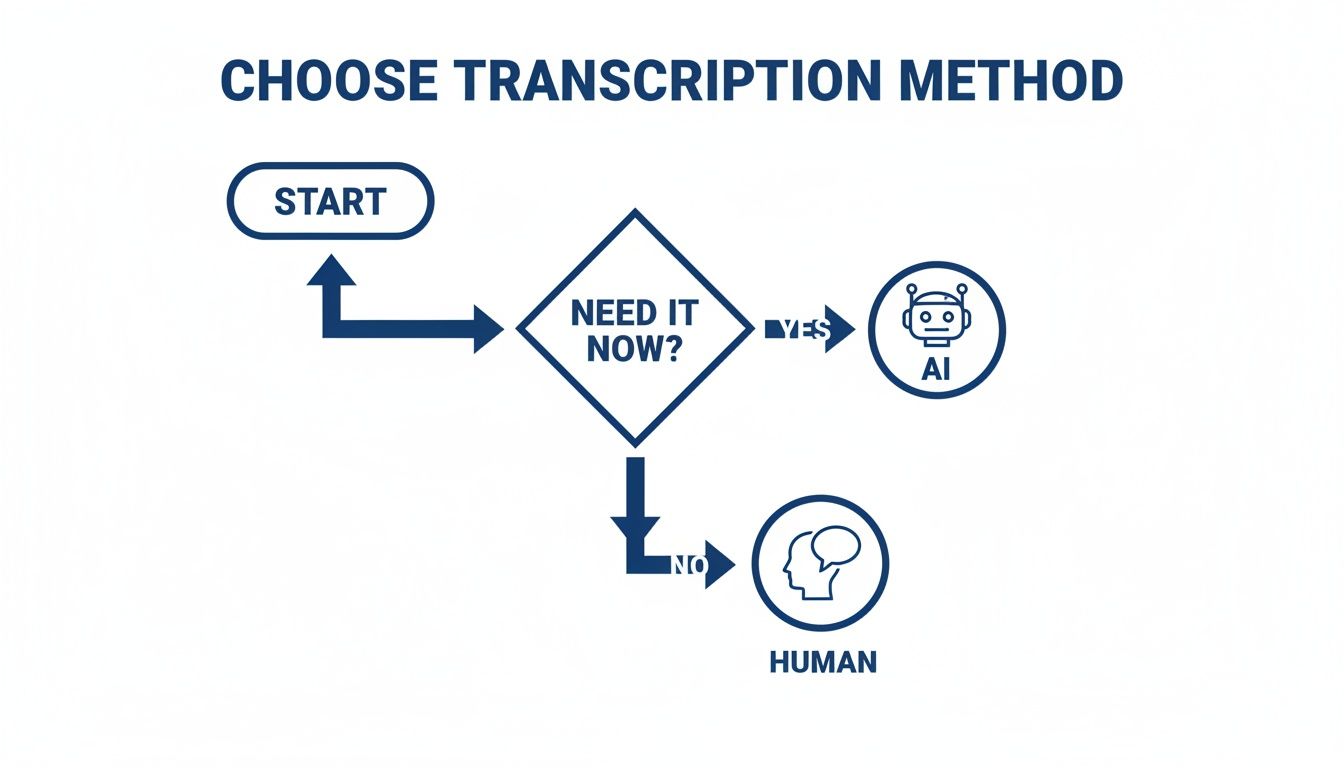
The choice often boils down to this: if you need it now, go with AI. For fast-moving revenue teams who need to act on what was said in a sales call five minutes ago, speed isn't just a nice-to-have; it's critical.
When Human Transcription Still Wins
Even with all the AI hype, human transcribers are still essential for high-stakes work. A machine can get tripped up by thick accents, people talking over each other, or niche industry jargon. A human just gets it.
This is exactly why sensitive fields like law and medicine still lean heavily on professionals. They can't afford a single misinterpreted word.
The global human transcription market hit around $4.5 billion in 2024, and it's still growing. This isn't because people are old-fashioned; it's because for some jobs, the need for perfect, human-level interpretation is worth the extra cost.
A standard one-hour recording might cost you between $90 and $180 for a human to transcribe. If it’s for a legal deposition with specific formatting, that number can easily jump to $360 or more. When compliance and accuracy are non-negotiable, you pay for the peace of mind. You can read more about how human transcription services continue to evolve in the age of AI.
How AI Is Closing The Gap For Business
For most everything else in the business world? AI is fast becoming the default choice. It’s perfect for turning your internal meetings, sales calls, and customer interviews into searchable, useful text. Leading AI engines now hit 95% accuracy on clear audio, which is plenty good for finding action items and spotting key takeaways.
This is a massive shift, especially for smaller companies and startups. The whole model has changed. You're no longer budgeting per minute for every call you want transcribed.
Instead, you use a platform where transcription is just part of the package. For Glinky users, it’s a standard feature—every conversation is automatically recorded, transcribed, and synced to your CRM for zero extra cost. What used to be a major expense line is now just an invisible part of your workflow. It completely eliminates the budget headache and the manual busywork of the old way.
Hidden Factors That Drive Up Your Final Bill
That tempting $1.50 per-minute rate you see advertised? Think of it as the base price. It's the absolute best-case scenario, and a whole host of factors can—and usually do—drive that number up.
Getting a handle on these variables beforehand is the difference between a predictable budget and a nasty surprise on your invoice.
A clean, one-on-one interview recorded in a quiet room is the "base model" for transcription. It’s straightforward and cheap to process. But the moment you start adding real-world complexity—background noise, overlapping speakers, or a tight deadline—the price tag starts to climb.
This isn’t just about nickel-and-diming. Every complication adds real work. An AI engine needs more processing power to untangle three people talking over each other, and a human transcriber has to hit rewind again and again to catch a muffled phrase. That extra effort translates directly to cost.
Common Cost Add-Ons
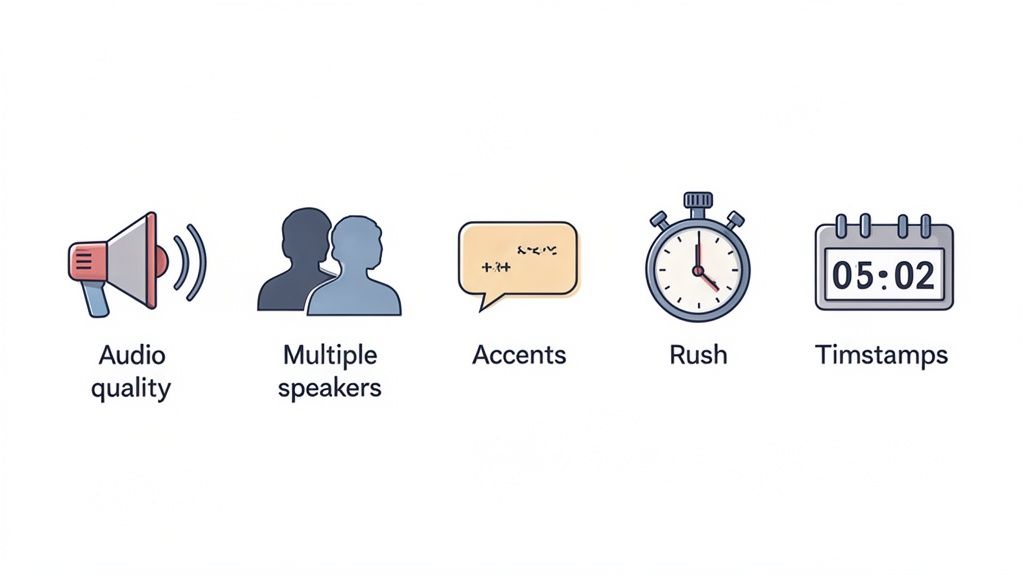
Your final transcription bill is a direct reflection of how difficult your audio is to work with. Here are the usual suspects that will increase the price:
Poor Audio Quality: This is the number one offender. Background noise from a cafe, a speaker who's too far from the mic, or static from a bad connection makes the work exponentially harder. Expect a surcharge of $0.25 to $0.50 per minute for messy audio.
Multiple Speakers: Most base rates are for a simple two-person conversation. Once you add a third person, a fourth, or a whole panel, it gets much harder to track who’s talking. This can trigger extra fees.
Heavy Accents: Strong, unfamiliar, or regional accents require a more experienced ear to transcribe accurately, and that expertise often comes at a premium.
Fast Turnaround Time: Standard delivery is usually 24 hours. Need it back in three? That rush order can easily double your per-minute rate.
The audio file itself isn’t the only thing that moves the needle. The type of transcript you need matters, too.
Actionable Insight: A "clean verbatim" transcript is the standard. It polishes the text by removing filler words like "um," "uh," and stutters. But if you need a "strict verbatim" transcript that captures every single sound—every pause, cough, and false start—get ready to pay more for that level of detail. Specify the type you need upfront to avoid overpaying.
Don't Forget The Extras
Finally, you have the à la carte services. These are features that aren't typically baked into the base per-minute price but are often critical for making the transcript actually useful. For specialized fields like healthcare or law, this can also mean finding providers that offer HIPAA compliant transcription services, where regulatory adherence itself can impact the cost structure.
Common add-ons include:
Timestamps: Adding time codes at regular intervals or for each speaker change.
Speaker Identification: Labeling each paragraph with the name of the person speaking.
Special Formatting: Structuring the final document to meet specific legal, academic, or corporate templates.
Each of these can tack on anywhere from $0.25 to $0.75 per minute.
So, let's do the math. Your initial $1.50 per minute quote for a difficult audio file with three speakers that also needs timestamps can quickly become $3.00 per minute or even more. Suddenly, a one-hour recording isn't $90—it's $180.
Calculating Your True Cost With Real Scenarios
Those per-minute rates on a pricing page look harmless enough. But to see what transcription is really costing you, you have to do the math. The sticker price is one thing; the real hit to your budget shows up when you zoom out across a month or a year.
Let’s run the numbers on a few common business scenarios. We'll pit a standard human transcription service, at a typical $1.50 per minute, against a tool where high-quality AI transcription is already baked into the platform. This is where the true cost of ownership becomes crystal clear.
Scenario 1: The Startup Sales Meeting
Your sales team huddles up for a 45-minute pipeline and strategy review every single week. It's a critical meeting, and you need a record of it.
Human Service Cost:
45 minutes x $1.50/minute = $67.50 per week
$67.50 x 52 weeks = $3,510 per year
Integrated AI Tool (like Glinky):
$0 per year (transcription is a built-in feature of the platform)
Actionable Insight: That one weekly meeting suddenly costs over $3,500 a year. That’s a serious expense that could be funding lead generation, marketing campaigns, or a new hire. Evaluate your recurring meeting costs to identify major savings opportunities.
Scenario 2: The Marketing Agency Focus Group
A marketing agency is running two 60-minute focus groups for a client this month. They need the transcripts to pull out key quotes and insights for their campaign report.
Human Service Cost:
120 minutes/month x $1.50/minute = $180 per month
$180 x 12 months = $2,160 per year
Integrated AI Tool:
$0 per year
For an agency juggling multiple clients, these costs stack up fast. It's a direct hit to project profitability. An integrated tool gives them the same text records without adding a line item to every client invoice.
Scenario 3: The Founder's Investor Calls
A founder is in fundraising mode, holding four 30-minute investor pitch calls every month. Every word matters, and capturing these conversations is non-negotiable for follow-ups and sharing with the team.
Human Service Cost:
120 minutes/month x $1.50/minute = $180 per month
$180 x 12 months = $2,160 per year
Integrated AI Tool:
$0 per year
As you can see, that "low" per-minute cost is a bit of a Trojan horse—it quickly balloons into a significant annual line item. For any team that regularly meets, interviews, or pitches, moving to a platform with bundled AI transcription isn't just a small savings; it's a major financial win.
You can see how Glinky's bundled features change the math on your total costs by checking our all-in-one pricing model.
Thinking Beyond The Transcript: Total Cost And ROI
Focusing only on the per-minute price of a transcription service is like buying a car based purely on its gas mileage. It’s a number, sure, but it tells you nothing about the real cost to own it, or more importantly, what you get back from your investment. The true value isn't the text file you end up with; it's what that transcript actually does for your business.
This is exactly where integrated platforms change the entire game. A traditional transcription service hands you a document and says, "Good luck." But an integrated revenue engine like Glinky takes that document and puts it to work, instantly. It gets rid of what we call the “stitching tax”—all the hidden time and money you burn manually piecing together separate tools for notes, CRM updates, and sales follow-ups.
The Hidden Cost Of Stitching Separate Tools
Just think about that clunky, old-school workflow for a second. First, you ship your audio off to a transcription service. Then, you wait. Once the file is back, a team member has to download it, clean it up, hunt for action items, manually copy-paste notes into your CRM, and finally draft a follow-up email. Every single step is a bottleneck and a massive drain on your team's productivity.
The global AI transcription market is projected to explode from $4.5 billion in 2024 to $19.2 billion by 2034, growing at a 15.6% CAGR. This incredible surge isn’t just about getting text from audio. It's fueled by a desperate need for instant, actionable intelligence from calls and meetings—a need that standalone services simply can't meet. As recent automated transcription statistics show, businesses are quickly moving past basic transcripts and demanding intelligent, integrated workflows.
Turning A Cost Center Into A Revenue Driver
When you switch to a unified platform, transcription stops being a passive cost center and becomes an active part of your revenue engine. Imagine your meeting intelligence tool automatically transcribing a call, knowing who said what, structuring the notes perfectly, and syncing every key detail right into your CRM. You aren't just saving a few bucks on transcription. You're handing hours back to your sales team.
That recovered time gets funneled directly into high-value work: building relationships, running more discovery calls, and actually closing deals. The ROI is no longer measured in pennies saved per minute of audio, but in whole new deals won per month. This holds true for content teams, too. For example, using AI transcripts for Podcast SEO can dramatically boost your show's reach and discoverability, turning an operational expense into a powerful marketing asset.
For founders and sales leaders, this is a fundamental shift in thinking. You’re no longer just buying a transcript. You're investing in a system that makes your entire revenue process faster, smarter, and more profitable. The initial transcription cost becomes almost irrelevant when the result is accelerated growth.
Actionable Tips To Reduce Costs And Boost Value
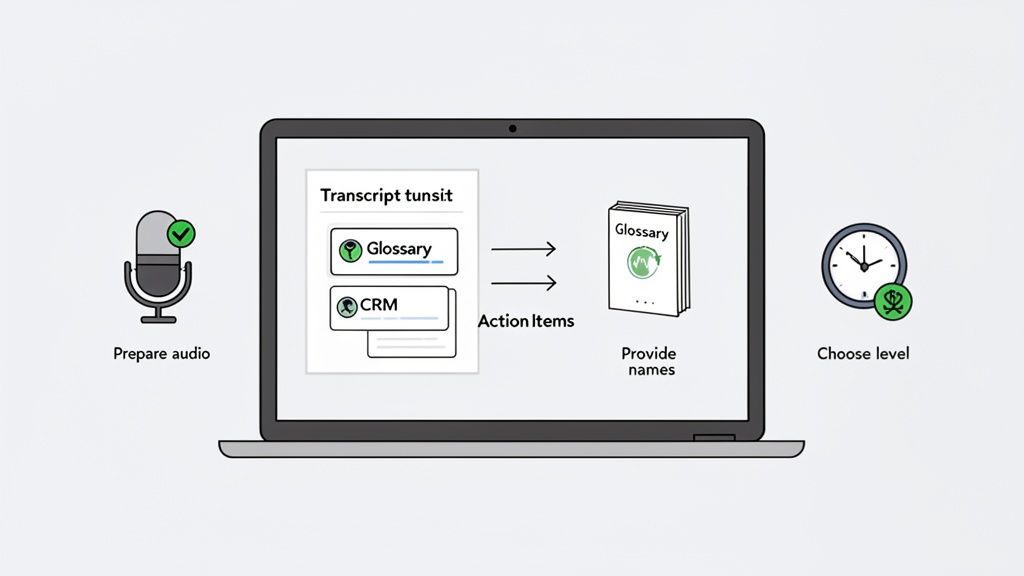
Getting a handle on your transcription costs isn't about endlessly hunting for the lowest per-minute rate. The real win comes from taking smart, proactive steps to squeeze the most value out of every dollar you spend. By making a few tweaks to your process, you can slash expenses and get a final transcript that’s far more useful from the get-go.
And the best part? These adjustments are surprisingly simple. Small changes at the source—like making sure speakers are close to the microphone and keeping background noise to a minimum—can help you avoid frustrating surcharges for poor audio quality. Think of it as prep work that pays for itself.
Your Cost-Saving Checklist
Before you ship your next audio file off for transcription, run through this quick checklist. It’ll help keep your final bill down while pushing accuracy up.
Improve Audio Quality: This is the big one. Record in a quiet room with a decent microphone. It’s the single most impactful thing you can do to cut costs and errors, whether you're using a human or an AI.
Provide a Glossary: Give your transcriber a cheat sheet with company names, unique acronyms, and any industry-specific jargon. This simple step eliminates guesswork and saves a ton of correction time later on.
Identify Speakers Upfront: If you can, provide a list of who is speaking. This helps the service accurately label speakers, which is often a paid add-on you can easily avoid.
These prep steps are especially powerful for human transcription services because they cut down on the manual effort needed. But the ultimate strategy for lowering your total cost of ownership goes beyond just good prep.
Actionable Insight: The smartest financial move for most businesses isn't a standalone transcription service. It's adopting an all-in-one platform where high-quality transcription is a built-in feature, not a separate line item.
For modern revenue teams, the real value isn’t just having a transcript; it’s about what that transcript unlocks. Platforms like Glinky bundle AI transcription into a complete revenue engine, giving you the lowest possible total cost of ownership. This approach gets rid of tedious manual work and pulls critical insights out of every single conversation. To see how this works in practice, check out our guide to automated meeting minutes.
When you shift your thinking this way, you turn a necessary expense into a powerful growth asset that fuels your entire sales process.
Frequently Asked Questions
When you start digging into transcription services, a few questions always seem to pop up. Whether you're a founder trying to keep track of investor calls or a sales leader mining discovery sessions for gold, getting the cost and quality equation right is crucial.
Let's clear the air on some of the most common points of confusion.
How Much Accuracy Do I Really Need?
The short answer: it completely depends on what you plan to do with the transcript. There's no one-size-fits-all number.
For high-stakes work like legal proceedings or critical medical records, 99%+ accuracy is the only acceptable standard. A single misplaced word can have massive consequences, which is why human transcription still reigns supreme in these fields.
But let's be realistic. For the vast majority of business uses—like generating meeting notes, pulling highlights from sales calls, or creating content—an accuracy rate between 90-98% is more than enough. Today’s AI services nail this on clear audio, making them a perfect and cost-effective fit for most internal team needs.
How Does Transcription Billing Actually Work?
Billing models are all over the place, which can make comparing services a real headache. Understanding the three main structures will help you get a handle on your actual transcription costs.
Per Minute: This is the most common model you'll see. You're charged based on the total audio or video duration. It’s simple and predictable.
Per Line: Mostly used in the medical or legal world, a "line" is typically defined as 65 characters. This can be cheaper for recordings that have a lot of dead air or long pauses.
Per Page/Report: Some niche services charge a flat rate per document, which is common for standardized reports that follow a specific template.
Actionable Insight: Per-minute billing is usually the most transparent option for fast-paced business conversations. But always—and I mean always—check the fine print for hidden fees. Extra charges for poor audio, multiple speakers, or rush jobs can sneak up on you and inflate your final bill.
What Should I Look For In A Sales Call Solution?
When you’re choosing a tool specifically for your sales team, the transcript is just the starting point. The real value isn't the text itself, but what you can do with it.
Don't settle for a simple transcription service. You need a solution that provides context and automates the grunt work. The best platforms can tell who is speaking, pull out key action items and decisions, and generate structured notes automatically.
Most importantly, a truly great tool will sync all of this intelligence directly with your CRM. It eliminates the manual data entry that eats up your reps' time and keeps them from what they do best: selling.
For revenue teams, the smartest move is to find a solution where transcription isn't a separate line item—it's part of an integrated workflow. Glinky unifies your entire process, transforming every conversation into actionable intelligence without the extra cost or complexity. Learn more at https://www.glinky.ai.
People also read

10 Sales Enablement Best Practices to Unify Your Revenue Engine in 2026
Productivity
Mar 13, 2026

How to Manage Sales Pipeline for Predictable Revenue Growth
Productivity
Mar 14, 2026

How to Qualify Leads in Sales Without Wasting Time
Productivity
Mar 17, 2026

What is Conversation Intelligence? A Practical Guide for Sales Teams
Productivity
Mar 18, 2026

Top 10 Sales Discovery Questions That Close More Deals
Productivity
Mar 25, 2026
Taking Minutes of Meeting: A Guide to Transforming Chaos into Action
Productivity
Feb 16, 2026

Action Items List: A Practical Guide to Drive Real Results
Productivity
Feb 19, 2026
Master the summary of a meeting for clear decisions and follow-ups
Productivity
Feb 22, 2026

Track Action Items: A Practical Guide to Using AI for Flawless Follow-Up
Productivity
Feb 17, 2026
Unlock: How to Take Notes on a Computer for Peak Productivity in 2026
Productivity
Feb 26, 2026
How to Record Google Meet: A Complete Guide for 2026
Productivity
Mar 4, 2026

12 Best AI Note Taking App Choices for 2026: The Definitive Guide
Productivity
Mar 6, 2026

How to Improve Customer Retention: Practical Tips to Boost Loyalty
Productivity
Mar 8, 2026

10 Client Communication Best Practices to Master in 2026
Productivity
Mar 7, 2026
The 12 Best AI Meeting Assistant Tools for 2026: A Deep Dive
Productivity
Mar 15, 2026
Your Guide to the Ultimate AI Email Writer
Productivity
Feb 27, 2026

10 Essential Customer Success Best Practices for 2026
Productivity
Mar 1, 2026
Your Guide to Sales Call Recording Software in 2026
Productivity
Mar 2, 2026
How to Take Better Meeting Notes and Drive Real Results
Productivity
Mar 5, 2026
Top 10 Picks for best crm for small business
Productivity
Mar 3, 2026

What is an Ideal Customer Profile: A Guide to Driving Growth
Productivity
Mar 9, 2026
Automated meeting minutes: Turn talks into actionable notes
Productivity
Mar 11, 2026

The Top 12 AI Powered Sales Tools to Boost Revenue in 2026
Productivity
Mar 16, 2026
AI Note Taking For Meetings: Fast, Smart AI Notes That Drive Collaboration
Productivity
Mar 19, 2026
Master Your Meetings With The Note Taking Charting Method
Productivity
Feb 18, 2026
The Ultimate 2026 Guide: 8 Meeting Follow Up Email Template Scenarios
Productivity
Feb 20, 2026
Master the Art of Taking Meeting Notes for Actionable Outcomes
Productivity
Feb 25, 2026

12 Best Sales Lead Generation Tools to Boost Your Pipeline in 2026
Productivity
Mar 10, 2026
Translation Vs Transcription: Which Service Do You Really Need?
Productivity
Mar 12, 2026
Mastering the goals of a meeting to drive decisions and boost team alignment
Productivity
Mar 23, 2026

The 12 Best Free AI Email Writer Tools for 2026
Productivity
Mar 22, 2026
A Guide to AI Sales Enablement Platforms in 2026
Productivity
Mar 21, 2026

Automate Follow Up Emails: Actionable Insights for Boosting Sales & Efficiency
Productivity
Mar 26, 2026

Follow Up Email Subjects That Convert: Increase Opens and Replies
Productivity
Feb 17, 2026

Your Playbook for Outbound Lead Generation in 2026
Productivity
Feb 28, 2026
Your Essential Meeting Action Items Template to Drive Results
Productivity
Feb 23, 2026
Your Guide to Using an Email Writer AI for Maximum Impact
Productivity
Feb 23, 2026
8 Essential Ground Rules at Meetings to Maximize Productivity in 2026
Productivity
Mar 24, 2026
Otter.ai vs Glinky
Productivity
Feb 5, 2026
AI Tools for Startup Founders [2026]
Productivity
Feb 4, 2026
Best AI Tools for Startups [2026]
Tools
Feb 3, 2026
Sales Call Notes: How to Capture Every Detail Without Losing the Deal
How to
Feb 2, 2026
How to Take Meeting Notes: 7 Methods That Actually Work [2026]
How to
Jan 14, 2026
![AI Meeting Minutes | Free Forever [2026]](https://framerusercontent.com/images/zYQGRjgLX63tiouLTK65LvCcjK8.png?width=402&height=263)
AI Meeting Minutes | Free Forever [2026]
How to
Jan 13, 2026
![How to Record Zoom Meetings Without a Bot [2026] 3 Easy Methods](https://framerusercontent.com/images/gGoQV8bPb9zR5weVruinbjaxO0.png?width=402&height=263)
How to Record Zoom Meetings Without a Bot [2026]
How to
Jan 9, 2026
Bot-Free AI Meeting Notes: We Tested the 6 Best Tools in 2026
Tools
Jan 8, 2026
Glinky vs Fireflies.ai
Tools
Jan 7, 2026
15 Best AI Tools to Boost Your Productivity in 2026
Productivity
Jan 6, 2026