Nov 13, 2025
Productivity
Translation Vs Transcription: Which Service Do You Really Need?
It’s a mix-up we see all the time. People use the terms “transcription” and “translation” as if they’re the same thing. But getting them wrong isn’t just a simple mistake; it can lead to wasted time, blown budgets, and missed opportunities.
Let's clear this up for good. The core difference is surprisingly simple.
Transcription is the process of converting spoken audio into written text in the exact same language. Think of it as creating a perfect written record of what was said. The goal is documentation and data capture.
Translation, on the other hand, is about converting written text from one language to another. This is all about bridging a communication gap by adapting meaning, not just documenting a conversation.
Translation Vs. Transcription: The Core Differences
One process captures what was said. The other makes sure it can be understood by a global audience. Understanding which one you need is the first step toward solving your actual business problem, whether that’s analyzing a sales call or launching a product in a new market.
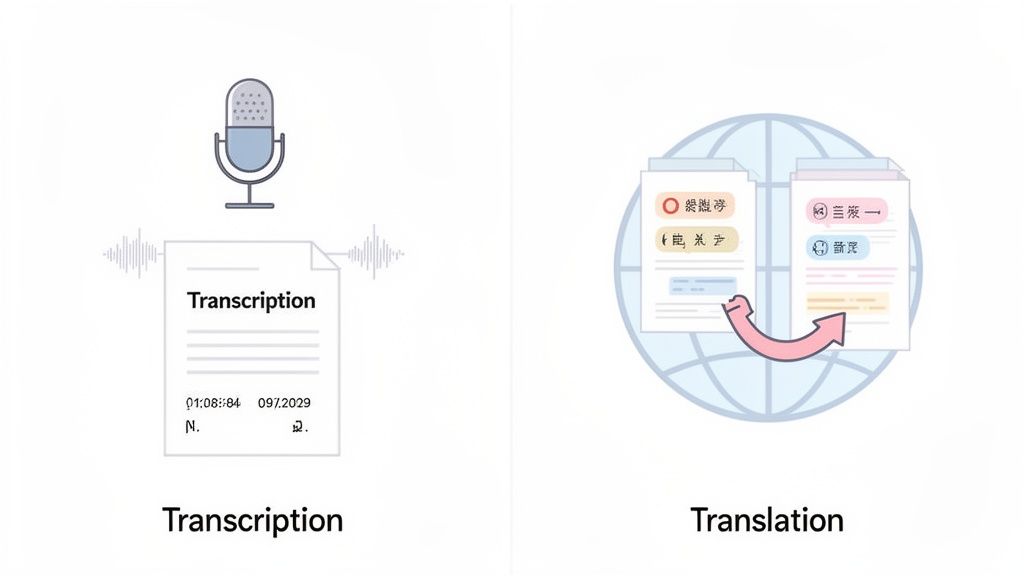
Transcription is purely about documentation and data capture. When you transcribe a sales demo, a support call, or an internal meeting, you're turning that unstructured audio into a searchable, shareable text file. The goal is a word-for-word record.
Translation focuses on localization and cultural adaptation. It takes existing written content—like a website, a legal document, or even the transcript of a video—and reshapes it so a new audience can connect with the message, not just the words.
The Golden Rule: Transcription always comes first. You can’t translate a conversation until you’ve transcribed it. Transcription deals with one language (spoken to written), while translation works with two (source text to target text).
Primary Functions and Outputs
The easiest way to decide which service you need is to look at the start and end points of the process. What are you starting with, and what do you need to have in your hands at the end?
Transcription always starts with an audio or video file and ends with a text document in the original language.
Translation always starts with a text document and delivers a new text document in a different language.
To make it even clearer, here’s a quick breakdown of the core differences.
Core Differences at a Glance: Transcription Vs. Translation
This table cuts through the noise and shows the fundamental distinctions between these two critical services.
Attribute | Transcription | Translation |
|---|---|---|
Primary Goal | To create an accurate text record of spoken words. | To convey the full meaning from a source language to a target language. |
Starting Format | Audio or video file. | Written text document. |
End Product | A text document in the original language of the audio. | A text document in a new, different language. |
Core Skill | Exceptional listening, attention to detail, and context awareness. | Deep linguistic fluency, cultural understanding, and subject matter expertise. |
Ultimately, it all boils down to your objective.
Need to find out why a customer churned by reviewing their final support call? You need transcription.
Want to make your latest case study available to potential clients in Japan? You need translation of the finished document.
How Each Process Actually Works
Let's get out of the textbook definitions and look at what happens under the hood. While people often use the terms interchangeably, transcription and translation are completely different animals. They involve distinct skills, workflows, and ultimately, deliver very different results.
Think about your last sales call or that all-hands meeting you recorded. That audio or video file is the starting point for transcription. The whole point is to capture a faithful, word-for-word record of what was said. No interpretation, just the facts.
The Transcription Workflow: From Audio to Actionable Text
Modern AI transcription is a world away from someone just typing up words. Sophisticated platforms are doing several things at once to turn messy audio into a structured, searchable asset.
Speaker Diarization: The AI’s first job is figuring out who is talking. It separates and labels each speaker, which is absolutely critical for making sense of the back-and-forth between a sales rep and a prospect.
Timestamping: Every single word gets a timestamp, linking it back to the exact moment it was spoken in the audio. This lets you click on a sentence in the transcript and instantly hear the original audio to check for tone or intent.
Accuracy and Refinement: This is where the magic happens. The AI isn't just listening; it’s using advanced models trained on countless accents and industry jargon to clean up the raw speech and hit a high degree of precision.
The output is a clean, objective record of the conversation. It's the ground truth you can then search, analyze, and build workflows around.
The Translation Workflow: From Words to New Meaning
Translation, on the other hand, kicks in only after you already have a finished written document—whether that’s a transcript, a website page, or a user manual. The goal isn't to copy, but to recreate meaning for an entirely new audience with a different language and cultural background.
This is a multi-layered process that requires deep expertise:
Machine Translation (MT): An AI model provides a fast, initial translation. This is great for getting the basic gist of a document quickly.
Human Post-Editing (MTPE): This is where a professional human linguist steps in. They review the AI's output, polishing the text to fix awkward phrasing, grammar mistakes, and syntax issues.
Transcreation: For really important content like marketing campaigns or ad copy, this goes even further. A specialist doesn't just translate; they adapt idioms, humor, and cultural references so the message hits home emotionally. They are essentially writing new copy for the target market.
A transcript is a factual record of what was said. A translation is a new creation of meaning, carefully adapted for a different audience. Transcription requires sharp listening, while translation demands deep linguistic and cultural fluency.
These different workflows tell a story about their respective markets. The translation industry is being transformed by neural machine translation, with hybrid models (AI plus human oversight) projected to grab 61.25% of revenues.
In contrast, the USD 32.01 billion U.S. transcription market is all about accuracy, especially for high-stakes conversations in sales, legal, and healthcare. This is exactly why tools like GLINKY are so essential—the high-precision output ensures that no detail, commitment, or nuance gets lost when a critical business conversation is turned into text. For a deeper dive, you can explore more data on these market trends to see where the industry is heading.
Understanding the Market Growth and Business Opportunity
When you're choosing between services, it's easy to get lost in feature lists. But the smart move isn't just about what a tool does today; it's about understanding market momentum and betting on where the real opportunity lies. Both translation and transcription solve critical business problems, but they are on wildly different growth trajectories. Knowing the difference is what separates a simple tactical purchase from a truly strategic investment.
The translation market is a well-oiled machine. It’s mature, stable, and chugging along steadily, powered by the constant push for globalization. As long as companies expand into new territories, the need for localized websites, product manuals, and marketing campaigns will be there. It’s an essential service for crossing language barriers.
But the transcription market? That’s where things get interesting. A massive, dynamic shift is underway, especially in one specific area. The widespread adoption of remote and hybrid work hasn't just changed where we work—it has fundamentally altered how business gets done, turning every single virtual meeting into a treasure trove of searchable, analyzable data.
The Explosive Growth of AI Meeting Transcription
This seismic shift has lit a fire under the AI meeting transcription market. This isn't just a trend about getting better meeting notes. It's a fundamental change in how businesses capture, dissect, and act on the conversational gold hidden in their sales calls, client check-ins, and support interactions. The goal is no longer simple documentation; it’s about extracting deep, actionable intelligence.
Actionable Insight: The real opportunity isn't just turning audio into text. It’s about building a searchable, analyzable history of every client conversation to drive productivity, improve sales coaching, and automate administrative work.
The numbers tell a story you can’t ignore. The global transcription market was valued at USD 26.66 billion in 2026 and is projected to hit USD 37.59 billion by 2032. That's solid growth. But the AI meeting transcription sub-market is where the explosion is happening. It's set to skyrocket from USD 4.85 billion in 2026 to an incredible USD 29.45 billion by 2034—a staggering 25.62% compound annual growth rate. This completely dwarfs the growth of the broader translation and transcription markets, as you can see in detailed market projections. Explore more insights on the transcription market growth.
This data screams business opportunity. While translation is vital for global reach, AI-powered transcription offers an immediate, high-impact way to sharpen your internal efficiency, boost sales performance, and directly fuel revenue. For teams using platforms like GLINKY, this trend is simply confirmation of what they already know: tools with native speaker recognition and automated workflows are becoming the indispensable backbone for capturing client intelligence without friction.
Practical Business Use Cases for Each Service
Okay, theory is great. But where do transcription and translation actually make a difference in your day-to-day operations? Knowing the dictionary definition is one thing; seeing how these services solve real problems and drive revenue is another entirely.
Let's get practical. The smartest applications for transcription are all about tapping into the goldmine of data trapped inside your spoken conversations. Think about it: every call that ends without a record is a missed opportunity. It's about creating a searchable, analyzable log of every interaction that used to just vanish. Whether you’re a solo operator trying to transcribe voice memos on the go or a full-fledged team, this creates an entirely new layer of business intelligence.
High-Value Transcription Scenarios
The real magic of transcription happens when you start pointing it at specific business functions. Here’s where we see it making the biggest impact:
Sales Enablement: Imagine your sales reps finishing a client call, and their CRM is already populated with accurate notes, action items, and clear buying signals. That's what transcription does. It kills manual data entry and builds a perfect history for every account, so no promise ever gets dropped.
Customer Retention: Your success managers can analyze support calls to find out what truly frustrates your customers. By spotting patterns in the language people use, they can get ahead of problems, slash churn, and keep customers happy.
Hiring and HR: Interviewing candidates becomes a much fairer and more consistent game when every conversation is documented. A complete transcript allows hiring managers to go back, review specific answers objectively, and make decisions based on data, not just gut feelings.
Actionable Insight: The core value of business transcription isn't just creating a text file; it’s about transforming unstructured audio from sales, support, and HR conversations into a strategic asset that fuels smarter decisions.
Strategic Translation Applications
If transcription is about boosting internal efficiency, translation is the engine for global growth. It’s all about making your brand, your products, and your support feel local to a worldwide audience. This builds trust and massively improves the user experience across different cultures. But to do this right, you need a clean, polished source text to start from, like the kind you get from tools that generate automated meeting minutes.
Translation isn't a "nice-to-have"—it's a requirement for any business with international ambitions.
Market Expansion: You can't just enter a new country; you have to resonate with it. Localizing your website and marketing materials is the first, most crucial step. This goes way beyond simple word-for-word swapping—it's about adapting your entire message to fit local customs and expectations.
Global Product Support: Translating your product manuals, user guides, and knowledge base articles is a massive win. It ensures users anywhere on the planet can get the help they need, which dramatically reduces the strain on your support teams.
Multilingual Customer Service: This is a loyalty powerhouse. Offering support via chat or email in a customer's native language is a game-changer. In fact, research shows that 73% of customers are more likely to buy from a brand that communicates in their own language.
How to Choose the Right Service for Your Goals
Deciding between transcription and translation isn't some complex, academic exercise. It boils down to a few surprisingly simple questions that get right to the heart of what you’re trying to accomplish. Nail these, and you’ll know exactly where to invest your time and money.
First things first: what are you starting with? Is it spoken audio from a sales call or a finalized, written document like a marketing brochure? This one question alone usually clears up 90% of the confusion.
This decision tree helps visualize the path forward based on your core business problem.
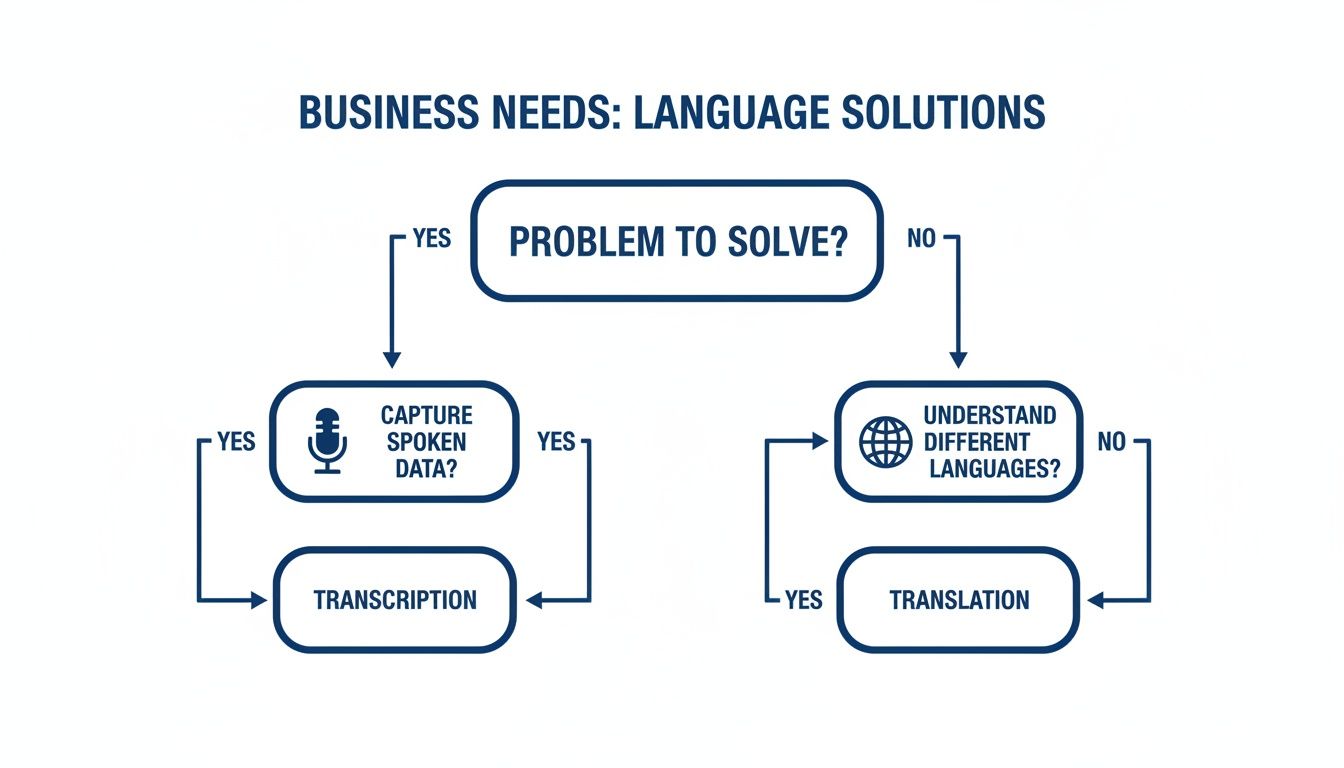
The flowchart makes the distinction crystal clear. If your goal is to capture and analyze data from a conversation, you need transcription. If you need to make existing text understandable across different languages, you need translation.
Key Questions for Your Decision
To make the right call, just walk through this framework. Your answers will immediately tell you whether transcription, translation, or a combination of both is the right move.
What’s my input?
Spoken Audio/Video: You need transcription. Period. There's no other way to start.
Written Text: You're ready for translation, assuming the text is finalized and approved.
What's the main goal?
Documentation and Analysis: You're looking to create a searchable, accurate record of a conversation for internal use—think call coaching, CRM updates, or product feedback. This is a clear-cut case for transcription.
Cross-Language Communication: You need your content to land with an audience that speaks another language. This is purely a job for translation.
How accurate does it need to be?
High-Stakes Business Details: For sales calls, client negotiations, or support escalations, every single word matters. You need a high-precision transcription service that can handle industry jargon, accents, and multiple speakers without breaking a sweat.
Cultural Nuance and Brand Voice: For marketing materials or websites, a literal, word-for-word translation is a recipe for disaster. You need a service that can adapt your message and brand personality for a different culture.
Actionable Insight: The most common mistake we see is people asking for a "translation" of an unrecorded conversation. Always remember the golden rule: transcription first. You have to turn speech into text before you can ever hope to translate it.
Why Advanced Transcription Is a Strategic Tool
For most businesses obsessed with internal efficiency and revenue growth, the real opportunity lies with advanced transcription. Modern platforms have evolved far beyond just turning audio into a wall of text. They are complete productivity systems engineered to solve specific business headaches.
For example, bot-free solutions like Glinky are built specifically for high-stakes business conversations. By using native AI for speaker recognition, it completely avoids that awkward moment when a "bot" joins your meeting, which can instantly put clients on guard. This is a game-changer for sales teams who need a perfect record of a call without disrupting the natural, human connection. You can learn more about how this works in our guide on sales call recording software.
These platforms transform a simple transcript into a powerful engine for productivity. They automatically generate structured summaries, draft follow-up emails, and push action items directly into your CRM. This turns a routine conversation into a fully documented, actionable event, ensuring your account history is always complete and your team can focus on selling, not on tedious admin work.
Thinking about transcription versus translation is a good first step, but let's be honest—the real magic for any business happens after the words are on the page. Getting a transcript is just the beginning. The goal is to turn raw conversation data into real, automated actions that actually move your business forward. This is where an intelligent system stops being a simple tool and becomes a core part of your operations.
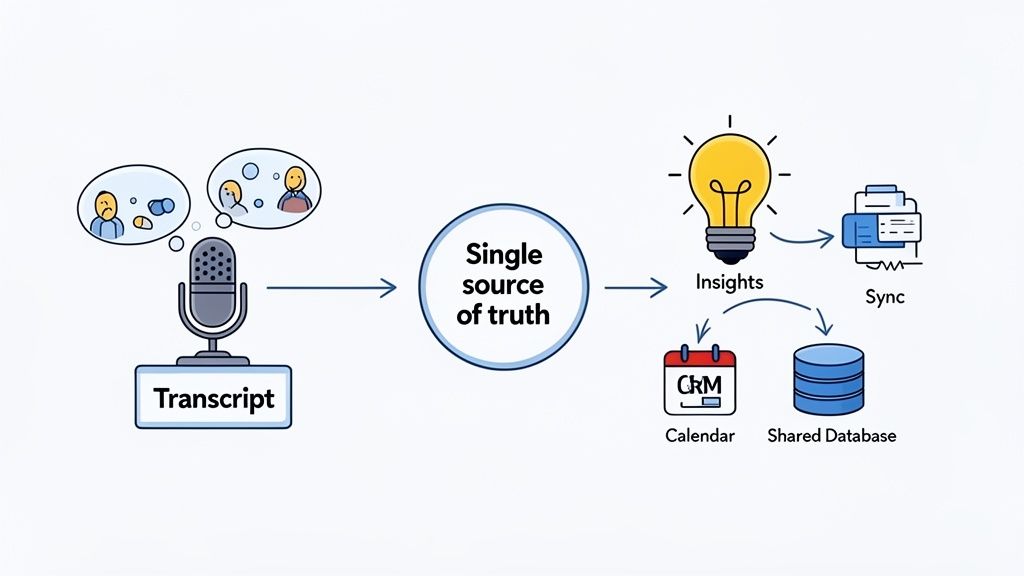
Think about it: a system that quietly runs in the background of every single client call. It captures the audio, turns it into a dead-accurate transcript, and then pushes all the key details straight into your tech stack, from your calendar to your CRM. Suddenly, every meeting and call contributes to one central source of truth. For any business trying to get more efficient, digging into advanced AI audio transcription solutions is the key to unlocking these kinds of workflows.
From Text to Actionable Intelligence
This is where a platform like Glinky really shines. After a call ends, it doesn't just hand you a wall of text and walk away. The system gets to work, analyzing the conversation to pull out the important stuff: decisions made, action items agreed upon, and critical topics.
Actionable Insight: while translation and transcription are two totally different services, smart transcription has become a full-blown workflow engine. It drives efficiency, helps your sales team perform better, and pushes revenue by making your data do the work for you.
From that analysis, it can automatically draft a follow-up email, create tasks in your project manager, and update the contact record in your CRM with fresh notes. This kind of automation instantly frees up hours of mind-numbing admin work, letting your team focus on what they were hired to do—build relationships and sell. For teams living in virtual meetings, our guide on how to record Google Meet has some great pointers to make sure you capture every detail.
At the end of the day, this isn't about choosing a way to get words on a page anymore. It’s about investing in a smart system that makes every conversation a documented, productive, and fully connected part of how you do business.
FAQs: Transcription vs. Translation in Practice
You’ve got the basics down, but the real world always has a few curveballs. Here are the straight answers to the questions that pop up when it's time to actually implement this stuff.
Can I Just Get One Tool for Both Transcription and Translation?
Not really, and you wouldn’t want to. While some platforms tack on both features, they are fundamentally different jobs. Think of it this way: a specialized transcription tool is obsessed with one thing—creating a perfect, word-for-word record of a conversation in its original language.
That clean transcript is the non-negotiable starting point. Once you have it, you can feed that perfect source material into a dedicated translation service. Accurate transcription must always come first. Trying to translate a messy, inaccurate transcript is like building a house on a foundation of sand. The entire structure will be flawed.
What Level of Accuracy Can I Actually Expect from AI Transcription?
This is where you get what you pay for. Free or basic services are notoriously bad with industry jargon, heavy accents, or calls with multiple people talking over each other. For casual use? Maybe fine. For business? Absolutely not.
When deals, commitments, and next steps are on the line, you need precision. Advanced, bot-free solutions like Glinky use native AI and sophisticated speaker identification to deliver accuracy you can actually trust. That said, for high-stakes legal depositions or critical medical records, you should still have a human review the final output. Always.
Actionable Insight: The real game-changer isn't just accuracy, but what happens after the transcript is made. The key is finding a tool that invisibly plugs into your existing workflow, automating the busywork so your team can focus on what they do best.
How Do I Actually Weave Transcription into My Team's Workflow?
The only way this works is with seamless integration. Don't even consider a tool that forces your team to manually download files, copy-paste notes, or update records by hand. That's just trading one form of admin work for another.
A truly smart system connects directly to your existing tech stack. For example, it should integrate with Google and Outlook calendars to automatically capture meetings without anyone lifting a finger. Afterward, it should be able to sync structured notes, key decisions, and action items right into the correct fields in your CRM. This keeps your client records perfectly up-to-date and frees your team from the soul-crushing "CRM tax."
Ready to turn your conversations into revenue-driving actions without the friction? GLINKY delivers native AI transcription and automated post-call workflows that keep your team selling and your CRM spotless.
People also read
10 Sales Enablement Best Practices to Unify Your Revenue Engine in 2026
Productivity
Mar 13, 2026
How to Manage Sales Pipeline for Predictable Revenue Growth
Productivity
Mar 14, 2026
How to Qualify Leads in Sales Without Wasting Time
Productivity
Mar 17, 2026
What is Conversation Intelligence? A Practical Guide for Sales Teams
Productivity
Mar 18, 2026
Top 10 Sales Discovery Questions That Close More Deals
Productivity
Mar 25, 2026
Taking Minutes of Meeting: A Guide to Transforming Chaos into Action
Productivity
Feb 16, 2026
Action Items List: A Practical Guide to Drive Real Results
Productivity
Feb 19, 2026
Master the summary of a meeting for clear decisions and follow-ups
Productivity
Feb 22, 2026
Track Action Items: A Practical Guide to Using AI for Flawless Follow-Up
Productivity
Feb 17, 2026
Unlock: How to Take Notes on a Computer for Peak Productivity in 2026
Productivity
Feb 26, 2026
How to Record Google Meet: A Complete Guide for 2026
Productivity
Mar 4, 2026
12 Best AI Note Taking App Choices for 2026: The Definitive Guide
Productivity
Mar 6, 2026
How to Improve Customer Retention: Practical Tips to Boost Loyalty
Productivity
Mar 8, 2026
10 Client Communication Best Practices to Master in 2026
Productivity
Mar 7, 2026
The 12 Best AI Meeting Assistant Tools for 2026: A Deep Dive
Productivity
Mar 15, 2026
Your Guide to the Ultimate AI Email Writer
Productivity
Feb 27, 2026

10 Essential Customer Success Best Practices for 2026
Productivity
Mar 1, 2026
Your Guide to Sales Call Recording Software in 2026
Productivity
Mar 2, 2026
How to Take Better Meeting Notes and Drive Real Results
Productivity
Mar 5, 2026
Top 10 Picks for best crm for small business
Productivity
Mar 3, 2026
What is an Ideal Customer Profile: A Guide to Driving Growth
Productivity
Mar 9, 2026
Automated meeting minutes: Turn talks into actionable notes
Productivity
Mar 11, 2026
The Top 12 AI Powered Sales Tools to Boost Revenue in 2026
Productivity
Mar 16, 2026
AI Note Taking For Meetings: Fast, Smart AI Notes That Drive Collaboration
Productivity
Mar 19, 2026
Understanding Transcription Service Cost: A 2026 Guide
Productivity
Mar 20, 2026
Master Your Meetings With The Note Taking Charting Method
Productivity
Feb 18, 2026
The Ultimate 2026 Guide: 8 Meeting Follow Up Email Template Scenarios
Productivity
Feb 20, 2026
Master the Art of Taking Meeting Notes for Actionable Outcomes
Productivity
Feb 25, 2026
12 Best Sales Lead Generation Tools to Boost Your Pipeline in 2026
Productivity
Mar 10, 2026
Mastering the goals of a meeting to drive decisions and boost team alignment
Productivity
Mar 23, 2026
The 12 Best Free AI Email Writer Tools for 2026
Productivity
Mar 22, 2026
A Guide to AI Sales Enablement Platforms in 2026
Productivity
Mar 21, 2026
Automate Follow Up Emails: Actionable Insights for Boosting Sales & Efficiency
Productivity
Mar 26, 2026

Follow Up Email Subjects That Convert: Increase Opens and Replies
Productivity
Feb 17, 2026

Your Playbook for Outbound Lead Generation in 2026
Productivity
Feb 28, 2026
Your Essential Meeting Action Items Template to Drive Results
Productivity
Feb 23, 2026
Your Guide to Using an Email Writer AI for Maximum Impact
Productivity
Feb 23, 2026
8 Essential Ground Rules at Meetings to Maximize Productivity in 2026
Productivity
Mar 24, 2026
Otter.ai vs Glinky
Productivity
Feb 5, 2026
AI Tools for Startup Founders [2026]
Productivity
Feb 4, 2026
Best AI Tools for Startups [2026]
Tools
Feb 3, 2026
Sales Call Notes: How to Capture Every Detail Without Losing the Deal
How to
Feb 2, 2026
How to Take Meeting Notes: 7 Methods That Actually Work [2026]
How to
Jan 14, 2026
![AI Meeting Minutes | Free Forever [2026]](https://framerusercontent.com/images/zYQGRjgLX63tiouLTK65LvCcjK8.png?width=402&height=263)
AI Meeting Minutes | Free Forever [2026]
How to
Jan 13, 2026
![How to Record Zoom Meetings Without a Bot [2026] 3 Easy Methods](https://framerusercontent.com/images/gGoQV8bPb9zR5weVruinbjaxO0.png?width=402&height=263)
How to Record Zoom Meetings Without a Bot [2026]
How to
Jan 9, 2026
Bot-Free AI Meeting Notes: We Tested the 6 Best Tools in 2026
Tools
Jan 8, 2026
Glinky vs Fireflies.ai
Tools
Jan 7, 2026
15 Best AI Tools to Boost Your Productivity in 2026
Productivity
Jan 6, 2026