
Nov 13, 2025
Productivity
A Guide to AI Sales Enablement Platforms in 2026
An AI sales enablement platform is more than just another tool in your stack. It's a cohesive, intelligent system engineered to manage your entire sales process—from prospecting and initial outreach to closing deals and automatically tracking every touchpoint.
Most sales teams are trapped in a cycle of gluing together a chaotic mess of separate apps: a lead database, a meeting recorder, an outreach tool, and a CRM that's perpetually out of date. An AI sales enablement platform eliminates that chaos, creating a single source of truth for your entire revenue team. This is the strategic shift that solves tool fatigue and ends the soul-crushing manual data entry that kills productivity and morale.
Beyond Simple Automation: What Is an AI Sales Enablement Platform, Really?
Let's be honest. Many sales teams feel like they’re trying to build a high-performance car with parts from a dozen different kits. You’ve got a tool for finding leads, another for recording calls, a separate one for sending email sequences, and a CRM that someone has to manually update after every interaction. This patchwork approach creates constant friction and slows everything down.
This is the exact problem an AI sales enablement platform is built to solve. It’s not about automating a few random tasks. It’s about creating a single, intelligent system that acts as the central nervous system for your entire revenue operation. It becomes the one source of truth that connects every dot in the customer journey.
The Hidden Costs of a Disconnected Sales Stack
A stitched-together sales stack quietly drains your productivity and revenue. It's why sales reps spend less than 30% of their time actually selling. The rest of their day is eaten up by administrative busywork that stems from a few core frustrations:
Tool Overload: Juggling multiple subscriptions is confusing, forces constant context-switching, and means you’re paying for software that’s barely being used.
Data Silos: When your call notes live in one app and your deal information is in another, you never get a complete, honest picture of your customer.
Crippling Manual Entry: Reps waste hours copying and pasting notes, logging calls, and updating contact records in the CRM. That’s time they should be spending building relationships and closing deals.
Actionable Insight: Conduct a "tool audit" with your team. Ask each rep to list every tool they use daily and estimate the time spent switching between them. The results will quickly highlight the hidden cost of a fragmented stack and build a strong case for consolidation.
From Disconnected Tools to a True Operating System
The move from a handful of individual AI tools to a unified AI sales enablement platform is more than an upgrade—it's a fundamental shift in strategy. You’re moving beyond simple task automation (like auto-filling a CRM field) and into the realm of intelligent augmentation, where AI actively helps your reps sell better.
This evolution is powered by different capabilities all working together in harmony. For instance, advanced features like AI-driven content personalization allow reps to craft the perfect message based on deep customer insights.
By weaving every part of the sales workflow together—from lead discovery and meeting intelligence to outreach sequences and CRM sync—these platforms don't just help your team work faster. They help them work smarter. This unified model is the foundation for any modern, efficient, and scalable revenue engine.
The Four Pillars of a Modern AI Sales Platform
A true AI sales platform isn't just one flashy feature. It's a complete system built on four foundational pillars that work together. When these pieces are connected, they eliminate the administrative busywork that drags sales teams down, freeing them up to focus on what actually generates revenue.
Let's break down each pillar and explore its real-world application.
The market is already making a huge shift in this direction. The sales enablement platform space is projected to explode from $7.4 billion in 2026 to an incredible $33.9 billion by 2036, growing at a 16.4% compound annual rate. This isn’t just hype; it shows that startups and small businesses are tired of duct-taping different tools together. They're moving to single, AI-native platforms that manage the entire revenue workflow, from finding a lead to closing a deal.
Pillar 1: Meeting Intelligence
The first pillar is Meeting Intelligence, which completely transforms how you handle sales conversations. Forget about inviting a clunky, distracting bot to your calls. A modern platform records and analyzes your meetings behind the scenes. It identifies speakers, then automatically creates structured notes, captures key decisions, and extracts a list of action items.
Actionable Insight: Use the AI-generated meeting summaries to build a "greatest hits" library of discovery call questions and objection-handling techniques. This becomes an invaluable, real-world training resource for new hires, helping them ramp up faster by learning from your top performers.
Pillar 2: Lead Discovery
Next up is Lead Discovery. This pillar reimagines how you find your next best customers. Forget about wrestling with complex filters and outdated databases. With a truly AI-native approach, you can find ideal prospects just by asking in plain English.
A sales rep can type a simple query like, "Show me VPs of Sales at SaaS companies in California with 50-200 employees." The platform instantly generates a clean list of qualified individuals, complete with verified business emails, phone numbers, and LinkedIn profiles. Prospecting goes from a soul-crushing manual task to a quick, intuitive search.
The diagram below shows this evolution perfectly. It contrasts the messy, fragmented process of juggling multiple tools with the clean, unified approach of an AI sales platform.
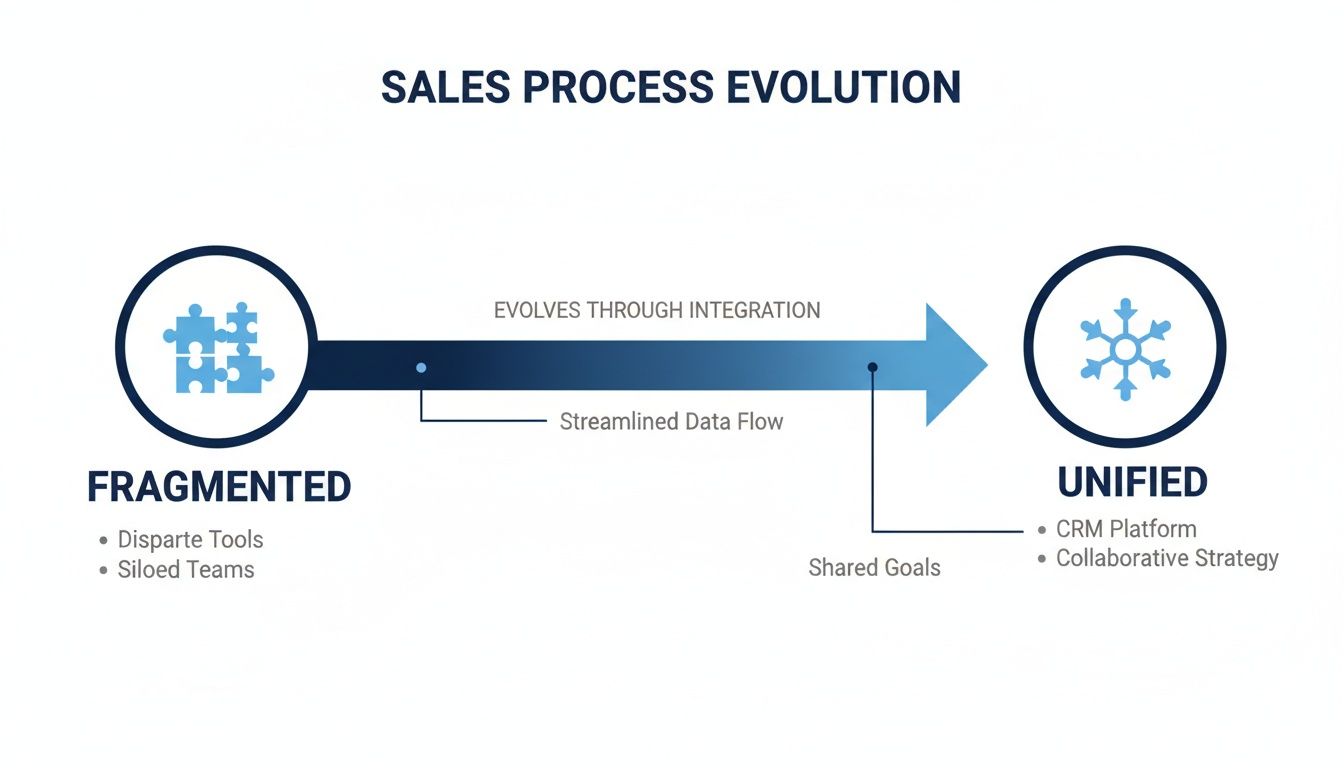
This visual gets to the heart of it: an AI platform consolidates everything into a single, intelligent hub. No more data silos, just a much more efficient way to work.
Pillar 3: Automated Outreach
The third pillar, Automated Outreach, is where you engage the prospects you just found. After using Lead Discovery to build your target list, this lets you connect with them at scale without sounding like a robot. You can build and launch multi-channel outreach sequences that run on their own.
These sequences can blend personalized emails with automated follow-ups, all designed to warm up leads without constant manual effort. For an SDR, this is a total game-changer. They can enroll hundreds of prospects into a well-designed sequence and then spend their energy actually talking to the warm leads who respond.
Pro Tip: Don't just "set and forget" your outreach. Use the platform's analytics to A/B test your subject lines, call-to-actions, and the timing of your follow-ups. A small tweak, like changing "Interested in a demo?" to "Open to learning more?", can significantly lift your reply rates.
Pillar 4: Unified CRM Sync
Finally, the Unified CRM Sync acts as the platform's brain and the ultimate source of truth. This might be the most important pillar because it connects everything and solves the biggest headache for sales teams: manual data entry.
Every call recording, meeting note, email, and prospect interaction is automatically logged in your CRM. It's all organized on a single, chronological timeline for each contact, ensuring your records are always complete and up-to-date.
For a sales leader, this means getting an accurate, real-time picture of the pipeline and what the team is doing without having to chase people down for updates. When you bring these four pillars together, you create a powerful revenue engine. This cohesive system doesn't just make your team faster; it makes them smarter at every single stage of the sales cycle.
If you're thinking about how to put these ideas into action, our guide on sales enablement best practices is a great place to start.
Why Modern Teams Are Ditching the Old Sales Stack
For most growing businesses, the sales tech stack isn’t a fine-tuned engine. It’s a Frankenstein's monster—a clumsy collection of tools stitched together with hope and a dozen different subscriptions. You’ve got a lead database over here, a meeting recorder over there, and a CRM that’s always a few steps behind reality.
This chaotic setup creates a hidden productivity tax, quietly bleeding revenue and draining team morale. It’s not just a small headache; it's a fundamental operational flaw. That’s exactly why so many modern teams, especially startups and SMEs, are walking away from the old way of doing things and embracing a single, intelligent AI sales enablement platform.
The True Cost of a Disconnected Workflow
Picture the daily grind for a small sales team. An SDR logs into five different apps just to figure out what’s on their plate. They burn the first hour of their day trying to match lead data from one system with conversation notes from another, all before sending a single email.
This isn’t hyperbole. It's the reality for anyone wrestling with a disjointed stack. The pain points are usually the same three things:
Subscription Bloat: Juggling multiple software subscriptions isn't just expensive; it’s a time sink. Every tool has its own login, its own learning curve, and its own billing cycle, creating a mountain of admin work that founders and small teams can't afford to climb.
Crippling Data Silos: When your meeting notes are in one place and your deal history is in another, you never see the full picture. Reps fly blind into calls, and leaders are forced to make big decisions with incomplete, fragmented information.
The Manual Data Entry Trap: Reps spend a shocking amount of their day on low-value admin—copying and pasting notes, logging calls, and manually updating the CRM. That’s time they should be spending building relationships and, you know, actually selling.
A Tale of Two Startups
Let’s look at two startups to see how this plays out. Startup A gives its sales team five separate tools: a lead database, an outreach sequencer, a meeting recorder, a note-taking app, and the CRM. Their rep, Alex, spends the first 90 minutes of every single day just getting organized, bouncing between browser tabs to prep for calls and log what happened yesterday. Keeping everything in sync is a constant battle, and critical customer context gets lost along the way.
Startup B, on the other hand, uses a unified AI sales enablement platform like Glinky. Their rep, Maria, logs into one system. From that single dashboard, she can find new prospects, enroll them in an outreach sequence, run her meetings, and see all her notes and action items automatically synced to a single customer timeline. She spends her day selling, not wrangling software. If you're curious what makes a great central system, check out our guide on choosing the best CRM for small business teams.
Actionable Insight: The real problem with a fragmented stack isn't the tools themselves—it's the gaps between them. Map out your current sales process step-by-step and identify every point where a rep has to manually transfer data between tools. These are your biggest opportunities for efficiency gains with a unified platform.
Following the Market Shift
This move toward unified platforms is more than just a trend; it's a massive market shift driven by a desperate need for efficiency and results you can actually measure.
The sales enablement platform market is on a rocket ship trajectory, projected to soar from USD 7.20 billion in 2026 to USD 25.65 billion by 2034. That’s a staggering 17.2% CAGR. Cloud-based solutions are the engine here, making up over 83% of the market share, which makes perfect sense for agile startups and SMEs. You can learn more about these market dynamics from Fortune Business Insights.
This explosive growth tells one simple story: founders, COOs, and sales leaders are tired of the old way. They’re ditching the five-tool juggle for a single revenue engine that delivers a real impact without the enterprise-level price tag or complexity. It’s the perfect model for lean teams focused on scaling sales without scaling the chaos.
How to Actually Use an AI Sales Platform: Real-World Workflows
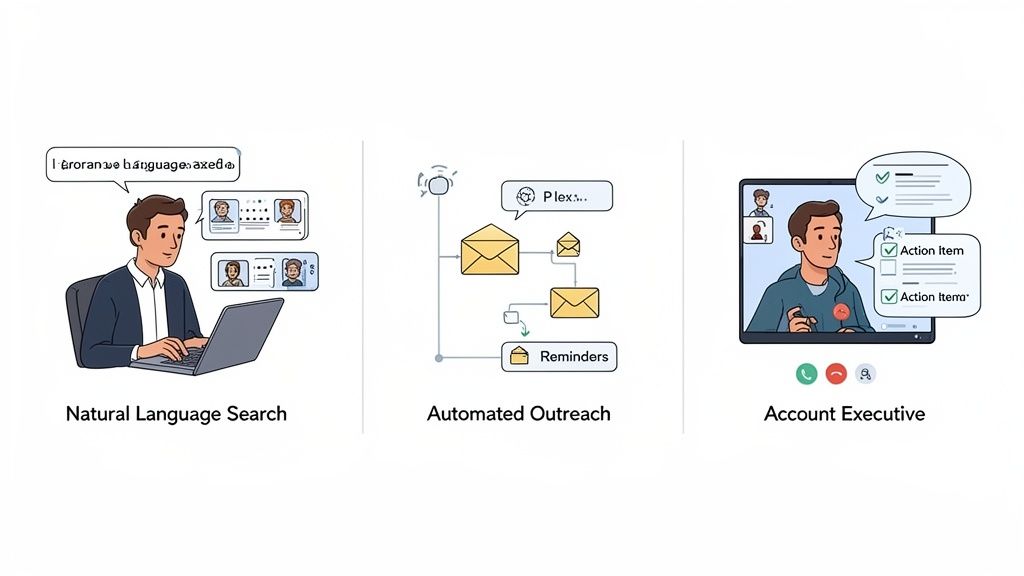
It’s one thing to understand the features of an AI sales enablement platform, but it’s another thing entirely to see how it works in the real world. The genuine value isn't in the tech itself—it's in how it slots into the daily grind of your sales team to make their lives easier and their work more impactful.
Let’s get out of the clouds and into the trenches. Here are some practical, step-by-step workflows that show how a unified platform changes the game for the key roles in a lean sales org: the SDR, the AE, and the founder.
The SDR's Prospect-to-Pipeline Workflow
For any Sales Development Rep, the mission is simple: build a pipeline of quality leads, and do it fast. The problem is, their days are often a slog of manual prospecting, list building, and copy-pasting emails. An AI platform completely flips that script, automating the grunt work so they can focus on what matters—having conversations.
Here’s what that looks like in practice:
Find 50 Ideal Prospects in Minutes: The SDR types a simple command into the platform, almost like a Google search: "Show me founders and heads of growth at B2B SaaS companies in North America with under 50 employees who recently raised funding." Instantly, they get a clean list of 50 qualified people, complete with verified contact info.
Enroll Them in a Sequence: Instead of one-by-one emails, the SDR selects the whole list and enrolls them in a pre-built, 5-step outreach sequence. This isn't just a basic autoresponder; it’s a smart series of emails and follow-ups spread out over two weeks.
Watch the Activity Log Itself: As the sequence runs, every single interaction—every email sent, opened, and replied to—is automatically logged on the contact’s timeline. No manual data entry. When a prospect replies with interest, they’re automatically flagged for the SDR to jump in and have a real conversation.
Actionable Insight: What used to be an entire day of mind-numbing prospecting and CRM updates is now condensed into less than an hour. Challenge your SDRs to use that reclaimed time to research the top 10% of their prospect list and add a hyper-personalized first line to their outreach emails. This combination of automation and human touch is unstoppable.
The AE's Discovery-to-Decision Workflow
Once a meeting is on the books, the Account Executive takes over. An AE's job is to run a great discovery call, dig into the customer’s pain points, and connect those problems to a solution. Their biggest challenge? Being fully present in the conversation while simultaneously trying to take notes, remember key details, and plan their follow-up.
This is where an AI sales enablement platform becomes an AE's co-pilot.
Run a Meeting, Get Perfect Notes: The AE just hosts the call like they normally would. In the background, the platform records, transcribes, and identifies who said what. More importantly, it pinpoints key decisions, competitor mentions, and action items without the AE having to jot anything down.
Get Instant Relationship History: Before the next call, the AE pulls up the contact’s unified timeline. They see everything in one place—the initial SDR outreach, notes from the last call, every email exchanged. This complete context means they can lead a much smarter, more strategic conversation.
Draft Follow-ups with AI: The moment the call ends, the AI drafts a follow-up email based on the meeting transcript. It summarizes the key discussion points and outlines the agreed-upon next steps. The AE just gives it a quick review, adds a personal touch, and hits send.
This process gives AEs a superpower, ensuring no detail slips through the cracks and every follow-up is perfectly timed and relevant. For a deeper dive, our guide on AI-powered sales tools has a ton of other ideas you can steal.
The Founder's High-Level Performance Workflow
In a startup, the founder is often the de facto head of sales. They don’t have time to get bogged down in clunky CRM reports. They need a crystal-clear, high-level view of what’s working, what isn't, and where the pipeline really stands.
An AI sales enablement platform delivers that clarity without the administrative headache.
There's a reason this market is exploding. The demand for these tools is projected to grow from USD 3.03 billion in 2025 to a staggering USD 10.2 billion by 2035. And with cloud-based platforms holding a dominant 96.3% market share, it's clear that lean, modern teams are driving this shift. You can explore more data about the AI sales tool market on Market.us.
For a founder, this means getting immediate answers to the most critical questions, right from a single dashboard:
Team Activity at a Glance: How many calls did the team make this week? How many new prospects were added to sequences?
Pipeline Health Overview: What’s the total value of the deals in our pipeline? How does it break down by stage?
Performance Hotspots: Which outreach sequences are getting the most replies? Which reps are booking the most meetings?
This instant visibility gives founders the power to make sharp, data-backed decisions on sales strategy—without ever having to build a custom report or pester their team for updates.
Measuring Success and Proving Platform ROI
Let's be real: investing in a new platform is a big deal. Any new tool you bring into your stack has to earn its keep with clear, measurable returns. When it comes to an AI sales enablement platform, proving its worth isn't about tracking fluffy activities. It's about drawing a straight line from the platform's features to the real business outcomes that show up on your bottom line.
You need to focus on results, not just effort. Forget counting how many calls were made and start measuring what those calls actually produced. The goal is to build a bulletproof business case that shows exactly how this technology is making your sales team more effective and your company more profitable.
Key Metrics for Tracking ROI
To truly see the impact of an AI sales platform, you need to know how to calculate ROI in a way that resonates with leadership. This starts by picking the right Key Performance Indicators (KPIs) to track before and after you flip the switch.
Here are three critical metrics that directly reflect the platform’s real-world value.
1. Time Reclaimed from Admin Tasks
Manual work is the silent killer of sales productivity. We’ve all seen the studies—reps often spend less than 30% of their time actually selling. The rest is lost to a black hole of administrative drag. An AI platform automates a huge chunk of this, so measuring time saved is a powerful way to prove its value from day one.
Metric: Hours saved per rep per week.
How to Track: Before rollout, survey your reps to estimate time spent on CRM data entry, writing follow-ups, and transcribing notes. Don't just ask for a number; have them log their time for three days to get a realistic baseline. Run the same log 30-60 days later and calculate the difference. Convert those saved hours into a dollar value using their loaded salary to show concrete financial impact.
2. Increased Meeting Bookings
Your SDRs need to be setting qualified meetings, not just sending emails into the void. An AI sales platform helps them find better leads and use automated outreach to engage them more effectively. This should translate directly into more appointments on your Account Executives' calendars.
Metric: Percentage increase in qualified meetings booked per SDR.
How to Track: Use your CRM or calendar data to establish a clear baseline for meetings booked per SDR per month over the previous quarter. After implementing the platform, track this same metric for a full quarter. The goal is to see a direct lift in the number of sales-qualified opportunities entering the pipeline.
3. Accelerated Sales Cycle Length
Time kills all deals. A faster sales cycle means revenue lands in the bank sooner. By giving reps instant access to a customer’s entire history and automating critical follow-ups, an AI platform cuts out the friction that slows deals down.
Metric: Reduction in average sales cycle length (in days).
How to Track: Pull a report from your CRM that measures the average time from the first touchpoint to a deal being marked "Closed-Won." This is your "before" picture. Track it again after a full sales quarter of using the platform to see if deals are closing faster. A shorter cycle is a direct indicator of increased efficiency.
Don't Forget the Qualitative Benefits
While hard numbers are your closing argument, the qualitative benefits are just as crucial for telling the full story. These "softer" metrics often have a massive, tangible impact on performance and long-term success.
A team that isn’t bogged down by administrative friction is a happier, more focused, and more motivated team. This boost in morale directly translates to better customer conversations and a stronger company culture.
Think about the impact on:
Higher Team Morale: When reps can focus on what they were hired to do—sell—job satisfaction skyrockets. This is your best defense against costly employee turnover.
Improved Focus: With AI handling the note-taking and CRM updates, your reps can be 100% present and engaged during customer calls. This leads to deeper discovery and better outcomes.
Better Onboarding: Imagine a new hire ramping up in weeks, not months. With a full library of recorded calls and a clear, unified workflow to follow, they can learn from the best and start contributing faster.
Getting Started Without the Implementation Headache
Let’s be honest: the thought of adopting new software often brings a wave of anxiety. Most of us have been burned by the six-month IT project, the endless configuration calls, and the lingering fear that we'll need a dedicated tech team just to get started. But a modern AI sales enablement platform isn't built that way.
The entire point is to get you value from day one. This is a complete departure from clunky enterprise tools that demand weeks of setup before you see a single benefit. For founders and lean teams, speed is everything, and these platforms are designed to move at your pace.
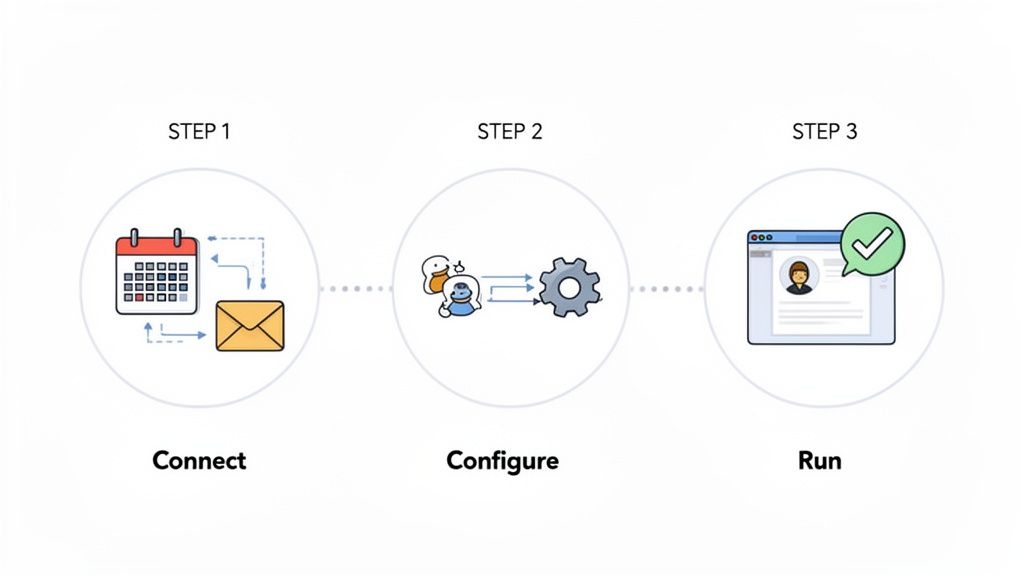
Your 3-Step Quick Start Plan
Getting up and running should take minutes, not months. The process is dead simple because it hooks into the tools you’re already using every single day. Here’s how you can get real value in under an hour.
Connect Your Core Accounts: First things first, you need to plug in your workhorse tools. This isn't complicated—with just a few clicks, you can link your Google or Outlook calendar, your Gmail or Outlook inbox, and your CRM. This single act creates the central nervous system for your sales operations.
Configure Your First Outreach Sequence: Now, put your prospecting on autopilot. Use the platform’s lead discovery to pull a small, targeted list of ideal prospects. Then, drop them into a simple 3-step email campaign. You’ve just launched an automated outreach engine before your coffee gets cold.
Run Your First AI-Powered Meeting: This is where the magic happens. Just run your next sales call exactly as you normally would. In the background, the platform will record, transcribe, identify who’s speaking, and spit out structured notes with clear action items. You’ll see firsthand how AI frees you up to just listen and connect with the buyer.
Actionable Insight: The beauty of a modern, unified platform is its immediacy. Don’t wait for a complex rollout. Start a free trial and task one rep with running this 3-step plan for a single day. The tangible results—the time saved, the notes generated—will be the most powerful internal case study you can create.
This rapid onboarding is a true game-changer for startups. Instead of fighting with your software, you can spend your time building relationships and closing deals. It’s proof that you can have enterprise-level power without the enterprise-level pain, giving you the confidence to scale your revenue engine fast.
Answering the Hard Questions About AI Sales Platforms
Whenever a new technology promises big changes, smart leaders get skeptical. And they should. An AI sales enablement platform isn't just another app; it’s a fundamental shift in how your revenue team operates.
It's completely normal to have a few tough questions. Based on my experience talking with hundreds of founders and sales leaders, these are the three that come up every single time. Here are the straight-up answers you're looking for.
Will This AI Replace My Sales Reps?
Let's clear this up right away: No. The goal is to make your reps superhuman, not redundant. An AI sales platform is designed to take over the thankless, low-value work that sellers absolutely hate.
Think about all the time they waste on CRM data entry, manually logging activities, or writing meeting summaries. That administrative grind can eat up 70% of a seller's week. This technology automates that grunt work, freeing your team to focus exclusively on the things only humans can do: building real relationships, navigating complex deal politics, and actually closing business.
Is This Only for Big Companies or Can My Startup Benefit?
This is a common misconception. While large enterprises use these tools, startups and smaller teams often see the most dramatic and immediate impact. Why? Because you get all the power without the bloat.
A unified platform gives you enterprise-grade tools—like sophisticated meeting intelligence and lead discovery—without the enterprise price tag or the need for a dedicated team to manage it all.
Actionable Insight: For a startup, an AI sales enablement platform is the ultimate equalizer. It packs the punch of five different sales tools into a single subscription, letting a small team build a scalable, professional revenue engine without needing a massive budget. This allows you to compete with larger, more established players on efficiency and execution, not just on headcount.
How Secure Is My Customer Data?
This is non-negotiable. Your customer data is your most valuable asset, and any platform you consider must treat it that way. Reputable AI sales platform vendors build their products on a foundation of enterprise-grade security from day one.
When you're vetting a partner, don't be shy about digging into their security posture. You need to see proof. Specifically, look for these table-stakes credentials:
Compliance Certifications: At a minimum, they must have SOC 2 Type II and be GDPR compliant. This is the industry standard for secure data handling.
Data Encryption: All your data must have end-to-end encryption, both when it's moving (in transit) and when it's stored (at rest).
Clear Privacy Policies: A partner you can trust will be completely transparent about how they store, handle, and protect your data. If their privacy policy is vague or hard to find, that's a major red flag.
Ready to stop stitching tools together and start building a real revenue engine? Glinky unifies your entire workflow in one AI-native platform. See how it works.
People also read
10 Sales Enablement Best Practices to Unify Your Revenue Engine in 2026
Productivity
Mar 13, 2026
How to Manage Sales Pipeline for Predictable Revenue Growth
Productivity
Mar 14, 2026
How to Qualify Leads in Sales Without Wasting Time
Productivity
Mar 17, 2026

What is Conversation Intelligence? A Practical Guide for Sales Teams
Productivity
Mar 18, 2026
Top 10 Sales Discovery Questions That Close More Deals
Productivity
Mar 25, 2026
Taking Minutes of Meeting: A Guide to Transforming Chaos into Action
Productivity
Feb 16, 2026
Action Items List: A Practical Guide to Drive Real Results
Productivity
Feb 19, 2026
Master the summary of a meeting for clear decisions and follow-ups
Productivity
Feb 22, 2026

Track Action Items: A Practical Guide to Using AI for Flawless Follow-Up
Productivity
Feb 17, 2026

Unlock: How to Take Notes on a Computer for Peak Productivity in 2026
Productivity
Feb 26, 2026
How to Record Google Meet: A Complete Guide for 2026
Productivity
Mar 4, 2026
12 Best AI Note Taking App Choices for 2026: The Definitive Guide
Productivity
Mar 6, 2026
How to Improve Customer Retention: Practical Tips to Boost Loyalty
Productivity
Mar 8, 2026
10 Client Communication Best Practices to Master in 2026
Productivity
Mar 7, 2026
The 12 Best AI Meeting Assistant Tools for 2026: A Deep Dive
Productivity
Mar 15, 2026

Your Guide to the Ultimate AI Email Writer
Productivity
Feb 27, 2026
10 Essential Customer Success Best Practices for 2026
Productivity
Mar 1, 2026
Your Guide to Sales Call Recording Software in 2026
Productivity
Mar 2, 2026

How to Take Better Meeting Notes and Drive Real Results
Productivity
Mar 5, 2026
Top 10 Picks for best crm for small business
Productivity
Mar 3, 2026
What is an Ideal Customer Profile: A Guide to Driving Growth
Productivity
Mar 9, 2026
Automated meeting minutes: Turn talks into actionable notes
Productivity
Mar 11, 2026
The Top 12 AI Powered Sales Tools to Boost Revenue in 2026
Productivity
Mar 16, 2026
AI Note Taking For Meetings: Fast, Smart AI Notes That Drive Collaboration
Productivity
Mar 19, 2026
Understanding Transcription Service Cost: A 2026 Guide
Productivity
Mar 20, 2026
Master Your Meetings With The Note Taking Charting Method
Productivity
Feb 18, 2026
The Ultimate 2026 Guide: 8 Meeting Follow Up Email Template Scenarios
Productivity
Feb 20, 2026
Master the Art of Taking Meeting Notes for Actionable Outcomes
Productivity
Feb 25, 2026
12 Best Sales Lead Generation Tools to Boost Your Pipeline in 2026
Productivity
Mar 10, 2026

Translation Vs Transcription: Which Service Do You Really Need?
Productivity
Mar 12, 2026
Mastering the goals of a meeting to drive decisions and boost team alignment
Productivity
Mar 23, 2026
The 12 Best Free AI Email Writer Tools for 2026
Productivity
Mar 22, 2026
Automate Follow Up Emails: Actionable Insights for Boosting Sales & Efficiency
Productivity
Mar 26, 2026

Follow Up Email Subjects That Convert: Increase Opens and Replies
Productivity
Feb 17, 2026

Your Playbook for Outbound Lead Generation in 2026
Productivity
Feb 28, 2026
Your Essential Meeting Action Items Template to Drive Results
Productivity
Feb 23, 2026
Your Guide to Using an Email Writer AI for Maximum Impact
Productivity
Feb 23, 2026
8 Essential Ground Rules at Meetings to Maximize Productivity in 2026
Productivity
Mar 24, 2026

Otter.ai vs Glinky
Productivity
Feb 5, 2026
AI Tools for Startup Founders [2026]
Productivity
Feb 4, 2026
Best AI Tools for Startups [2026]
Tools
Feb 3, 2026
Sales Call Notes: How to Capture Every Detail Without Losing the Deal
How to
Feb 2, 2026
How to Take Meeting Notes: 7 Methods That Actually Work [2026]
How to
Jan 14, 2026
![AI Meeting Minutes | Free Forever [2026]](https://framerusercontent.com/images/zYQGRjgLX63tiouLTK65LvCcjK8.png?width=402&height=263)
AI Meeting Minutes | Free Forever [2026]
How to
Jan 13, 2026
![How to Record Zoom Meetings Without a Bot [2026] 3 Easy Methods](https://framerusercontent.com/images/gGoQV8bPb9zR5weVruinbjaxO0.png?width=402&height=263)
How to Record Zoom Meetings Without a Bot [2026]
How to
Jan 9, 2026
Bot-Free AI Meeting Notes: We Tested the 6 Best Tools in 2026
Tools
Jan 8, 2026
Glinky vs Fireflies.ai
Tools
Jan 7, 2026
15 Best AI Tools to Boost Your Productivity in 2026
Productivity
Jan 6, 2026