Nov 13, 2025
Productivity
How to Qualify Leads in Sales Without Wasting Time
Learning how to qualify leads is the single most important skill in sales. It’s not about ticking boxes on a checklist; it’s about confirming three non-negotiable truths before you invest a single minute of your time: they have a real, nagging pain; they have the power to actually fix it; and they have the money to pay for your solution.
Getting this right is the fastest way to stop chasing ghosts and start closing real deals.
Stop Chasing Bad Leads and Start Closing Qualified Buyers
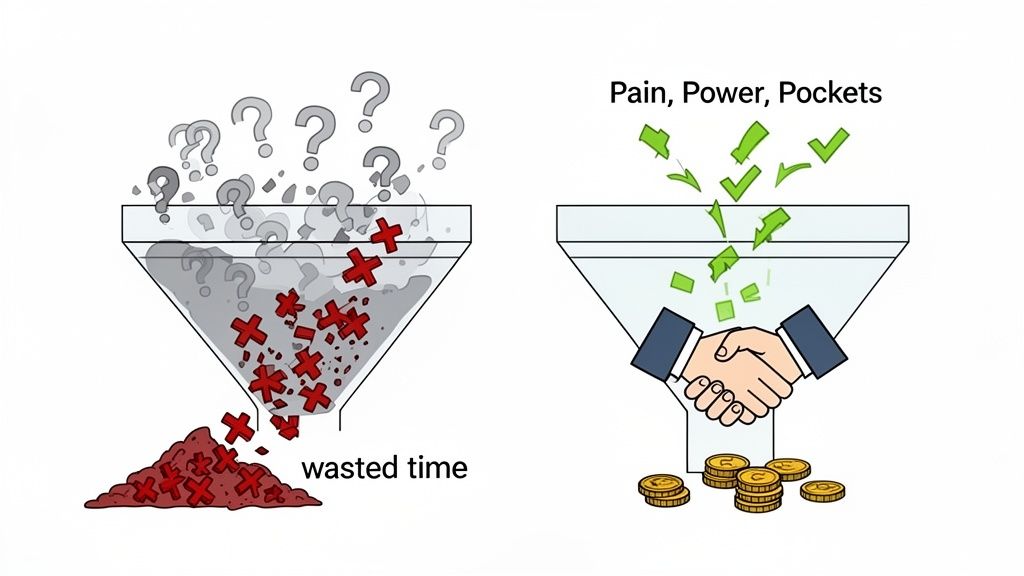
We’ve all been there. Your rep spends weeks nurturing a lead, running perfect demos, and crafting a killer proposal. Then comes the gut punch: "This looks great, but I'll need to get it into the budget for next year." It’s not just a frustrating moment; it’s a massive revenue leak you can’t afford.
Poor qualification is the silent killer of sales pipelines. The numbers are shocking: an estimated 67% of lost deals are a direct result of reps failing to qualify leads properly from the start. That means two out of every three deals you lose were dead on arrival.
The True Cost of a Bad Lead
Chasing unqualified leads doesn't just waste time—it actively harms your business. The ripple effects are serious:
It inflates your pipeline with deals that will never, ever close, giving you a dangerously false sense of security.
It burns out your sales team on opportunities that were destined to fail, tanking morale and driving up turnover.
It skyrockets your customer acquisition cost (CAC) because your reps are spending precious resources on non-buyers.
With studies showing that only 25% of marketing-generated leads are actually ready for a sales conversation, a strong qualification filter isn't just nice to have. It's mission-critical.
The Three Pillars of a Truly Qualified Lead
Before you dive into complex frameworks, get back to basics. A truly qualified lead must meet three hard criteria. If even one is missing, they are not a qualified lead—at least not right now.
Think of it as a three-legged stool. If one leg is missing, the whole thing collapses. You can have a decision-maker with a huge budget, but if they don't feel any real, measurable pain, there's no urgency to buy. You can sell to homeless people who have both the pain and the decision-making power, but if they have no budget—it won't work. All three must be in place.
This simple "Pain, Power, and Budget" mindset instantly sharpens your focus. And it all starts with having a crystal-clear picture of who you're selling to. If you haven't nailed this down, check out our guide on what is an ideal customer profile.
Here's a quick-reference guide to the three essential criteria for identifying a sales-qualified lead. If a prospect doesn't meet all three, they aren't ready for your sales team.
The Three Pillars of a Truly Qualified Lead
Criteria | What It Really Means | Why It Is Non-Negotiable |
|---|---|---|
Real & Measurable Pain | The prospect has a tangible problem with a clear, negative impact on their business (e.g., lost revenue, high costs, customer churn). | Without a recognized, measurable pain, there's no urgency. This is the core driver that creates the "why now?" factor for any purchase. |
Decision-Making Power | The contact has the authority and power to pay to resolve the pain—either by signing the contract themselves or having a direct line to that person. | Selling to someone without power results in endless internal loops, stalls, and getting stuck on "maybe" indefinitely. |
Sufficient Budget | The prospect's organization has allocated funds or can realistically access the financial resources required for your solution. | A prospect can have immense pain and power, but if the organization cannot afford your solution, it's not a real opportunity. |
Nailing these three pillars is the foundation of a high-performing sales process. It ensures your team spends their valuable time on deals that can actually close, driving revenue and building momentum.
Mastering Discovery and Asking the Right Questions
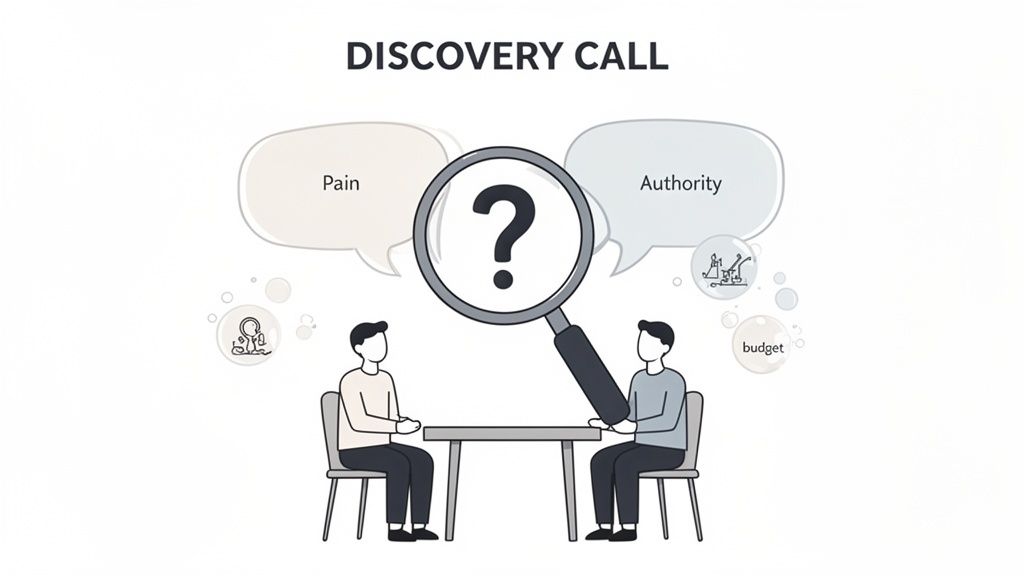
Okay, so you've confirmed a lead fits your basic Ideal Customer Profile (ICP). Now the real work begins. This is where deals are won or lost, long before a proposal is ever sent.
A discovery call isn't an interrogation—it's a consultation. Your mission is to dig deeper than surface-level chatter to find out if this prospect has the pain, the power, and the budget to actually become a customer. Get this right, and you earn the right to move forward.
By asking smart, open-ended questions, you let them tell you their problems in their own words. They feel heard, not sold to. Meanwhile, you're gathering the intel you need to qualify them with complete confidence.
Probing for Real and Measurable Pain
The first thing you absolutely must uncover is pain. No real, tangible problem means no urgency. And no urgency means no deal. It's that simple.
Forget generic questions like, "What keeps you up at night?" You need to ask questions that make them quantify their struggles.
"What happens if you do nothing about this problem for another quarter? For another year?" This question is brilliant because it forces them to visualize the cost of sitting still, creating a natural sense of urgency.
"Can you walk me through how your team handles [specific process] today?" This helps you pinpoint the bottlenecks and hidden frustrations they might not even see as a “pain point” yet.
"How are you currently measuring success for this area of the business?" Their answer hands you the exact metrics and KPIs they care about, giving you a roadmap to connect your solution directly to what matters.
The goal here is to shift the conversation from vague complaints to hard business impact. When you hear a prospect say things like, "we're losing 15 hours per rep each week" or "our churn rate has jumped by 5%," you’ve hit pay dirt. You're no longer just selling a feature; you're selling a solution to a real, expensive problem.
Key Takeaway: If a prospect can't articulate the specific, negative impact of their problem, they don't feel enough pain to buy. Vague problems always lead to stalled deals.
Identifying True Decision-Making Power
Selling to an enthusiastic fan who has zero buying power is one of the oldest and most frustrating traps in sales. You can have the world's best champion, but if they can't sign the contract or get the budget approved, your deal is going nowhere fast.
Your job is to tactfully map out the decision-making tree without making your contact feel small. The best way to do this is by leaning on proven Sales Qualification Frameworks like BANT or MEDDPICC to guide your questions.
Here’s how you can probe for power without being pushy:
"Who else on your team is typically involved in evaluating new tools like this?" This is a collaborative, non-threatening way to ask who else you need on your side.
"What does your typical purchasing process look like for a solution at this price point?" This uncovers the formal hoops you'll have to jump through—security reviews, legal, finance, you name it.
"Besides yourself, who would be most impacted by this decision?" This is a great way to identify other key stakeholders you might need to win over.
Keeping track of who said what and the agreed-upon next steps is absolutely critical. To capture every detail without interrupting the conversation's flow, check out our guide on how to take much better sales call notes.
Spotting Red Flags and Green Flags
As you guide the conversation, you need to listen for what’s said—and what isn’t. Certain phrases and behaviors are dead giveaways about the health of your deal.
Green Flags (Signals to keep going):
They use "we" instead of "I," showing it's a team-wide problem.
They mention specific metrics and KPIs they're trying to hit.
They ask detailed questions about implementation, pricing, and onboarding.
They proactively suggest bringing other people into the next conversation.
Red Flags (Signals to disqualify or proceed with caution):
They get vague or dodge questions about budget or timeline.
They're obsessed with features but can't connect them to a business problem.
They resist bringing in other stakeholders or decision-makers.
One of the biggest red flags is what we call the "postponement pile-up." When a lead shows interest but gives you two or more reasons to delay a decision, you’ve probably lost them. If you hear, "I have to discuss this with my wife, my manager, get it into the budget and circle back with the team," they are out. You can't close four objections at once.
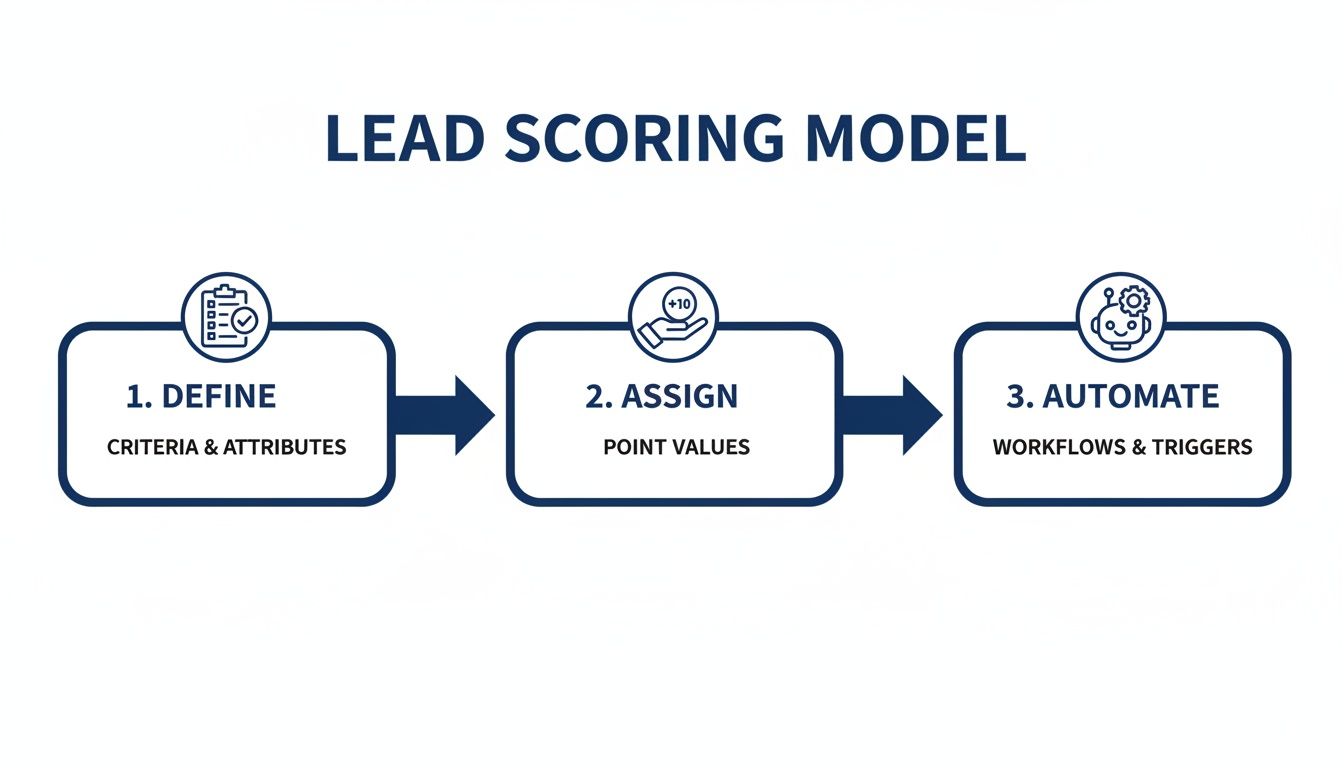
Building a Practical Lead Scoring Model
Once you master asking the right questions, you'll have a pipeline full of leads at all different stages. But here’s the hard truth: not all leads are created equal. Treating them that way is the fastest route to burning out your sales team on dead-end conversations.
A lead scoring model is your secret weapon for this. It's how you prioritize your team's valuable time on the opportunities that are actually likely to close. This isn’t about building some monstrously complex spreadsheet. It's about creating a simple, practical system that automatically surfaces your hottest leads so your closers can focus on what they do best—closing.
Defining Your Scoring Criteria
First, you need to get crystal clear on what a good lead actually looks like. Think about your absolute best customers. What do they all have in common? Your scoring model will assign points based on those shared traits and actions.
Break it down into three core categories:
Firmographics: These are the hard facts about a company—their industry, company size, and location. If you sell to B2B SaaS companies with 50-250 employees, a lead matching that exact profile should get a healthy point boost right away.
Engagement Behaviors: This is all about tracking how a lead interacts with you. Someone visiting your pricing page is screaming intent much louder than someone who just downloaded a top-of-funnel blog post. Score them accordingly.
Explicit Qualification Data: This is the gold you unearth during discovery calls. When a rep confirms a lead has the budget, a clear timeline, and is the decision-maker, that lead's score should skyrocket.
This simple system turns fuzzy "interest" into a concrete number. A whitepaper download might be worth 5 points, but a demo request? That’s an immediate 40 points. This guarantees your reps are always aimed at the highest-impact targets. If you really want to dial this in, you can dig into advanced lead scoring best practices for more granular ideas.
A Simple Lead Scoring Template to Get Started
Building a scoring model from scratch can feel like a huge task, but you don't need to boil the ocean. You can start with a simple foundation and refine it as you learn what really signals buying intent for your business.
Use this starter template to build your own lead scoring model. Assign points based on lead characteristics and actions that signal a good fit for your business.
Category | Attribute or Action | Suggested Points | Rationale |
|---|---|---|---|
Role/Title | C-Level or Founder | +25 | Highest decision-making authority. |
Firmographics | Ideal Industry (e.g., B2B SaaS) | +20 | Matches your most successful customer profile. |
Firmographics | Ideal Company Size (e.g., 50-250) | +15 | Falls within your target customer segment. |
High-Intent Behavior | Demo Request | +40 | The strongest signal of active buying intent. |
High-Intent Behavior | Pricing Page Visit | +30 | Indicates serious consideration and budget awareness. |
Engagement | Case Study Download | +15 | Shows interest in proven results and solutions. |
Explicit Qualification | Confirmed Budget & Timeline | +50 | Directly confirms two of the three qualification pillars. |
This kind of automated sorting is far more than an efficiency hack; it has a huge impact on team morale by making sure reps aren't stuck chasing ghosts. By systematizing this part of your workflow, you can more effectively manage your sales pipeline and keep everyone focused on real revenue.
The data backs this up. A staggering 79% of marketing leads fail to convert simply because they aren't properly nurtured or vetted. Worse, only 56% of B2B firms even bother to verify leads before tossing them over the fence to sales. High-performing teams know this is a losing game and are shifting to a model of fewer, hyper-qualified touches to free up time for what matters: winning deals.
This structured approach to sorting leads ensures your sales reps are always focused on the hottest opportunities first. It replaces guesswork with a data-driven system, dramatically improving efficiency, forecast accuracy, and team morale.
When you implement a clear scoring model, you're doing more than just organizing leads. You're engineering a smarter, more predictable revenue engine.
Automate and Accelerate: Your Playbook for AI-Powered Qualification
Let's be blunt: manual lead qualification is a growth killer. It’s a slow, error-prone grind that ties up your best reps in administrative muck instead of letting them do what they do best—run demos and close deals.
The smartest sales teams aren't just working harder; they're fundamentally redesigning their process with automation and AI. Instead of wrestling with five different tools, they use a unified revenue engine like Glinky to bring the entire workflow into a single, cohesive system. This is about moving from operational chaos to an intelligent, automated machine that connects lead discovery, outreach, and meeting intelligence so nothing ever gets dropped.
Pinpoint Your Ideal Buyers with AI Search
Qualification starts long before the first call. It starts with finding the right people to talk to. You could have a world-class product and the perfect pitch, but if you're aiming at the wrong audience, you're just shouting into the void. This is where AI search is a genuine game-changer.
Think about a founder who needs to connect with VPs of Marketing at B2B SaaS companies with 50-200 employees in North America. The old way involved days of tedious LinkedIn scraping. The new way? Using an AI-powered search to generate a hyper-accurate list of prospects matching their Ideal Customer Profile (ICP) in seconds.
If you properly define your ICP from the start, AI-powered search allows you to get very high accuracy on your prospect lists. This increases the qualification of your leads in magnitudes because you're starting with the right audience.
This precision is your first, and most important, qualification filter. It means every bit of outreach effort is focused on prospects who are already a strong fit, dramatically improving the quality of every conversation you have down the line.
This ability to instantly generate lists of perfect-fit prospects with verified contact data completely removes the most soul-crushing part of prospecting.
Automate Nurturing to Surface Intent
With your target list ready, the next move is engaging them at scale without sounding like a robot. This is where automated outreach sequences come in, letting you enroll contacts into a multi-step campaign that runs on its own.
You can build a smart sequence that automatically:
Sends an initial intro email that references a prospect’s specific role or industry.
Follows up two days later with a relevant case study.
Sends a final "breakup" email a week later to spark a reaction.
This isn’t just about sending emails; it’s about pre-qualification through engagement. A prospect who opens every email and clicks your case study is demonstrating real intent. They automatically bubble to the top of your priority list, while the unengaged contacts are left for the system to nurture. This systematic approach ensures your reps only spend their valuable time on prospects who are already raising their hands.
Turn Every Conversation into Qualification Gold
The final piece of the puzzle clicks into place during and after your discovery calls. Forget frantically scribbling notes while trying to listen. Modern meeting intelligence tools can automatically record, transcribe, and summarize your sales conversations.
This technology is a massive lever for qualification. AI-powered call summaries and analytics allow your reps to come back to the conversation and analyze it without the blur they might have in the moment. This helps them:
Confirm Key Criteria: Easily review the transcript to double-check that the prospect's pain, power, and budget were clearly established.
Spot Missed Signals: Catch subtle red flags or buying signals that were missed during the live conversation.
Improve Over Time: Analyze what questions lead to the best qualification data and refine their approach for future calls.
This gives you a complete, unified picture of every opportunity, making your qualification process faster, sharper, and built to scale.
Tracking the Sales Metrics That Actually Matter
Let’s be honest. Most sales dashboards are filled with noise. Call volume, emails sent, meetings booked—these are activity metrics. They might make you feel busy, but they don’t tell you a thing about whether your qualification process is actually working.
If you’re serious about building a predictable revenue machine, you have to look past the vanity numbers. You need to zero in on the Key Performance Indicators (KPIs) that connect directly to pipeline health and closed deals. These are the metrics that act as your diagnostic tool, showing you exactly where the process is breaking down so you can fix it.
Moving from MQL to SQL
One of the most telling numbers on any dashboard is your Marketing Qualified Lead (MQL) to Sales Qualified Lead (SQL) Conversion Rate. This metric cuts right to the chase: what percentage of leads marketing sends over are actually good enough for your sales team to accept?
A low conversion rate here is a massive red flag. It’s almost always a sign of a fundamental disconnect between what marketing thinks is a good lead and what sales knows is a real opportunity. When this number drops, your reps are forced to waste time on dead-end conversations, tanking morale and slowing down the entire pipeline.
What it reveals: A breakdown in the critical handoff between sales and marketing.
What to do: If this rate is low (say, under 20%), get a meeting on the books with marketing immediately. Your goal is to realign on the definition of an SQL and recalibrate your lead scoring model.
Tracking this single rate creates a powerful feedback loop. It forces both teams to stay on the same page and ensures only high-potential leads ever make it into the sales funnel.
Measuring Sales Cycle Velocity
How long does it take for a newly qualified lead to sign on the dotted line? That's your Sales Cycle Length, and it's a direct reflection of your qualification efficiency. If deals are dragging on forever, it often means your reps are getting bogged down with prospects who lack real urgency or buying authority.
In sales, speed is a weapon. The data doesn't lie: responding to an inbound lead within the first 5 minutes can boost your odds of converting them by an incredible 9x.
And the flip side? A shocking 81.2% of companies that take more than an hour to follow up end up losing those leads to faster competitors. You can dig into more of these eye-opening lead generation statistics to see just how much speed matters.
If your sales cycle feels like a marathon, it’s time to look at your initial qualification questions. Are you effectively digging for pain and manufacturing urgency, or are you just letting unqualified leads clog up the pipeline for months on end?
From Qualified to Closed
At the end of the day, it's all about winning deals. Your SQL-to-Close Rate tells you what percentage of your sales-qualified leads ultimately become paying customers. This is the ultimate bottom-line metric for your entire qualification process.
A strong SQL-to-close rate is proof that your team is successfully identifying prospects who have the genuine pain, authority, and budget to make a purchase. If this number is weak, you likely have one of a few problems:
Your qualification criteria are too loose, letting unqualified leads slip through.
Your reps aren't effectively communicating value later in the sales process.
There’s a fundamental mismatch between your product or price and the market you’re targeting.
By focusing on these three core metrics—MQL-to-SQL Conversion, Sales Cycle Length, and SQL-to-Close Rate—you can stop guessing. You gain a clear, data-driven picture of what’s working and what’s broken in your lead qualification playbook.
Monitoring these numbers isn't about building pretty reports. It’s about taking decisive action. Use this data to diagnose problems, coach your reps, and constantly refine your approach. This is how you move from chaos to a predictable revenue engine that scales.
Your Top Lead Qualification Questions, Answered
Even with the best playbook, you’re going to run into tricky situations on the ground. Let’s tackle some of the most common questions from founders and sales leaders as they dial in their qualification process.
What are the three absolute, non-negotiable criteria for a real lead?
It's that simple, and all three should be there. Forget complex frameworks for a moment and focus on these three hard criteria. If one is missing, you don't have a deal.
Real, Measurable Pain: The prospect has an existing pain that is real and measurable for them. If the pain isn't felt or quantifiable, but the person is a decision-maker with a budget, it won't work.
Decision-Making Power: The person you're talking to has the power to pay to resolve their pain. They are the one who can make the final call and sign the check.
Sufficient Budget: They have enough budget to afford your solution. If you sell courses to homeless people who have both the pain and decision-making power but no budget, it won't work.
All three must be in place. Think of it like a three-legged stool: if one leg is missing, the whole thing collapses. You can have the pain and the power, but no budget means no deal. You can have the budget and the power, but no pain means no urgency.
What's a deal-breaking red flag you spot in the discovery stage?
One of the biggest red flags to disqualify a deal is what I call the "postponement pile-up." This happens when the lead shows interest but gives you two or more reasons to postpone a decision.
For example, if you hear a string of excuses like, "I have to discuss this with my wife, my manager, get it into the budget and circle back with the team,"—they are out. You can't close four objections at once. It's a polite but firm no. When a lead starts stacking multiple delay tactics, you’ve likely lost them.
How much faster can reps qualify leads with AI?
The improvement is massive, especially in accuracy, which is the most important part of qualification. It happens in two key ways:
First, AI-powered search allows you to get very high accuracy on your Ideal Customer Profile (ICP). This increases the qualification of leads in magnitudes if you properly define your ICP from the start. You're beginning the process with a much higher quality pool of prospects.
Second, call summary and analytics tools allow reps to come back to the conversation and analyze it without the blur they might have in the moment. It removes guesswork and helps them confirm that all qualification criteria were actually met, catching subtle details they might have missed live.
Ready to stop stitching together five different tools and unify your revenue workflow? Glinky combines lead discovery, automated outreach, and meeting intelligence into a single, AI-native platform built for founders and small businesses. Discover, engage, and close more deals with less manual work. See how it works at Glinky.
People also read
10 Sales Enablement Best Practices to Unify Your Revenue Engine in 2026
Productivity
Mar 13, 2026
How to Manage Sales Pipeline for Predictable Revenue Growth
Productivity
Mar 14, 2026

What is Conversation Intelligence? A Practical Guide for Sales Teams
Productivity
Mar 18, 2026
Top 10 Sales Discovery Questions That Close More Deals
Productivity
Mar 25, 2026
Taking Minutes of Meeting: A Guide to Transforming Chaos into Action
Productivity
Feb 16, 2026

Action Items List: A Practical Guide to Drive Real Results
Productivity
Feb 19, 2026
Master the summary of a meeting for clear decisions and follow-ups
Productivity
Feb 22, 2026

Track Action Items: A Practical Guide to Using AI for Flawless Follow-Up
Productivity
Feb 17, 2026

Unlock: How to Take Notes on a Computer for Peak Productivity in 2026
Productivity
Feb 26, 2026
How to Record Google Meet: A Complete Guide for 2026
Productivity
Mar 4, 2026

12 Best AI Note Taking App Choices for 2026: The Definitive Guide
Productivity
Mar 6, 2026
How to Improve Customer Retention: Practical Tips to Boost Loyalty
Productivity
Mar 8, 2026

10 Client Communication Best Practices to Master in 2026
Productivity
Mar 7, 2026
The 12 Best AI Meeting Assistant Tools for 2026: A Deep Dive
Productivity
Mar 15, 2026

Your Guide to the Ultimate AI Email Writer
Productivity
Feb 27, 2026

10 Essential Customer Success Best Practices for 2026
Productivity
Mar 1, 2026
Your Guide to Sales Call Recording Software in 2026
Productivity
Mar 2, 2026
How to Take Better Meeting Notes and Drive Real Results
Productivity
Mar 5, 2026
Top 10 Picks for best crm for small business
Productivity
Mar 3, 2026
What is an Ideal Customer Profile: A Guide to Driving Growth
Productivity
Mar 9, 2026
Automated meeting minutes: Turn talks into actionable notes
Productivity
Mar 11, 2026

The Top 12 AI Powered Sales Tools to Boost Revenue in 2026
Productivity
Mar 16, 2026
AI Note Taking For Meetings: Fast, Smart AI Notes That Drive Collaboration
Productivity
Mar 19, 2026
Understanding Transcription Service Cost: A 2026 Guide
Productivity
Mar 20, 2026
Master Your Meetings With The Note Taking Charting Method
Productivity
Feb 18, 2026
The Ultimate 2026 Guide: 8 Meeting Follow Up Email Template Scenarios
Productivity
Feb 20, 2026
Master the Art of Taking Meeting Notes for Actionable Outcomes
Productivity
Feb 25, 2026
12 Best Sales Lead Generation Tools to Boost Your Pipeline in 2026
Productivity
Mar 10, 2026

Translation Vs Transcription: Which Service Do You Really Need?
Productivity
Mar 12, 2026
Mastering the goals of a meeting to drive decisions and boost team alignment
Productivity
Mar 23, 2026

The 12 Best Free AI Email Writer Tools for 2026
Productivity
Mar 22, 2026
A Guide to AI Sales Enablement Platforms in 2026
Productivity
Mar 21, 2026
Automate Follow Up Emails: Actionable Insights for Boosting Sales & Efficiency
Productivity
Mar 26, 2026

Follow Up Email Subjects That Convert: Increase Opens and Replies
Productivity
Feb 17, 2026
Your Playbook for Outbound Lead Generation in 2026
Productivity
Feb 28, 2026
Your Essential Meeting Action Items Template to Drive Results
Productivity
Feb 23, 2026

Your Guide to Using an Email Writer AI for Maximum Impact
Productivity
Feb 23, 2026
8 Essential Ground Rules at Meetings to Maximize Productivity in 2026
Productivity
Mar 24, 2026

Otter.ai vs Glinky
Productivity
Feb 5, 2026

AI Tools for Startup Founders [2026]
Productivity
Feb 4, 2026
Best AI Tools for Startups [2026]
Tools
Feb 3, 2026
Sales Call Notes: How to Capture Every Detail Without Losing the Deal
How to
Feb 2, 2026
How to Take Meeting Notes: 7 Methods That Actually Work [2026]
How to
Jan 14, 2026
![AI Meeting Minutes | Free Forever [2026]](https://framerusercontent.com/images/zYQGRjgLX63tiouLTK65LvCcjK8.png?width=402&height=263)
AI Meeting Minutes | Free Forever [2026]
How to
Jan 13, 2026
![How to Record Zoom Meetings Without a Bot [2026] 3 Easy Methods](https://framerusercontent.com/images/gGoQV8bPb9zR5weVruinbjaxO0.png?width=402&height=263)
How to Record Zoom Meetings Without a Bot [2026]
How to
Jan 9, 2026

Bot-Free AI Meeting Notes: We Tested the 6 Best Tools in 2026
Tools
Jan 8, 2026

Glinky vs Fireflies.ai
Tools
Jan 7, 2026
15 Best AI Tools to Boost Your Productivity in 2026
Productivity
Jan 6, 2026