Nov 13, 2025
Productivity
Mastering the goals of a meeting to drive decisions and boost team alignment
Let's be blunt: what's the point of a meeting? It’s not just to talk. The goal is to drive a specific, pre-defined outcome—making a key decision, aligning the team on a clear plan, or generating a list of actual next steps.
Without that sharp focus, a meeting is just an expensive conversation. Every meeting should be a strategic investment with a measurable return, not just another block on the calendar. This guide provides actionable insights to help you set and achieve clear meeting goals, transforming them into powerful drivers of productivity and growth.
Why Clear Meeting Goals Are Your Greatest Growth Engine
Unproductive meetings don't just waste time; they actively sabotage your growth. Think of a meeting without a goal as a ship without a rudder. It just drifts, pushed around by random tangents and side conversations, and ultimately ends up nowhere.
This isn't just a feeling; it's a massive hidden cost. The average employee spends a staggering 392 hours a year in meetings. That’s more than 16 full workdays lost to discussions that often go completely off the rails. You can see just how bad it gets in these eye-opening meeting statistics.
Defining a clear purpose ahead of time is the antidote. When you establish a specific objective, you create a filter for every agenda item and discussion point. It’s your North Star, keeping the conversation productive and locked on target.
From Vague Objectives to Actionable Goals
The first step is a simple mental shift: reframe those fuzzy, common meeting objectives into sharp, actionable goals. This one change instantly improves focus and makes it crystal clear to everyone why they’re in the room in the first place. You move from ambiguity to action.
"A meeting without a clear goal is like starting a road trip without a destination. You'll burn a lot of fuel and end up somewhere you never intended to be. The goal is your GPS—it guides every turn and keeps you on the most efficient path to your desired outcome."
This is how you instantly upgrade your meetings. Watch how we transform those typical, ineffective objectives into goal-oriented powerhouses that drive real results.
From Vague Objectives to Actionable Meeting Goals
Vague Objective (The Problem) | Actionable Goal (The Solution) | Key Outcome |
|---|---|---|
"Let's touch base on the Q4 marketing plan." | "Finalize and approve the top three marketing channels for the Q4 launch, with budget allocated to each." | A locked-in Q4 marketing strategy with clear budget assignments. |
"We need to discuss the new website design." | "Decide on one of the two proposed homepage mockups and create a list of five specific revision requests for the chosen design." | A clear decision on the website's direction and actionable feedback for the design team. |
"Let's review last quarter's sales performance." | "Identify the top two reasons for missed sales targets and brainstorm three actionable strategies to address them in the next 30 days." | A root-cause analysis and a concrete action plan for sales improvement. |
See the difference? One is a suggestion to talk; the other is a mandate to decide. This simple reframing ensures that when the meeting ends, something has actually changed.
The Three Types of Goals Your Meetings Should Have
Not all meetings are created equal, so why would their goals be? You wouldn't bring a brainstormer's whiteboard to a final contract signing, and the same logic applies here. The secret to a killer meeting is matching its goal to its core purpose. Get this right, and a generic discussion transforms into a focused, high-impact session.
This is all about turning a fuzzy idea into a concrete outcome. A well-defined goal is the bridge that gets you there.
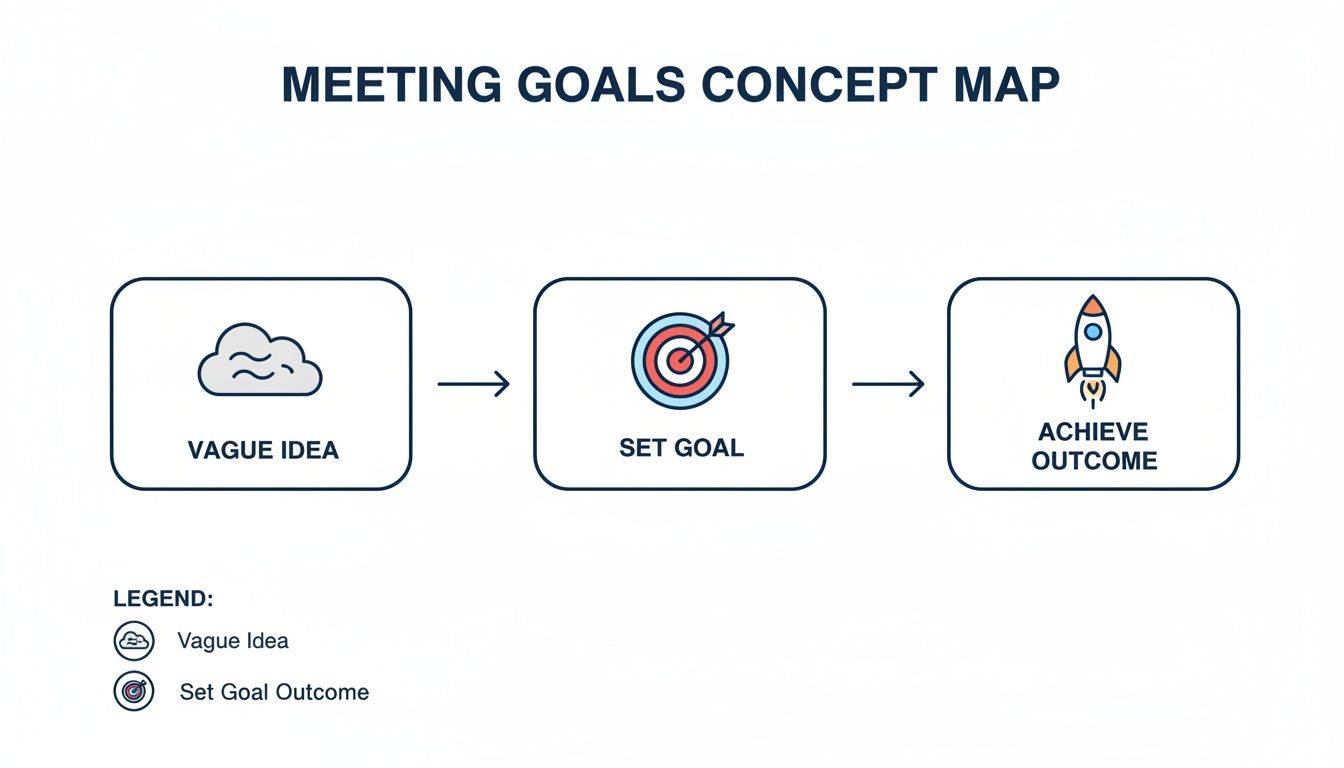
As you can see, the goal is what gives an idea momentum and turns it into real action. So, let’s break down the three fundamental types of goals you should be setting.
1. Decisional Goals for “Crossroads” Meetings
Think of these as your “Crossroads Meetings.” The whole point is to make a choice. The team has hit a fork in the road, and the goal is to leave the meeting having collectively picked a path forward. Ambiguity is the enemy; the objective is to walk out with a firm, binding decision.
These goals demand a clear "yes," "no," or a definitive selection from a handful of options. They’re all about commitment and momentum.
Sales Example: "By the end of this 30-minute call, we will qualify or disqualify Prospect X based on our ideal customer profile."
Marketing Example: "Approve the final creative for the Q3 campaign or provide a single, consolidated list of final revisions."
Operations Example: "Decide whether to renew our current software subscription or move forward with Vendor B’s proposal."
2. Informational Goals for “Town Hall” Meetings
Next up are the “Town Hall Meetings.” Here, the primary goal is pure alignment and creating a shared understanding. You're not there to debate or decide, but to make sure every single person gets the same critical information, in the same way, at the same time. This is how you kill confusion and keep the team marching in lockstep.
An informational goal is a success when every attendee leaves the room with the same clear, accurate picture of the situation. It’s about creating a single source of truth that prevents misalignment down the road.
The entire focus is on distributing knowledge. A successful informational meeting means no one can ever say, "Well, I didn't know that."
3. Generative Goals for “Whiteboard” Meetings
Finally, we have our “Whiteboard Meetings.” The goal here is simple: creation. These sessions are built for brainstorming, untangling tough problems, and generating brand-new ideas from scratch. Success isn't measured by a final decision, but by the sheer volume and quality of new possibilities you put on the table.
Generative goals create a sandbox for creativity. They give your team the freedom to explore wild ideas without the immediate pressure of having to commit to one.
Product Example: "Brainstorm a list of at least 10 potential new features for the next product update."
Creative Example: "Generate three distinct campaign concepts for the new product launch, each with its own unique tagline."
By first identifying what kind of meeting you’re running—a crossroads, a town hall, or a whiteboard session—you can set the precise goals of a meeting needed to guarantee a valuable outcome every single time.
How to Craft SMART Goals for High-Stakes Meetings
Knowing you need a goal is the easy part. Actually writing one that prevents a meeting from spiraling into a pointless conversation? That’s a different game entirely.
The single best way to bring surgical precision to your meeting objectives is by using the SMART framework. Think of it as a simple, powerful checklist that turns a vague intention like "let's talk about the pipeline" into a concrete, time-bound mission. It’s the difference between a chat and a decision.
A SMART goal is Specific, Measurable, Achievable, Relevant, and Time-bound. This structure forces clarity and eliminates ambiguity before anyone even joins the call.
The real disease plaguing most meetings isn't the length; it's the lack of accountability. A SMART goal forces you to define what winning looks like before the meeting starts, making it painfully obvious when the conversation drifts off track.
When goals are fuzzy, meetings multiply. It's a frustratingly common cycle—a staggering 77% of employees report that unproductive meetings lead directly to… you guessed it, another meeting just to get a decision. Considering 57% of meetings don't even have an agenda, it's no shock that only 33% end with a clear outcome.
From Vague Intention to Actionable Mission
Let's walk through a real-world example. Your team has a meeting on the calendar with the goal: "Discuss the Q3 sales pipeline."
It sounds productive, but it's not. It’s a passive invitation for a meandering discussion with no defined finish line. Let's sharpen it using the SMART criteria.
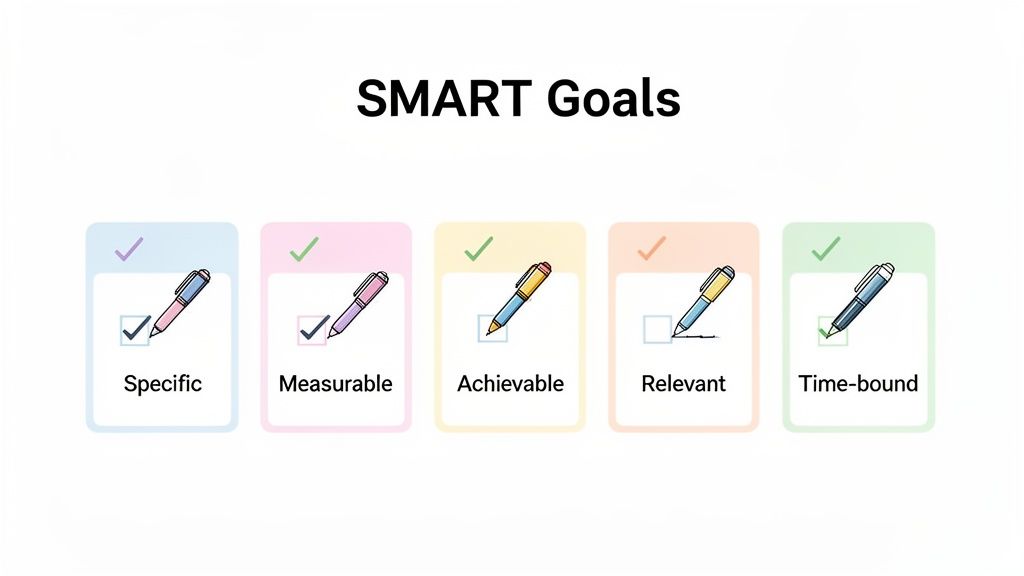
Here's how we transform that flimsy objective into something solid:
Specific: We won’t just "discuss." We will decide on the top 3 target accounts to prioritize.
Measurable: The result is a number. We need three accounts, with one owner assigned to each.
Achievable: This is a perfectly reasonable task for a focused, 45-minute meeting with the key decision-makers.
Relevant: Choosing top accounts directly supports our company's Q3 revenue targets.
Time-bound: This decision must be locked in by the end of this 45-minute call.
Now, our new and improved SMART goal is crystal clear: "Decide on the top 3 target accounts to prioritize for Q3, assign an owner to each, and confirm the first outreach step by the end of this 45-minute call."
See the difference? It’s no longer a casual chat; it's an actionable assignment with a deadline. Every minute is now measured against this specific outcome.
To get even deeper on this, a great ultimate goal setting guide can give you a more robust framework for applying this thinking beyond just meetings. Applying this level of rigor is the only way to ensure the goals of a meeting are actually met.
Goal-Setting Templates for Revenue-Driving Teams
Knowing the theory behind great meeting goals is one thing. Actually putting it into practice when you're under pressure to close a deal or solve a client's problem? That's a different ballgame.
To close that gap, here are some structured, actionable templates for the most critical meetings your revenue team runs. Think of these less as rigid scripts and more as strategic roadmaps. Each one is built to keep your conversations focused, efficient, and squarely aimed at moving the needle.
If you want a framework to build from, using a dedicated goal-setting template can help your team get into the right rhythm.
The Discovery Call Template
The discovery call is, without a doubt, the most important conversation in the entire sales cycle. Your goal here isn't to sell anything. It's to diagnose. You're a doctor figuring out if there's a problem you can actually solve and if this prospect is a real fit.
A great discovery call means you talk less and learn more. The only acceptable outcomes are a clear "yes" or a firm "no" on whether to invest more time—not a fuzzy "maybe."
Primary Goal: Qualify or disqualify the prospect based on our Ideal Customer Profile (ICP) and uncover at least two specific, high-priority pain points we can solve.
Key Guiding Questions:
"What made you start looking for a solution right now?" (This question cuts straight to urgency.)
"Walk me through how you're currently handling [the problem we solve]." (This reveals their broken process and where the pain is.)
"If we were talking again in six months, what would a successful outcome look like for you?" (This aligns your solution to their actual business goals.)
Desired Outcomes:
A rock-solid understanding of their biggest challenges.
Confirmation of their budget, authority to buy, and a realistic timeline.
A firm Go/No-Go decision on moving to the next stage.
The Product Demo Template
Let's be clear: a product demo is not a feature tour. It's a storytelling session. Your product is the hero that solves the specific problems you already uncovered during discovery. The goal is to connect your solution so directly to their pain that the value becomes undeniable.
Primary Goal: Show the prospect exactly how our product solves their top two pain points, getting them to agree that our solution is a viable path forward.
Key Guiding Questions:
"In our last chat, you mentioned [Pain Point 1]. Can I show you precisely how we tackle that?"
"Can you see how this would save your team a ton of time on [Specific Task]?"
Desired Outcomes:
The prospect verbally confirms they see the value.
They agree to a clear next step (e.g., proposal, trial, meeting with the CFO).
You have a defined timeline for their decision-making process.
The Client Check-In Template
For your customer success team, the check-in is all about proactive value reinforcement. The goal is to make sure your client is winning, identify any new headaches, and find opportunities to grow the partnership. This isn't a casual "how's it going?" call—it's a strategic account meeting.
Primary Goal: Confirm the client is hitting their primary business objective with our solution and identify one new opportunity for them to get even more value.
Desired Outcomes:
A documented success story or a key metric you can use.
A list of any new challenges or goals on their radar.
A clear action plan for any follow-up items.
Remember, the whole point of these templates is to build consistency and discipline. After every meeting, it’s absolutely crucial to document what was decided and who owns what. You can learn more about structuring that follow-through with our guide on a meeting action items template.
Using AI to Enforce and Automate Meeting Goals
Setting clear meeting goals is the easy part. The real work—and where most teams stumble—is actually sticking to them. The real challenge is enforcement. It's about making sure every discussion stays on track and every promise made is captured and acted on.
This is where good intentions usually fall apart. We all slip back into old habits, drowning in a sea of frantic note-taking, forgotten tasks, and follow-ups that never get sent. It’s a manual, chaotic process that undermines the very purpose of meeting in the first place.
But what if you could change that? Imagine a workflow that doesn't rely on your memory or multitasking skills. This is exactly what meeting intelligence does: it transforms the discipline of running goal-oriented meetings from a manual chore into an automated, reliable process.
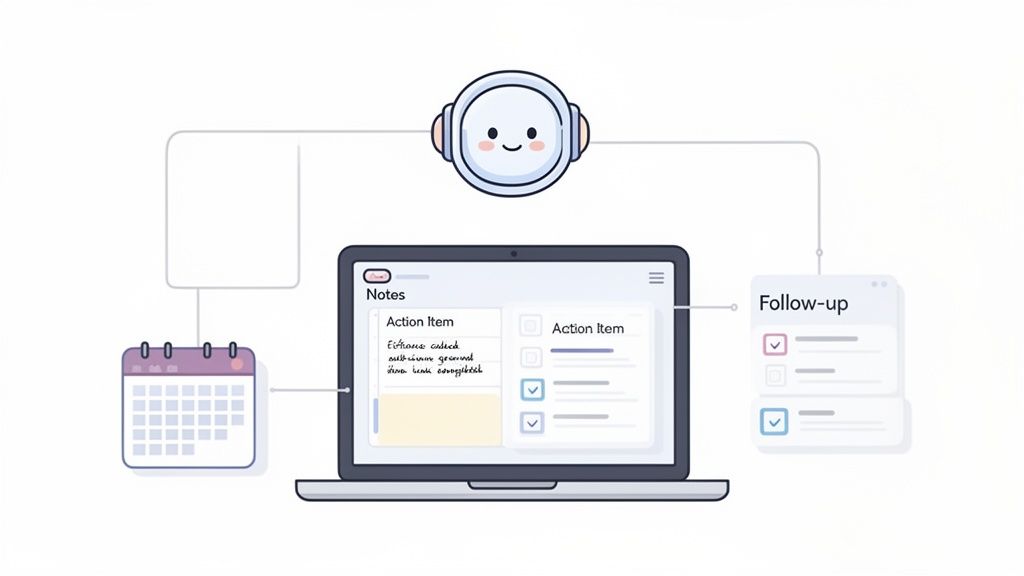
This isn’t just about convenience; it’s about plugging a massive hole in your company’s resources. Ineffective meetings cost US businesses a staggering $532 billion every year. Employees spend an average of 35 hours a month in meetings, yet only 45% of them feel that time is well spent.
By automating the prep and note-taking, AI-driven tools can give your team back 2-3 of those hours every single week, providing the structure needed to make every conversation count.
From Manual Chaos to Automated Accountability
The "before" picture is one we all know too well. You're trying to type notes and participate at the same time, inevitably missing something important. Action items are mentioned in passing but never formally assigned. Follow-up emails are an afterthought, often delayed or completely forgotten.
The "after" picture, powered by AI, is a world away from that chaos.
Here’s how modern tools automatically enforce the goals of a meeting:
Automated Capture: Instead of relying on a human note-taker, AI captures the entire conversation, word for word, and knows who said what. This creates a perfect, searchable record you can always go back to.
Structured Notes: The raw transcript is instantly transformed into structured notes. Key decisions, action items, and important topics are automatically pulled out and organized for you.
Instant Task Assignment: When a team member says, "I'll get that done by Friday," the system recognizes it as a commitment. It can then assign it as a task to the right person, right inside your project management tools.
Drafted Follow-Ups: AI uses the meeting's content to draft a concise, accurate follow-up email, ensuring nothing gets lost in translation between the call and the inbox.
This automated workflow is your built-in enforcement mechanism. It creates an undeniable record of who committed to what, and by when.
By operationalizing meeting goals with AI, you remove human error and the friction of manual tracking. Accountability becomes the default, not an afterthought, which directly accelerates project velocity and decision-making across the entire team.
This system ensures the outcomes defined by your goals don’t just get discussed—they get driven to completion. The tedious but critical task of creating automated meeting minutes becomes a seamless, invisible part of your workflow. It frees your team to focus on doing the actual work, not just talking about it. This is how you guarantee the value from every single meeting is fully realized.
Measuring the ROI of Goal-Oriented Meetings
A meeting goal without a measurable outcome is just a wish. If you really want to fix your meeting culture, you have to prove that setting clear objectives isn't just another box to check—it's an activity that directly fuels your revenue.
Tracking the return on this shift from "just talking" to "getting things done" is what makes the new habit stick. You can't just rely on gut feelings. You need to track hard numbers, the same way you track your sales pipeline or win rates. When you get serious about the goals of a meeting, you should see real, measurable improvements across the business.
Key Metrics to Track
To draw a straight line from better meetings to bottom-line results, start keeping an eye on these numbers:
Decision Velocity: This one is huge. How long does it take to make a key decision now compared to before? If you can shrink that timeline from weeks down to a few days, you’re directly speeding up project delivery and shortening your sales cycles.
Action Item Completion Rate: Are people actually doing what they said they would? Track the percentage of action items assigned in meetings that get done on time. A high completion rate is a clear sign that your meetings are turning conversations into real progress.
Meeting Time Reduction: Are your meetings getting shorter and sharper? Even a 15% cut in total meeting time across the team can claw back hundreds of hours a month for deep work.
The real proof that your meeting strategy is working? You start seeing fewer, shorter meetings on everyone's calendar, yet more is getting accomplished. That's the signal that your team is resolving issues decisively instead of just scheduling another follow-up to the follow-up.
Don't forget the qualitative wins, either. Things like reduced meeting fatigue and higher team engagement are just as important. When every meeting has a point, people show up prepared and leave with a clear path forward, which is a massive boost for both morale and momentum.
A great way to build this clarity is by nailing your post-meeting process. You can learn more about how to do that by improving your summary of a meeting. Ultimately, this direct link from focused goals to faster outcomes proves that a well-run meeting is one of the most powerful levers you can pull in your business.
Frequently Asked Questions About Meeting Goals
Shifting to a goal-first meeting culture sounds great on paper, but what about the real-world friction? Here are straight answers to the tough questions we hear all the time—the stuff that actually gets in the way of making this stick.
What Is the Single Most Important Goal of a Meeting?
The most important goal is always to get a specific, pre-defined outcome. It’s the verb at the end of the meeting.
Are you trying to decide on the Q4 marketing budget? Align the team on a new sales script? Generate three actionable ideas to improve customer onboarding? If your meeting doesn’t have a clear outcome, it's not a meeting; it's just a conversation that could've been a Slack message. The goal must drive an action or a change, not just "to discuss" something.
How Do I Get My Team to Adopt Setting Meeting Goals?
You have to lead from the front. Start by adding a single, clear goal to every meeting invitation you send out. Then, state that goal out loud at the beginning of every meeting and be the one to gently pull the conversation back when it starts to drift.
The key is to demonstrate the value, not just demand compliance. When your team sees that goal-oriented meetings are shorter, more decisive, and kill the need for endless follow-ups, they’ll get on board. Share the wins—like how you made a decision in 30 minutes that used to take three separate calls. That's how you build buy-in.
Can a Meeting Have More Than One Goal?
Technically yes, but it’s a trap. A meeting should have one primary, overarching goal to keep everyone locked in. For example, your primary goal is to "Decide on the Q4 marketing budget."
You can absolutely have secondary objectives, like "Review Q3 performance data," but only if they directly serve the main goal. Trying to cram two or three unrelated primary goals into one session is a recipe for disaster. You'll end up leaving with none of them accomplished, guaranteeing yet another meeting on the calendar.
Ready to transform your meetings from conversations into revenue-driving outcomes? Glinky unifies your entire workflow, from automated meeting notes and action items to lead discovery and outreach. Stop juggling tools and start closing deals. Discover how Glinky can power your growth.
People also read
10 Sales Enablement Best Practices to Unify Your Revenue Engine in 2026
Productivity
Mar 13, 2026
How to Manage Sales Pipeline for Predictable Revenue Growth
Productivity
Mar 14, 2026

How to Qualify Leads in Sales Without Wasting Time
Productivity
Mar 17, 2026

What is Conversation Intelligence? A Practical Guide for Sales Teams
Productivity
Mar 18, 2026

Top 10 Sales Discovery Questions That Close More Deals
Productivity
Mar 25, 2026
Taking Minutes of Meeting: A Guide to Transforming Chaos into Action
Productivity
Feb 16, 2026
Action Items List: A Practical Guide to Drive Real Results
Productivity
Feb 19, 2026
Master the summary of a meeting for clear decisions and follow-ups
Productivity
Feb 22, 2026

Track Action Items: A Practical Guide to Using AI for Flawless Follow-Up
Productivity
Feb 17, 2026
Unlock: How to Take Notes on a Computer for Peak Productivity in 2026
Productivity
Feb 26, 2026
How to Record Google Meet: A Complete Guide for 2026
Productivity
Mar 4, 2026

12 Best AI Note Taking App Choices for 2026: The Definitive Guide
Productivity
Mar 6, 2026
How to Improve Customer Retention: Practical Tips to Boost Loyalty
Productivity
Mar 8, 2026

10 Client Communication Best Practices to Master in 2026
Productivity
Mar 7, 2026
The 12 Best AI Meeting Assistant Tools for 2026: A Deep Dive
Productivity
Mar 15, 2026

Your Guide to the Ultimate AI Email Writer
Productivity
Feb 27, 2026
10 Essential Customer Success Best Practices for 2026
Productivity
Mar 1, 2026
Your Guide to Sales Call Recording Software in 2026
Productivity
Mar 2, 2026
How to Take Better Meeting Notes and Drive Real Results
Productivity
Mar 5, 2026
Top 10 Picks for best crm for small business
Productivity
Mar 3, 2026

What is an Ideal Customer Profile: A Guide to Driving Growth
Productivity
Mar 9, 2026
Automated meeting minutes: Turn talks into actionable notes
Productivity
Mar 11, 2026

The Top 12 AI Powered Sales Tools to Boost Revenue in 2026
Productivity
Mar 16, 2026
AI Note Taking For Meetings: Fast, Smart AI Notes That Drive Collaboration
Productivity
Mar 19, 2026
Understanding Transcription Service Cost: A 2026 Guide
Productivity
Mar 20, 2026
Master Your Meetings With The Note Taking Charting Method
Productivity
Feb 18, 2026
The Ultimate 2026 Guide: 8 Meeting Follow Up Email Template Scenarios
Productivity
Feb 20, 2026
Master the Art of Taking Meeting Notes for Actionable Outcomes
Productivity
Feb 25, 2026
12 Best Sales Lead Generation Tools to Boost Your Pipeline in 2026
Productivity
Mar 10, 2026

Translation Vs Transcription: Which Service Do You Really Need?
Productivity
Mar 12, 2026

The 12 Best Free AI Email Writer Tools for 2026
Productivity
Mar 22, 2026
A Guide to AI Sales Enablement Platforms in 2026
Productivity
Mar 21, 2026

Automate Follow Up Emails: Actionable Insights for Boosting Sales & Efficiency
Productivity
Mar 26, 2026

Follow Up Email Subjects That Convert: Increase Opens and Replies
Productivity
Feb 17, 2026

Your Playbook for Outbound Lead Generation in 2026
Productivity
Feb 28, 2026
Your Essential Meeting Action Items Template to Drive Results
Productivity
Feb 23, 2026

Your Guide to Using an Email Writer AI for Maximum Impact
Productivity
Feb 23, 2026
8 Essential Ground Rules at Meetings to Maximize Productivity in 2026
Productivity
Mar 24, 2026

Otter.ai vs Glinky
Productivity
Feb 5, 2026
AI Tools for Startup Founders [2026]
Productivity
Feb 4, 2026
Best AI Tools for Startups [2026]
Tools
Feb 3, 2026
Sales Call Notes: How to Capture Every Detail Without Losing the Deal
How to
Feb 2, 2026
How to Take Meeting Notes: 7 Methods That Actually Work [2026]
How to
Jan 14, 2026
![AI Meeting Minutes | Free Forever [2026]](https://framerusercontent.com/images/zYQGRjgLX63tiouLTK65LvCcjK8.png?width=402&height=263)
AI Meeting Minutes | Free Forever [2026]
How to
Jan 13, 2026
![How to Record Zoom Meetings Without a Bot [2026] 3 Easy Methods](https://framerusercontent.com/images/gGoQV8bPb9zR5weVruinbjaxO0.png?width=402&height=263)
How to Record Zoom Meetings Without a Bot [2026]
How to
Jan 9, 2026
Bot-Free AI Meeting Notes: We Tested the 6 Best Tools in 2026
Tools
Jan 8, 2026

Glinky vs Fireflies.ai
Tools
Jan 7, 2026
15 Best AI Tools to Boost Your Productivity in 2026
Productivity
Jan 6, 2026