Nov 13, 2025
Productivity
Your Playbook for Outbound Lead Generation in 2026
Let's be real—the old "spray and pray" method of outbound is dead. If you're still blasting generic messages to a list you bought for a few bucks, you're not just wasting time; you're actively burning your brand's reputation.
Today's outbound lead generation is a whole different ballgame. It's a blend of surgical precision, genuine value, and smart personalization. Think of it less like shouting with a megaphone and more like a well-crafted conversation starter.
The New Rules of Outbound Lead Generation

The game has completely changed. Buyers are smarter, their inboxes are more crowded, and their tolerance for irrelevant noise is at an all-time low. This isn't a bad thing; it just means we have to be better.
Sure, inbound often brings in leads at a lower cost, but that doesn't make outbound obsolete. It just makes it more strategic. In fact, data shows that buyers flat-out ignore nearly 70% of generic B2B outbound messages. Why? They're impersonal and irrelevant. This tells us one thing loud and clear: outbound only works when it's done right.
Let's look at how the strategy has evolved.
The Evolution of Outbound Strategy
The shift from casting a wide net to crafting a sharp spear is the single biggest change in outbound sales. The old way was a numbers game focused on activity. The new way is a quality game focused on relevance and results.
Metric | Traditional Outbound | Modern Outbound |
|---|---|---|
Philosophy | Volume-based "spray and pray" | Precision-based "spear-fishing" |
List Source | Purchased, unverified mass lists | Curated, verified ideal customer lists |
Message | Generic, one-size-fits-all pitch | Personalized, value-driven conversation starter |
Goal | Get a demo booked | Start a meaningful conversation |
Key Metric | Number of dials/emails sent | Number of positive replies & meetings |
This isn't just a minor tweak—it's a fundamental change in mindset. Modern outbound is about earning attention, not demanding it.
Precision Over Volume
Modern outbound is all about finding the right people and hitting them with a message that actually means something to them. It’s not about how many dials you can make in an hour, but about the quality of each conversation you start.
The Old Way: Buy a massive, stale list and spam everyone with the same template.
The New Way: Build a small, hyper-targeted list of ideal prospects and personalize your outreach based on their specific role, recent company news, or a shared connection.
This precision-first approach immediately cuts through the noise. It shows you've done your homework and have a real reason for reaching out, instantly earning you a bit of respect and attention.
Key Takeaway: The goal of modern outbound isn't to interrupt. It's to engage. You're starting a relevant conversation with someone who is a perfect fit for your solution, even if they don't know it yet.
Value Before the Ask
The most effective outbound campaigns lead with value, not a sales pitch. This isn't about being pushy; it's about being helpful. That "value" could be an interesting industry insight, a link to a resource that solves a common headache, or even a simple observation about their company.
For instance, instead of the tired, "Can I have 15 minutes to demo our product?" try something like this: "I saw your company is expanding its remote team. I put together a guide on scaling distributed engineering teams that I thought you might find useful."
This simple shift establishes your credibility and builds goodwill before you ever ask for a single thing in return. To dig deeper into this, you can explore more expert B2B lead generation strategies.
This value-first philosophy is the engine of a modern outbound machine. It's built on the understanding that trust is something you earn, not something you're entitled to. The rest of this playbook will walk you through exactly how to build this kind of predictable, growth-driving engine.
Your outbound campaigns live and die by the quality of your list. It’s that simple.
Forget the clever email copy or the perfectly polished phone script for a moment. The list is the bedrock of your entire operation. Its quality will make or break your success. A junk list guarantees failure before you even hit “send”—think abysmal deliverability, zero engagement, and a sales team that’s completely burned out.
On the flip side, a well-researched, hyper-targeted list is the single biggest lever you can pull to get replies and book meetings. This whole game is about finding the right people, not just more people.
Move Beyond Basic Demographics
Building a prospect list that actually converts means getting serious about your Ideal Customer Profile (ICP). Too many teams stop at the basics: company size, industry, job title. Sure, that's a start, but it's table stakes. The real magic happens when you dig into the signals that point to a genuine, urgent need for what you sell.
To forge a powerful ICP, you need to layer in more sophisticated criteria:
Firmographics: Go deeper than just employee count. What about their revenue, funding stage, or specific office locations? Are you chasing companies that just landed a Series A, or are you better off with established enterprises looking to optimize a specific department?
Technographics: What’s in their tech stack? Tools like BuiltWith can instantly tell you if a company uses a competitor's product or, even better, a piece of software that integrates perfectly with yours. That’s a warm intro waiting to happen.
Psychographics: What are the actual human beings you're selling to like? Think about their goals, their values, their attitudes. Are they early adopters hungry for new tech, or are they conservative buyers who need to see proven ROI before they’ll even talk to you?
Buying Triggers: What event just happened that means they need you right now? This is the gold. It could be a key new hire (like a fresh VP of Sales), a big funding announcement, or a press release about expansion into a new market.
When you layer these attributes, you stop targeting a vague persona like "Marketing Manager at a SaaS company." Instead, you're looking for a "Marketing Director at a 50-200 employee B2B SaaS company that uses HubSpot and just hired three new content marketers." That level of detail is what turns a cold, annoying email into a relevant, timely conversation.
Sourcing and Verifying Your Data
Once you have a razor-sharp ICP, it’s time to find these people. The accuracy of your data is everything. A high bounce rate doesn’t just waste your time; it actively damages your domain's sending reputation, a nightmare that's incredibly difficult to fix.
For sales teams, this is where automation becomes a non-negotiable. Manually digging for contacts and then verifying them is a colossal time sink. Imagine an AE using a tool like GLINKY's lead discovery feature. They can type in a natural language search like "find VPs of Sales in SaaS companies with 50-200 employees" and instantly get a list of prospects with verified emails, LinkedIn profiles, and direct dials. This isn't just about saving a few minutes; it's about reclaiming hours every single day so they can focus on what they were hired to do: sell. If you want more tips on this, check out this great resource from Headleymedia.com on optimizing outbound efforts.
My Personal Tip: Never, ever trust a single data source. I always cross-reference information from at least two providers and then run every single email through a separate verification tool before it goes into a sequence. A clean list of 100 perfect-fit prospects is infinitely more valuable than a messy list of 1,000 maybes.
This meticulous process—defining, sourcing, and verifying—is the unsung hero of successful outbound lead generation. It might feel tedious, but this is the hard work that separates campaigns that build real pipeline from those that just create noise. For a deeper look into a complete system, you might be interested in our guide on building a powerful lead generation engine. With a pristine list in hand, you're finally ready to craft outreach that actually gets attention.
You’ve got a clean, verified list of prospects. That's a huge win, but it’s only half the battle. Now, it's time to turn that data into actual conversations. This is where we shift from strategy to execution—building outreach that doesn’t just land in an inbox, but actually gets a reply.
Forget about blasting generic templates. We're talking about a thoughtful system of persistent, personalized touchpoints that add value. It’s all about mixing the right channels, timing your interactions perfectly, and making every single message feel like it was written just for them.
The process for building the list that fuels all this is foundational. You can't skip the basics of defining your ideal customer, sourcing their info, and making sure it's all accurate.
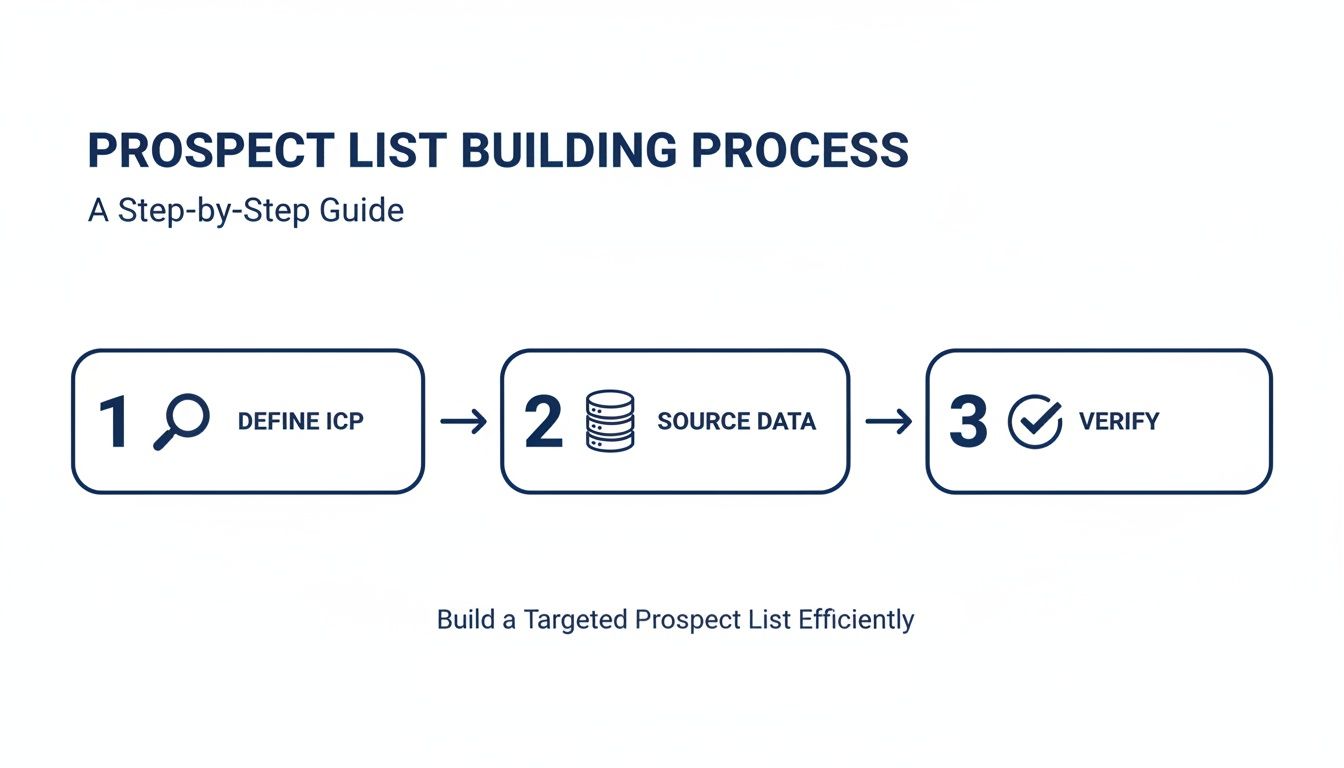
Without this solid groundwork, even the most brilliantly crafted outreach will fall on deaf ears.
The Anatomy of a High-Converting Email
Let’s be clear: your first cold email is not a sales pitch. It’s a conversation starter. The only thing you're "selling" is the next step—a quick reply or a brief call. To do that, every single part of your email has to work in harmony to grab their attention and spark some curiosity.
The Subject Line: This is your first impression, so make it count. Keep it short, personal, and intriguing. Ditch the clickbait and anything that screams "SALES!". A great subject line often feels like it could have come from a colleague. Think "Quick question about [Company Name]'s expansion" or "[Mutual Connection] suggested I reach out."
The Opening Line: Here’s where you prove you’ve done your homework. Reference a recent company announcement, a LinkedIn post they wrote, or a shared experience. Something like, "Saw your recent post on scaling engineering teams—your point about CI/CD pipelines was spot on."
The Value Proposition: Connect their likely problem to your solution. Do it concisely. Don’t just list features; talk about a compelling outcome. For instance, "Companies like yours often find that as they scale, manual note-taking leads to lost action items. We help teams automate this, saving reps about 5 hours per week."
The Call-to-Action (CTA): Keep it low-friction. Instead of the demanding "When are you free for a 30-minute demo?" try an interest-based question like, "Is solving this a priority for your team this quarter?" This makes it easy for a busy person to give a simple "yes" or "no" answer.
Focusing on relevance instead of a hard sell is what gets you a positive response. To make this even easier, you can check out our guide on using an AI email writer to craft compelling messages.
Beyond Email: Designing Your Multi-Channel Cadence
Relying on a single channel is a fast track to being ignored. An effective outbound lead generation strategy weaves together multiple touchpoints across different platforms to create a persistent, yet respectful, presence.
The days of the one-and-done email are over. Combining email, LinkedIn, phone calls, and even personalized video can lead to 3.5x higher response rates. I've seen top-performing teams consistently execute 6 to 8 touchpoints over two to three weeks. They blend automation for scale with a human touch for genuine personalization. For more on this, the folks at Rev-Empire.com have some great insights into building a modern sales process.
This multi-touch approach, often called a cadence or sequence, ensures you’re meeting prospects where they’re most active.
Key Takeaway: The point of a multi-channel cadence isn't to bombard your prospect. It’s to create a series of thoughtful, connected touchpoints that build on each other, showing your persistence and genuine belief that you can help them.
Personalizing for Different Personas
Your outreach has to adapt to who you're contacting. A message that resonates with a founder will almost certainly fall flat with an operations manager. The trick is to frame your value proposition through the lens of their specific role and what keeps them up at night.
Look at how you'd approach two different people with the exact same product:
Scenario 1: Reaching out to a Busy Founder
Persona: Starved for time, focused on high-level growth, revenue, and team efficiency.
Message Angle: "I know how critical it is for founders to maximize every minute. We help sales teams at fast-growing companies like yours close deals faster by automating the busywork that follows every sales call. Is improving sales cycle velocity a priority for you right now?"
Scenario 2: Reaching out to a Detail-Oriented Operations Manager
Persona: Focused on process, systems, data integrity, and cross-functional workflows.
Message Angle: "I saw you use Salesforce and were recently hiring new AEs. We specialize in ensuring new reps can ramp up quickly by automatically syncing accurate call notes and next steps directly to the right Salesforce opportunity, eliminating manual data entry. Would cleaning up your CRM data be a relevant topic for your team?"
This kind of targeted messaging proves you understand their world and have a solution for their specific challenges, making them far more likely to engage.
Turning Conversations Into Qualified Opportunities
Getting that positive reply is a huge win, but it’s just the starting gun. The real work in outbound lead generation starts now. This is where you shift from broadcasting your message to having a real conversation, turning that first spark of interest into a genuine sales opportunity.
This next phase is all about managing the conversation. You have to be ready to handle objections, ask the right questions, and figure out if there's actually a good fit. It's about building momentum with every single touchpoint.
Listening Between the Lines with Conversation Intelligence
The best reps don't just talk; they listen with incredible intent. They hear the prospect’s stated pain points but connect them to the deeper business problems hiding just beneath the surface. The problem? It's almost impossible to do that effectively when you're also frantically trying to take notes.
This is where conversation intelligence tools completely change the game. Picture a rep on a discovery call who is 100% present, making eye contact, and fully engaged, never once looking down to type. In the background, an AI notetaker like GLINKY is transcribing the entire call, tagging speakers, and pulling out key details with pinpoint accuracy.
Once the call ends, that raw transcript is instantly turned into something you can actually use:
Clean Notes: A neat summary of what was discussed, highlighting the most important topics.
Key Decisions: Any agreements or conclusions from the call are documented clearly.
Next Steps: Action items are automatically flagged and ready to be assigned.
This frees up your team to focus on what humans do best: building rapport and truly understanding the prospect's world. The tech shoulders the administrative load, making sure no critical detail ever gets lost.
Using Qualification Frameworks in Real Conversations
Classic qualification frameworks aren't dead, but they need an update for today’s fast-paced sales world. You can’t just drag a prospect through a rigid checklist. Instead, you need to weave your qualifying questions into a natural, flowing conversation.
One of the most powerful frameworks out there is MEDDIC (Metrics, Economic Buyer, Decision Criteria, Decision Process, Identify Pain, Champion). Think of it less as an interrogation script and more as a mental guide for your calls.
MEDDIC Element | What It Is | Example Question |
|---|---|---|
Metrics | The measurable business results the prospect is trying to hit. | "What specific improvement in team productivity would make this a home run for you?" |
Economic Buyer | The person who has the final say and can sign the check. | "Who else on your team typically gets involved when you're looking at new software?" |
Decision Criteria | The specific "must-haves" the solution needs to meet. | "As you start looking at options, what are the top three capabilities you're looking for?" |
Decision Process | The steps the company follows to buy something. | "Could you walk me through your team's typical steps, from here to getting a new tool up and running?" |
Identify Pain | The core business problem that's making them look for a solution. | "What's the single biggest headache your team is dealing with in your current process?" |
Champion | The person inside the company who will fight for your solution. | "Who on your team is going to feel the biggest positive impact from solving this?" |
When you embed these kinds of questions into your calls, you gather the intel you need without making the prospect feel like they're on the hot seat. Many modern outbound teams are taking this even further by using AI voice agents to qualify leads and book appointments, streamlining this part of the process.
Key Insight: Qualification isn't a one-and-done checklist. It's a continuous process. Every email, call, and meeting is another chance to gather more intelligence and build a stronger case.
From Call Notes to Actionable CRM Data
The real magic of modern conversation intelligence happens after the call. The organized notes and outcomes captured by a tool like GLINKY don't just sit there—they get put to work.
With solid CRM integrations, those call summaries, action items, and key decisions are automatically pushed to the right contact or opportunity record in your system. Suddenly, you have a rich, complete history for every single prospect that anyone on the team can see. If you're looking for more tips on keeping the conversation going, check out our guide on crafting compelling follow-up email subjects.
This automated sync is a cornerstone of a successful outbound lead generation program. It makes handoffs between SDRs and Account Executives completely seamless and can even trigger automated follow-up sequences, ensuring no lead ever falls through the cracks.
Measuring Performance and Scaling Your Success
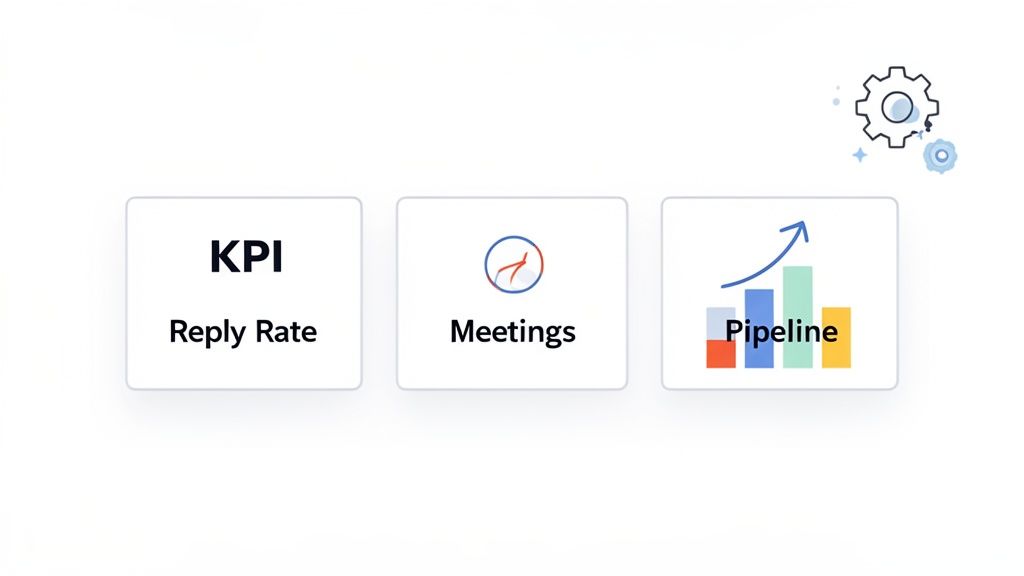
An outbound program without measurement is just expensive guesswork. If you want to turn your outreach into a predictable revenue machine, you have to know what's working, double down on it, and ruthlessly cut what isn't.
This isn't about chasing vanity metrics. It's about finding the real signal in all the noise—the numbers that tell you if you're actually getting closer to closing deals. This data tells the true story of your campaign's health.
Key Performance Indicators That Actually Matter
Let's get one thing straight: "emails sent" is not a KPI. It’s an activity metric. Real results come from tracking genuine engagement and how it moves prospects down the funnel.
Reply Rate: This is your first real gut check. Are people even responding? A consistently low reply rate (under 2-3%) is a massive red flag. It tells you something is broken—your list, your subject lines, or your opening sentence.
Positive Reply Rate: This is where the magic happens. It filters out the polite "no thanks" messages and shows you who is genuinely interested. This number tells you if your value prop is actually hitting the mark.
Meetings Booked: The most concrete output of your efforts. This hard number proves your team can turn a conversation into a scheduled discovery call. It's the bridge from outreach to sales.
Sales Qualified Leads (SQLs): How many of those meetings convert into legitimate, qualified opportunities for your Account Executives? This measures the quality of the leads your outbound team is generating.
Watching these metrics like a hawk is the difference between hoping for success and engineering it.
A/B Testing for Continuous Improvement
The best outbound teams are never satisfied. They operate with a relentless optimization mindset, constantly testing small variables to find those tiny gains that compound into massive wins over time. This is where A/B testing comes in.
The key is to test one thing at a time for clean data. For example, pit two subject lines against each other while keeping the email body identical. Once you have a statistically significant result, the winner becomes the new control, and you move on to the next test.
Here are a few high-impact elements to start testing:
Subject Lines: Try a question vs. a statement. Think
"Question about [Company Name]"versus"Idea for [Company Name]".Calls-to-Action (CTAs): Test a low-friction "interest check" against a high-friction "book a time" ask. For instance,
"Worth a closer look?"vs."Do you have 15 minutes Tuesday?".Value Proposition: Experiment with different angles. Does your audience care more about saving time or increasing revenue? Frame your solution accordingly.
Personalization Level: Is a hyper-personalized first line more effective than a sharp, role-based opener? Test it.
This continuous feedback loop is what separates a good outbound strategy from a great one.
Key Takeaway: Treat every campaign as a learning opportunity. The data from your tests, whether they win or lose, provides the insights you need to make your next campaign even more effective.
Building a Scalable and Integrated Workflow
To scale, you have to move from manual, one-off tasks to a connected, automated system. The goal is a seamless flow of data between your core tools, slashing administrative work and letting your team operate at peak efficiency.
Think about it: B2B sales reps spend a staggering 28% of their time just researching targets. That's followed by 21% on cold calling and 14% on manual emails. Winning teams turn this time sink into a revenue engine by obsessively tracking performance—keeping bounce rates under 2% and pushing for response rates above 10%. You can find more on building a modern outbound sales process over at Rev-Empire.com.
A truly scalable workflow is built on tight integrations. When your sales engagement platform, CRM, and calendar all talk to each other, you kill data silos and annoying manual entry errors. This is the foundation that lets you support a growing team and higher outreach volume without the whole system falling apart.
Answering Your Top Outbound Strategy Questions
Once you start moving from theory to practice, the real questions bubble up. Building a modern outbound program means navigating new tools, tweaking old-school tactics, and making some key strategic calls. I get these questions all the time, so let's tackle the most common ones head-on.
How Much Personalization Is Really Necessary?
The goal is "relevant personalization," not deep, time-sucking research on every single person you contact. You're trying to show you understand their world, not that you've been stalking their LinkedIn profile for an hour.
An email that's relevant and gets sent is infinitely better than a perfectly personalized masterpiece that never leaves your drafts.
For those big-ticket, enterprise-level accounts? Sure, it pays to reference a specific company initiative, a quote from their latest earnings call, or a recent award. But for most of your scaled-out outreach, personalization can be as straightforward as aligning your message with the common headaches of a specific job title or industry.
What’s the Ideal Tech Stack for a Small Team?
Keep it lean and integrated. The temptation is to grab a dozen different single-purpose tools, but that just creates data chaos and a ton of manual work. You really only need to start with three core components:
A Central CRM: This is your non-negotiable single source of truth for all customer data. Whether it's HubSpot, a Salesforce alternative, or another platform, this is where everything lives.
An All-in-One Engagement Platform: Find a tool that pulls together lead data, multi-channel outreach (email, calls, social), and conversation intelligence. This cuts down on the constant app-switching that kills productivity.
Your Core Productivity Suite: Your standard email and calendar, like Google Workspace or Outlook, are the final, simple pieces of the puzzle.
The real magic happens when your data flows seamlessly. When your tools talk to each other, your team can spend their time actually selling instead of being bogged down by manual data entry.
Should I Choose Inbound or Outbound Marketing?
Honestly, this is a false choice. The most successful companies don't pick one; they integrate both. Think of them as two sides of the same revenue-generating coin.
Inbound marketing is your powerful magnet. It pulls in prospects who are already out there looking for a solution like yours. It builds your brand and fills your pipeline with people who have actively raised their hands.
Outbound lead generation, on the other hand, is your spear. It lets you go out and proactively target your absolute best-fit customers—the ones who perfectly match your ICP—even if they aren't actively searching right now. A winning strategy uses both to build a pipeline that is robust, predictable, and always full.
How Do I Actually Measure Outbound ROI?
To get the true return on your investment, you have to track both your costs and the revenue you bring in. The classic formula is (Lifetime Value of Closed Deals - Campaign Cost) / Campaign Cost.
But you can't wait six months for deals to close to figure out if your strategy is working. You need to track the leading indicators that give you early feedback. Keep a close eye on metrics like Positive Reply Rate, Meetings Booked, and the number of Sales Qualified Opportunities you create. This data lets you fine-tune your approach long before the final revenue numbers come in.
Ready to get rid of the manual busywork and build a smarter outbound engine? GLINKY transforms your sales conversations into actionable data. It captures perfect notes without you lifting a finger and syncs key outcomes straight into your CRM. This gives your team the power to stay present on calls, follow up faster, and close more deals. See how it all works at https://www.glinky.ai.
People also read
10 Sales Enablement Best Practices to Unify Your Revenue Engine in 2026
Productivity
Mar 13, 2026
How to Manage Sales Pipeline for Predictable Revenue Growth
Productivity
Mar 14, 2026
How to Qualify Leads in Sales Without Wasting Time
Productivity
Mar 17, 2026

What is Conversation Intelligence? A Practical Guide for Sales Teams
Productivity
Mar 18, 2026
Top 10 Sales Discovery Questions That Close More Deals
Productivity
Mar 25, 2026
Taking Minutes of Meeting: A Guide to Transforming Chaos into Action
Productivity
Feb 16, 2026
Action Items List: A Practical Guide to Drive Real Results
Productivity
Feb 19, 2026
Master the summary of a meeting for clear decisions and follow-ups
Productivity
Feb 22, 2026

Track Action Items: A Practical Guide to Using AI for Flawless Follow-Up
Productivity
Feb 17, 2026
Unlock: How to Take Notes on a Computer for Peak Productivity in 2026
Productivity
Feb 26, 2026
How to Record Google Meet: A Complete Guide for 2026
Productivity
Mar 4, 2026

12 Best AI Note Taking App Choices for 2026: The Definitive Guide
Productivity
Mar 6, 2026
How to Improve Customer Retention: Practical Tips to Boost Loyalty
Productivity
Mar 8, 2026

10 Client Communication Best Practices to Master in 2026
Productivity
Mar 7, 2026
The 12 Best AI Meeting Assistant Tools for 2026: A Deep Dive
Productivity
Mar 15, 2026
Your Guide to the Ultimate AI Email Writer
Productivity
Feb 27, 2026
10 Essential Customer Success Best Practices for 2026
Productivity
Mar 1, 2026
Your Guide to Sales Call Recording Software in 2026
Productivity
Mar 2, 2026
How to Take Better Meeting Notes and Drive Real Results
Productivity
Mar 5, 2026
Top 10 Picks for best crm for small business
Productivity
Mar 3, 2026
What is an Ideal Customer Profile: A Guide to Driving Growth
Productivity
Mar 9, 2026
Automated meeting minutes: Turn talks into actionable notes
Productivity
Mar 11, 2026
The Top 12 AI Powered Sales Tools to Boost Revenue in 2026
Productivity
Mar 16, 2026
AI Note Taking For Meetings: Fast, Smart AI Notes That Drive Collaboration
Productivity
Mar 19, 2026
Understanding Transcription Service Cost: A 2026 Guide
Productivity
Mar 20, 2026
Master Your Meetings With The Note Taking Charting Method
Productivity
Feb 18, 2026
The Ultimate 2026 Guide: 8 Meeting Follow Up Email Template Scenarios
Productivity
Feb 20, 2026
Master the Art of Taking Meeting Notes for Actionable Outcomes
Productivity
Feb 25, 2026
12 Best Sales Lead Generation Tools to Boost Your Pipeline in 2026
Productivity
Mar 10, 2026

Translation Vs Transcription: Which Service Do You Really Need?
Productivity
Mar 12, 2026
Mastering the goals of a meeting to drive decisions and boost team alignment
Productivity
Mar 23, 2026
The 12 Best Free AI Email Writer Tools for 2026
Productivity
Mar 22, 2026
A Guide to AI Sales Enablement Platforms in 2026
Productivity
Mar 21, 2026
Automate Follow Up Emails: Actionable Insights for Boosting Sales & Efficiency
Productivity
Mar 26, 2026

Follow Up Email Subjects That Convert: Increase Opens and Replies
Productivity
Feb 17, 2026
Your Essential Meeting Action Items Template to Drive Results
Productivity
Feb 23, 2026
Your Guide to Using an Email Writer AI for Maximum Impact
Productivity
Feb 23, 2026
8 Essential Ground Rules at Meetings to Maximize Productivity in 2026
Productivity
Mar 24, 2026

Otter.ai vs Glinky
Productivity
Feb 5, 2026
AI Tools for Startup Founders [2026]
Productivity
Feb 4, 2026
Best AI Tools for Startups [2026]
Tools
Feb 3, 2026
Sales Call Notes: How to Capture Every Detail Without Losing the Deal
How to
Feb 2, 2026
How to Take Meeting Notes: 7 Methods That Actually Work [2026]
How to
Jan 14, 2026
![AI Meeting Minutes | Free Forever [2026]](https://framerusercontent.com/images/zYQGRjgLX63tiouLTK65LvCcjK8.png?width=402&height=263)
AI Meeting Minutes | Free Forever [2026]
How to
Jan 13, 2026
![How to Record Zoom Meetings Without a Bot [2026] 3 Easy Methods](https://framerusercontent.com/images/gGoQV8bPb9zR5weVruinbjaxO0.png?width=402&height=263)
How to Record Zoom Meetings Without a Bot [2026]
How to
Jan 9, 2026
Bot-Free AI Meeting Notes: We Tested the 6 Best Tools in 2026
Tools
Jan 8, 2026
Glinky vs Fireflies.ai
Tools
Jan 7, 2026
15 Best AI Tools to Boost Your Productivity in 2026
Productivity
Jan 6, 2026