
Nov 13, 2025
Productivity
10 Essential Customer Success Best Practices for 2026
In the modern subscription-based economy, customer acquisition is merely the starting point. The true measure of a company’s long-term viability lies in its ability to retain, grow, and convert customers into advocates. This is the domain of customer success, a discipline that has shifted from a reactive support function to a primary engine for sustainable growth. But simply having a customer success team isn't enough. The difference between a struggling program and a high-performing one comes down to implementing proven, repeatable strategies.
This article provides a detailed breakdown of essential customer success best practices that move beyond theory. We will explore specific, actionable tactics for everything from creating a seamless onboarding experience and calculating meaningful health scores to conducting strategic business reviews and fostering deep cross-functional collaboration. Each point is designed to help you make your customers genuinely successful with your product, which in turn drives retention and expansion revenue. As customer success transforms from a reactive function to a strategic growth driver, understanding the foundational principles is paramount. For a comprehensive look, explore these 10 actionable customer success best practices to reduce churn.
Prepare to elevate your approach from transactional to strategic. By adopting these methods, you can build powerful partnerships that not only prevent churn but also unlock new avenues for growth, turning your customer base into your most valuable asset.
1. Proactive Communication and Regular Check-ins
Effective customer success is built on anticipation, not reaction. Proactive communication involves establishing a consistent cadence of scheduled touchpoints to understand evolving customer needs, address concerns before they escalate, and demonstrate a genuine investment in their success. This practice shifts the role of a Customer Success Manager (CSM) from a reactive problem-solver to a strategic partner, a core principle of modern customer success best practices.
Rather than waiting for a support ticket, you actively create opportunities to deliver value. This could be through scheduled calls, email check-ins, or in-app messages timed to key moments in the customer journey. For example, HubSpot’s CSMs often conduct check-ins at 30, 60, and 90-day milestones for new customers, while Slack assigns dedicated success managers to high-touch accounts for continuous dialogue.
How to Implement This Practice
Establish a Cadence: Define check-in frequency based on customer segments. High-touch accounts might require bi-weekly or monthly calls, while tech-touch segments could receive automated, milestone-based emails.
Set Clear Agendas: Maximize the value of every interaction. Send a clear agenda 48 hours before a call, outlining discussion points and desired outcomes. This respects your customer's time and keeps the conversation focused.
Document and Reference Goals: During your initial onboarding calls, carefully document the customer's primary goals. In every subsequent check-in, reference these goals to demonstrate continuity and track progress, reinforcing your role as a partner.
Automate Follow-up: Use a meeting intelligence tool like GLINKY to automatically capture call notes and generate follow-up action items. This ensures commitments are never missed and frees you to focus on the conversation. Capturing these details is critical, and you can find techniques for better call notes to support this process.
Key Insight: Proactive check-ins reframe the customer relationship. Instead of asking, "Are you having any problems?", you're asking, "How can we help you achieve your next goal?" This subtle shift builds trust and drives long-term loyalty.
2. Comprehensive Onboarding and Implementation Planning
The first 90 days of a customer relationship are the most critical. Comprehensive onboarding is not just about product training; it's a structured, time-bound process designed to guide customers to their first win as quickly as possible. This approach dramatically reduces time-to-value, prevents early-stage churn, and establishes a strong foundation for future growth and advocacy, making it a cornerstone of customer success best practices.
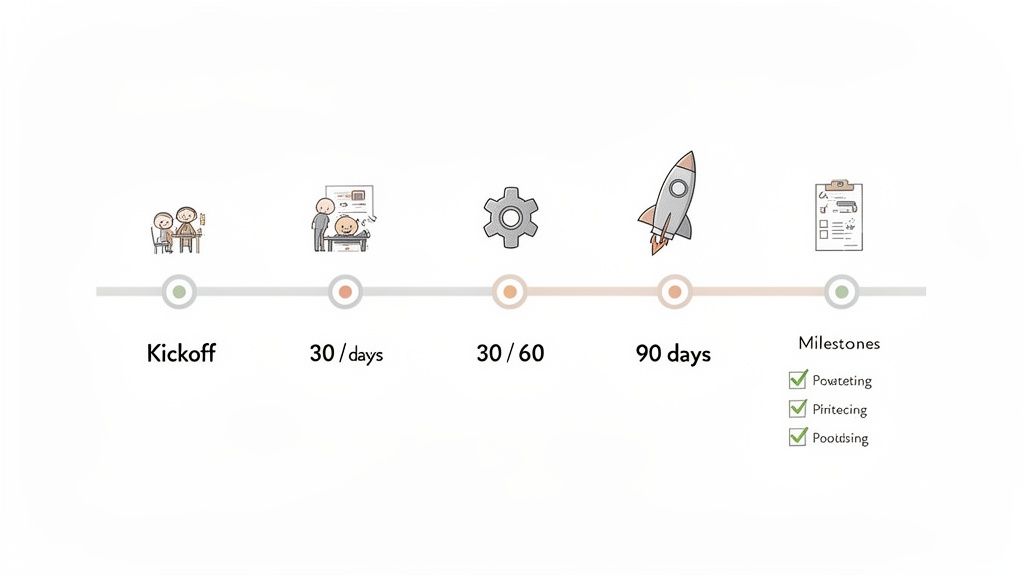
A well-executed plan moves a customer from purchase to proficiency with clear, manageable steps. For instance, Gainsight offers structured onboarding templates to guide new users, while Workday is known for its detailed requirements gathering and phased implementation timelines. Similarly, Stripe’s extensive developer documentation acts as a self-service onboarding tool that empowers technical users to implement the solution independently and effectively.
How to Implement This Practice
Schedule a Kick-off Call: Start every new partnership with a formal kick-off meeting. Bring all key stakeholders from both sides together to align on goals, establish timelines, define roles, and confirm the specific outcomes the customer expects to achieve.
Create a Shared Success Plan: Develop a customer-facing document that outlines the entire onboarding journey. This plan should include key milestones, assigned owners for each task, and clear deadlines to maintain momentum and ensure accountability.
Document Every Decision: Use a meeting intelligence tool like GLINKY to automatically record discovery and kick-off calls. Capturing these conversations ensures that all requirements, decisions, and assumptions are documented and easily accessible, which is vital for smooth handovers between sales, onboarding, and success teams.
Assign Clear Ownership: Prevent ambiguity by assigning a single, directly responsible individual (DRI) for each phase of the implementation. This clarity ensures that tasks are completed on schedule and that the customer always knows who to contact with questions.
Key Insight: Onboarding is the first promise you deliver on after the sale. A structured, transparent, and goal-oriented implementation process doesn't just activate an account; it builds the customer's confidence in your ability to deliver long-term value.
3. Health Scoring and Predictive Analytics
A data-driven approach to customer success involves moving beyond gut feelings to quantify customer well-being. Health scoring is a method for assigning a value-based score to each account by combining quantitative and qualitative metrics. This score acts as a leading indicator of churn risk or an expansion opportunity, forming the backbone of proactive customer success best practices.
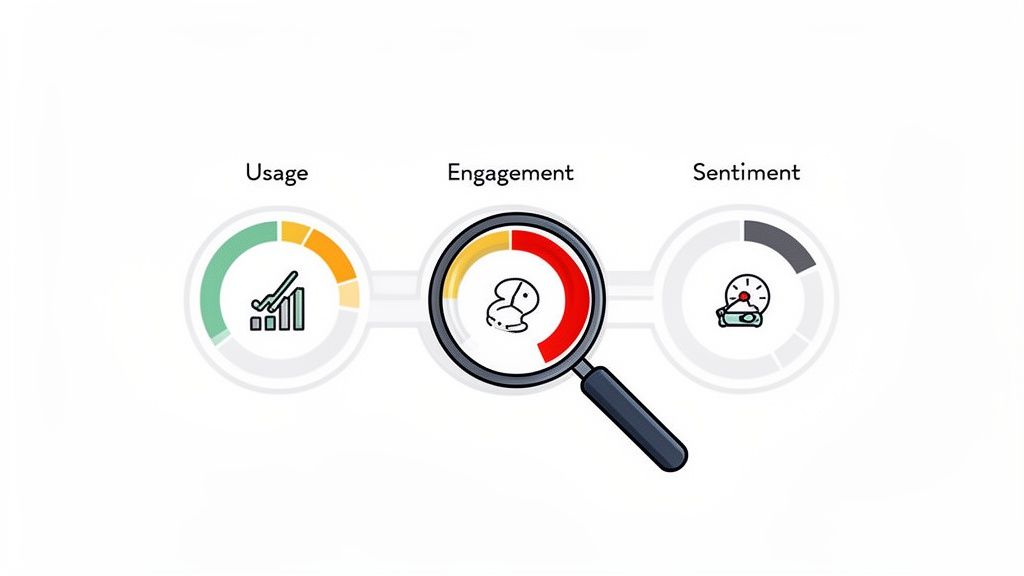
By aggregating data points like product usage, support ticket volume, and engagement levels, you can create a single, actionable score. For instance, Totango built its platform around this concept, while Zendesk analyzes support patterns to predict risk. These scores allow CSMs to prioritize their efforts, focusing on at-risk accounts before they disengage and identifying happy customers ripe for upsells or advocacy programs.
How to Implement This Practice
Define Your Metrics: Identify the key behaviors that correlate with success and churn. Combine product usage data (e.g., key feature adoption, login frequency) with engagement metrics (e.g., support ticket resolution times, meeting attendance) and sentiment data.
Weight Each Metric: Not all data points are created equal. Assign a weight to each metric based on its impact on retention. For example, a drop in key feature usage might be a stronger churn signal than a single negative support interaction.
Integrate Qualitative Insights: Use a meeting intelligence tool like GLINKY to capture conversation insights, such as customer sentiment, competitor mentions, or stated frustrations. Syncing these qualitative notes with your CRM provides a much richer, more accurate context for your health scores.
Automate and Alert: Configure your CRM or customer success platform to automatically update health scores after every significant interaction. Create automated alerts that notify the assigned CSM when an account's score drops below a predefined threshold, prompting immediate, targeted outreach.
Key Insight: Customer health scores transform data into a clear directive. They tell your team exactly where to focus their attention, enabling you to move from a reactive "firefighting" model to a predictive, strategic one that protects and grows revenue.
4. Clear Success Metrics and Goal Alignment
True customer success is not about satisfaction; it’s about delivering measurable business outcomes. This requires establishing mutually agreed-upon success criteria and KPIs at the start of the relationship, ensuring your product's capabilities are directly tied to the customer's objectives. This practice creates accountability on both sides and provides a clear framework for measuring and proving return on investment (ROI), a fundamental component of modern customer success best practices.
Without defined goals, a CSM's efforts can feel random and lack impact. With them, every action is purposeful. For instance, Salesforce CSMs often align with customers on metrics like pipeline generation and sales cycle reduction. Similarly, ServiceTitan helps its home service clients track KPIs such as average ticket value and crew utilization, making its value undeniable. The goal is to move from "using the product" to "achieving results with the product."
How to Implement This Practice
Define Outcomes During Discovery: In your initial discovery calls, move beyond feature discussions. Explicitly ask, "What business outcome do you need to achieve in the next six months?" and "How will you measure success?" These direct questions set the foundation for a goal-oriented partnership.
Document and Centralize Metrics: Use a meeting intelligence tool like GLINKY to automatically capture call notes where these KPIs are discussed. Ensure the follow-up email, which can be auto-generated, summarizes these agreed-upon metrics. This creates a documented source of truth from day one.
Create a Shared Success Plan: Formalize the goals in a shared success plan document. This living document should outline the primary business objectives, the KPIs to track them, and the key milestones for achieving them.
Center Reviews on Progress: Structure every quarterly business review (QBR) around these established metrics. Start the meeting by showing progress against the goals defined in the success plan, immediately reinforcing the value your partnership delivers. GLINKY's CRM sync can ensure these KPIs are visible across all teams, keeping everyone aligned.
Key Insight: When you define success in the customer's terms, you shift the conversation from your product's features to their business results. This alignment turns your solution from a simple expense into an essential driver of their growth.
5. Effective Knowledge Base and Self-Service Resources
Empowering customers to find answers on their own is a cornerstone of modern customer success. A robust knowledge base and accessible self-service resources allow users to solve problems independently and learn at their own pace. This approach not only enhances customer satisfaction by providing immediate solutions but also frees up Customer Success Managers (CSMs) from handling repetitive, low-level queries. This shift enables them to focus on high-impact, strategic activities that drive deeper value, a critical component of effective customer success best practices.
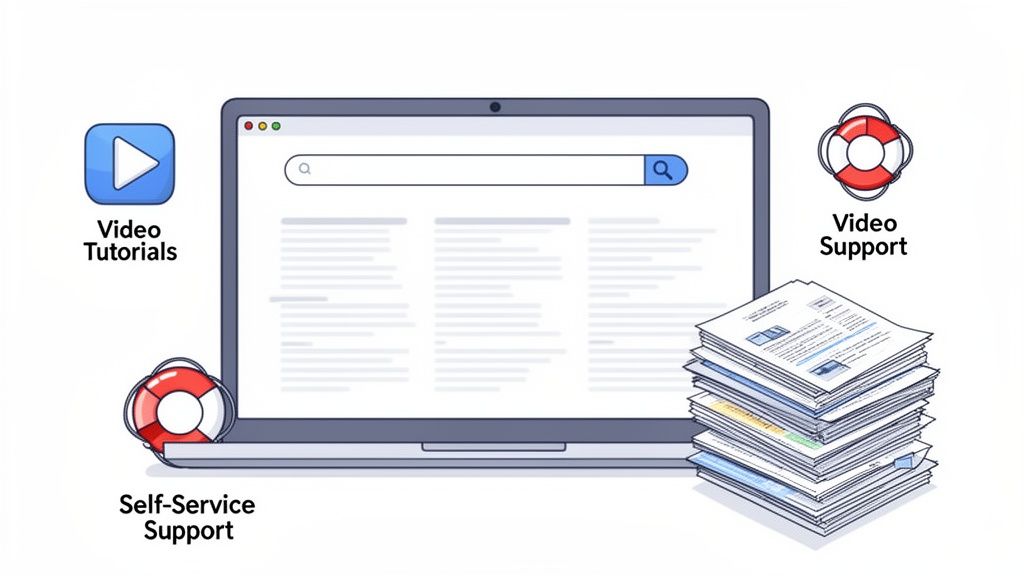
This strategy turns your documentation into a 24/7 success tool. Companies like Atlassian excel at this, maintaining comprehensive documentation and community forums that act as a first line of defense for user questions. Similarly, Shopify’s extensive help center successfully addresses millions of merchant queries without direct human intervention, demonstrating the scalability and efficiency of a strong self-service model.
How to Implement This Practice
Identify Common Questions: Use a meeting intelligence tool like GLINKY to analyze customer calls and automatically identify frequently asked questions and common pain points. This data provides a clear roadmap for what content to create first.
Create Diverse Content Formats: Cater to different learning styles. Convert call recordings of feature walkthroughs into concise video tutorials. Turn detailed explanations from call notes into step-by-step written guides with screenshots.
Make Resources Context-Aware: Integrate your knowledge base directly into your application. Use tools that can suggest relevant articles based on the page a user is viewing, providing help exactly when and where it is needed.
Integrate Resources into Your Workflow: Use GLINKY to automatically include links to relevant knowledge base articles in your post-meeting follow-up emails. This reinforces the conversation and directs customers to resources where they can learn more, building their self-sufficiency.
Key Insight: A great self-service portal does more than just answer questions; it teaches customers how to be more successful with your product. Every article and video is an opportunity to guide them toward achieving their goals independently.
6. Executive Engagement and Strategic Business Reviews
While daily interactions focus on operational health, true strategic alignment requires connecting with executive sponsors. Executive Business Reviews (EBRs) are high-level, forward-looking meetings that shift the conversation from product features to business impact. This practice solidifies your company's role as an indispensable partner by demonstrating tangible value directly to the decision-makers who control budgets and long-term strategy.
This approach moves beyond standard Quarterly Business Reviews (QBRs) by focusing purely on strategic outcomes and future planning, rather than tactical support issues. For example, Salesforce leadership often engages in EBRs with key stakeholders at its Fortune 500 accounts to discuss market trends and joint innovation. Similarly, Workday schedules annual executive reviews with CFOs and CIOs to align its product roadmap with their financial and technological goals. This is a core component of effective customer success best practices.
How to Implement This Practice
Prepare a Strategic Narrative: Use a tool like GLINKY to review the unified timeline of all customer interactions, decisions, and past outcomes. Build a compelling story that connects your solution directly to the customer’s major business accomplishments over the last period.
Reference Key Milestones: Your preparation should include referencing specific achievements and value propositions discussed in previous calls, which are documented in your central repository. This demonstrates consistency and shows that your entire team is aligned with their goals.
Identify and Engage Executives: Use a platform with verified contact data, like GLINKY, to identify additional executive stakeholders who should be included. Expanding your footprint within the C-suite protects the account and opens doors for new opportunities.
Document and Assign Actions: Rigorously document all outcomes and strategic action items from the EBR. Assign clear ownership and deadlines within a shared system to ensure accountability and drive progress on the agreed-upon initiatives. You can find powerful templates for meeting follow-up emails to confirm these next steps professionally.
Key Insight: An EBR is not a report card; it's a strategic summit. The goal is to stop talking about your product's performance and start discussing how your partnership will shape their business's future. This elevates the relationship from vendor to strategic ally.
7. Timely and Contextual Support Response
Resolving customer issues quickly is a foundational expectation, but doing so with deep contextual awareness is what separates adequate support from exceptional customer success. Timely and contextual support means every interaction is informed by the customer’s history, goals, and recent activities. This practice transforms support from a reactive ticket-clearing function into a value-reinforcing component of the customer journey, making it a critical customer success best practice.
When a customer reaches out, they shouldn't have to repeat their business goals or explain their usage patterns. World-class companies like Amazon and Zendesk excel by equipping their support teams with the necessary context to provide fast, relevant solutions. For instance, a GitHub support agent can see a user’s repository and recent activity, allowing them to offer specific, informed guidance instead of generic troubleshooting steps.
How to Implement This Practice
Centralize Customer Interaction History: Consolidate all customer touchpoints, from sales calls to support tickets, into a single source of truth. A complete history gives support agents immediate context on past challenges and objectives.
Train Support on Business Context: Equip support teams to look beyond the immediate ticket. When a request comes in, they should reference notes from past QBRs or check-ins to understand how the issue impacts the customer's larger goals.
Integrate Meeting Intelligence with Support Tools: Sync your meeting intelligence platform with your helpdesk. A tool like GLINKY can automatically push call notes, key decisions, and action items into a CRM, which then populates the support agent’s view. This provides instant access to conversations that happened with the CSM or account manager.
Document and Share Solutions: Use a meeting intelligence tool to capture the details of support calls and their resolutions. Documenting these interactions in a shared platform like GLINKY creates a searchable knowledge base that helps CSMs and other support agents resolve similar issues faster in the future.
Key Insight: Context turns a support interaction from a simple transaction into a relationship-building moment. When customers feel understood, their trust in your product and your team deepens, directly impacting retention and advocacy.
8. Customer Feedback Loops and Continuous Product Improvement
The most successful products evolve in direct response to customer needs. A systematic customer feedback loop involves gathering, analyzing, and acting on customer input to guide product improvements. This practice turns customer insights into a core driver of your product roadmap, ensuring development efforts are always aligned with real-world user challenges and one of the most vital customer success best practices.
By actively soliciting and incorporating feedback, you demonstrate that customer voices are heard and valued, which builds immense loyalty. Companies like Figma excel at this by running customer advisory boards and beta testing programs, directly involving users in the creation process. Similarly, Slack's product development is famous for being heavily influenced by user feedback, ensuring the tool remains indispensable to its teams.
How to Implement This Practice
Make Feedback a Standing Agenda Item: Dedicate time in every customer check-in or QBR to specifically ask for product feedback. Include it as a formal point on your meeting agenda to signal its importance.
Capture and Centralize Insights: Use a tool like GLINKY to record calls where feedback is shared. Its transcripts and notes make it easy to extract specific feature requests, pain points, and suggestions without losing context. Sync these notes directly to your product management system (e.g., Jira, Asana) to create a direct line from the customer to your development team.
Analyze for Themes: Don't just collect individual comments; look for patterns. Use GLINKY's conversation intelligence to search across multiple customer transcripts for keywords related to specific features or frustrations. This helps you identify high-impact trends that should be prioritized.
Close the Loop: The process isn't complete until you inform the customer of the outcome. When a feature they requested is shipped, send a personal note referencing their original feedback. This small action has a massive impact on loyalty and makes customers feel like true partners. Following up on these commitments is key, and you can find effective methods for tracking action items to ensure nothing is missed.
Key Insight: A closed feedback loop transforms customer complaints into a strategic asset. It proves you are listening and empowers your product team to build what customers actually want, directly reducing churn and increasing expansion revenue.
9. Cross-Functional Alignment and Handoffs
Siloed departments are the enemy of a cohesive customer experience. Effective cross-functional alignment ensures that customer context, goals, and history are preserved as they move from prospect to advocate. This practice prevents the customer from having to repeat themselves and ensures that every team, from sales to support, is working from the same script. This alignment is a foundational customer success best practice that turns a collection of departments into a unified, customer-centric organization.
A poor handoff from sales to customer success can erode trust before the relationship truly begins. The customer's initial excitement fades when they realize their new point of contact has no idea what was promised or what their primary goals are. Companies like Salesforce solve this by creating "Account Teams" where sales and success representatives work together, while Slack uses shared channels for accounts so sales, support, and success can collaborate in real time.
How to Implement This Practice
Establish a Formal Handoff Protocol: Define a clear, non-negotiable process for the sales-to-success handoff. This should include a final joint call where the salesperson introduces the Customer Success Manager (CSM), and the CSM can confirm the goals and next steps discussed during the sales process.
Create a Single Source of Truth: Use a meeting intelligence tool like GLINKY to capture all pre-sale and post-sale interactions. When the notes and action items from every call are synced to a central CRM, the CSM can review the entire sales history, understand the customer’s "why," and start the relationship with full context.
Assign Cross-Functional Action Items: During internal strategy sessions or customer calls, use your tools to create shared action items. With GLINKY, you can assign an action item to a product manager to investigate a feature request or to a support lead to address a technical question, ensuring clear ownership and follow-through.
Build Shared Dashboards: Create dashboards in your CRM or data platform that are visible to all teams. These should display key account health metrics, upcoming renewals, open support tickets, and key objectives, providing a single-pane view of the customer's status.
Key Insight: The customer doesn't see your company as separate departments; they see it as one entity. A seamless internal handoff makes that perception a reality, demonstrating that you are an organized and reliable partner committed to their success from day one.
10. Expansion and Upsell Strategy Based on Customer Success
True expansion revenue isn't a product of opportunistic selling; it's the natural outcome of a customer achieving their desired results. This approach ties upsell and cross-sell opportunities directly to customer value, turning expansion into a validation of your partnership. It positions growth not as a sales goal, but as the next logical step in the customer's success journey, a fundamental component of effective customer success best practices.
Rather than a surprise pitch from a sales rep, the conversation is initiated by the Customer Success Manager (CSM) who has a deep understanding of the customer's business. For example, HubSpot encourages customers to adopt additional hubs (Marketing, Sales, Service) as their needs mature and business scales. Similarly, Adobe Cloud drives significant growth by showing how adding tools like Photoshop or Premiere Pro can solve new creative challenges for existing Illustrator users, grounding the expansion in proven value.
How to Implement This Practice
Identify Needs During Check-ins: During regular customer calls, actively ask about unmet needs or challenges in adjacent departments or business units. Frame these questions around their goals, asking, "What's the next big milestone for your team, and are there any roadblocks we haven't discussed?"
Ground Proposals in Data: Use CRM data and usage patterns to build a business case. If you see a customer is hitting API limits or has high adoption in one department, present an upgrade or cross-seat expansion as a solution to their visible growing pains.
Integrate into Business Reviews: Make expansion a natural part of the Quarterly Business Review (QBR). Present it as a forward-looking strategy based on the success they've already achieved. Show them a roadmap where adding a new feature or service helps them reach their next set of KPIs.
Document and Socialize Expansion Ideas: After a call where an expansion opportunity is discussed, use a tool like GLINKY to automatically capture notes and include the potential business case in the follow-up email. This creates a documented thread of the conversation and allows your internal champion to socialize the idea with other stakeholders.
Key Insight: When expansion is driven by the CS team and tied directly to the customer's documented goals and successes, it strengthens the relationship. The conversation shifts from "Do you want to buy more?" to "Here is how we can help you achieve more." This builds trust and makes growth a shared objective.
Customer Success: 10 Best Practices Comparison
🔄 Implementation Complexity | ⚡ Resource Requirements & Scalability | 📊 Expected Outcomes | 💡 Ideal Use Cases | ⭐ Key Advantages |
|---|---|---|---|---|
Proactive Communication and Regular Check-ins — Medium: requires cadence design, agendas, multi-stakeholder coordination. | High time investment per account; scales poorly without automation but improves with tooling. | Higher retention, earlier churn detection, more upsell opportunities. | High-touch enterprise accounts, renewal-risk customers, strategic partnerships. | Builds trust, reduces reactive tickets, uncovers expansion (Effectiveness: ⭐⭐⭐⭐) |
Comprehensive Onboarding and Implementation Planning — High: structured discovery, roadmaps, role-based training. | Significant upfront resources (CS, PM, trainers); resource-heavy for custom implementations. | Faster time-to-value, higher adoption, lower early churn. | New customers, complex product deployments, enterprise implementations. | Accelerates ROI and adoption, aligns expectations (Effectiveness: ⭐⭐⭐⭐) |
Health Scoring and Predictive Analytics — High: data integrations, modeling, calibration and maintenance. | Moderate-to-high engineering and analytics effort; highly scalable once implemented. | Data-driven prioritization, early risk identification, targeted expansion. | Companies with rich usage/CRM data aiming to scale CS programs. | Objective account prioritization, scalable management (Effectiveness: ⭐⭐⭐⭐) |
Clear Success Metrics and Goal Alignment — Medium: discovery workshops, KPI definition, ongoing tracking. | Moderate resources for discovery and reporting; scales with standardized templates. | Shared accountability, clearer ROI evidence, smoother renewals. | Enterprise customers needing measurable business outcomes, executive sponsors. | Reduces misalignment, supports renewal and upsell decisions (Effectiveness: ⭐⭐⭐⭐) |
Effective Knowledge Base and Self-Service Resources — Medium: content creation and maintenance process. | High initial content effort; low marginal cost; very scalable when well organized. | Fewer support tickets, 24/7 customer enablement, higher satisfaction. | Large SMB user bases, common repeatable questions, product-led growth models. | Reduces support load, empowers users, SEO value (Effectiveness: ⭐⭐⭐) |
Executive Engagement and Strategic Business Reviews — High: C-level coordination, customized presentations, prep. | Very high executive time and preparation; not scalable to all accounts. | Strengthened strategic partnership, increased expansion and renewals. | Top-tier enterprise accounts, strategic partnerships, roadmap alignment. | Drives strategic alignment and large expansions (Effectiveness: ⭐⭐⭐⭐) |
Timely and Contextual Support Response — Medium: SLAs, context access, routing, QA processes. | Requires trained support staff and tooling; costly to operate 24/7 but critical for retention. | Faster resolution, higher CSAT, identification of product issues. | Time-sensitive products, high-touch customers, mission-critical use cases. | Improves satisfaction and reliability (Effectiveness: ⭐⭐⭐⭐) |
Customer Feedback Loops and Continuous Product Improvement — Medium: feedback channels, analysis, PM collaboration. | Ongoing effort across CS and Product; can be automated for collection and tracking. | Product improvements aligned to customer needs, increased advocacy. | Product-led companies, rapid-release cycles, customers engaged in roadmap. | Drives customer-centric roadmap and loyalty (Effectiveness: ⭐⭐⭐⭐) |
Cross-Functional Alignment and Handoffs — High: process design, shared systems, cultural change. | Requires investments in CRM integrations, governance, and cross-team meetings; scalable with discipline. | Seamless customer experience, fewer repeated handoffs, faster resolutions. | Complex account lifecycles, multi-team organizations, enterprise accounts. | Reduces silos, preserves context across teams (Effectiveness: ⭐⭐⭐⭐) |
Expansion and Upsell Strategy Based on Customer Success — Medium: playbooks, analytics, coordinated GTM. | Moderate resources for analysis and collaboration; scalable when playbooks and signals exist. | Higher LTV, profitable growth grounded in customer outcomes. | Accounts showing product adoption and clear business impact signals. | Drives revenue growth while preserving trust (Effectiveness: ⭐⭐⭐⭐) |
Turning Best Practices into Business reality
We've explored a detailed roadmap of customer success best practices, from the initial handshake of onboarding to the strategic partnership of Executive Business Reviews. Moving from theory to application is where the real work begins. It’s not about executing a flawless, simultaneous rollout of all ten strategies overnight. Instead, it's about making a deliberate commitment to a customer-centric operational model.
The core idea connecting proactive communication, health scoring, and cross-functional handoffs is the creation of a single, reliable source of truth for every customer relationship. When your teams operate from a unified understanding of a customer's history, goals, and challenges, the friction that causes churn and missed opportunities begins to dissolve. This unified view is the foundation upon which true customer success is built.
Synthesizing the Core Tenets
Let's distill the journey down to its most crucial takeaways. The most impactful customer success programs are not just reactive support functions; they are proactive, data-informed, and deeply integrated into the business's revenue engine.
Proactivity Over Reactivity: The shift from putting out fires to preventing them is fundamental. Health scores, regular check-ins, and clear success plans are all tools to get ahead of problems before they derail a customer's journey.
Data as a Compass: Gut feelings have their place, but sustainable success is guided by data. Health scoring, clear metrics, and feedback loops provide the objective insights needed to make smart decisions, allocate resources effectively, and prove the value of your efforts.
Alignment is Non-Negotiable: A disjointed customer experience is a leading cause of churn. Seamless handoffs from Sales, unified goals with Product, and consistent messaging across all touchpoints are critical. Success is a team sport, requiring deep collaboration across departmental lines.
Key Insight: The ultimate goal is to make your customer's success synonymous with their use of your product. When they win, you win. This alignment transforms a transactional vendor relationship into a strategic partnership, paving the way for retention, advocacy, and expansion.
Your Actionable Next Steps
Adopting these customer success best practices is a marathon, not a sprint. To avoid feeling overwhelmed, start with a focused, iterative approach.
Conduct an Audit: Begin by evaluating your current processes against the practices outlined in this article. Where are the most significant gaps? A common starting point is the onboarding experience, as it sets the tone for the entire customer lifecycle.
Pick One or Two Focus Areas: Don't try to boil the ocean. Select one or two practices that will have the most immediate impact on your business. For a SaaS company, this might mean refining customer health scores or building out a self-service knowledge base.
Define and Measure Success: For each initiative, establish clear KPIs. If you're improving onboarding, track time-to-first-value. If you're implementing feedback loops, measure the number of product improvements influenced by customer input.
Empower Your Team with the Right Tools: Manual tracking and siloed information are the enemies of effective customer success. A central system for capturing meeting notes, action items, and customer sentiment is vital for maintaining momentum and ensuring nothing falls through the cracks.
To truly turn these best practices into reality, especially within the SaaS landscape, exploring comprehensive approaches like these 10 actionable SaaS customer support best practices can provide invaluable guidance. By integrating world-class support with proactive success strategies, you create a powerful, retention-focused customer experience. The journey toward mastering customer success is continuous, built on a cycle of implementation, measurement, and refinement. By consistently placing your customers' achievements at the heart of your strategy, you don't just reduce churn; you cultivate your most potent and sustainable engine for growth: your own happy customers.
Ready to turn customer conversations into actionable intelligence? GLINKY automatically captures, summarizes, and organizes every interaction, creating the single source of truth your customer success team needs to drive results. See how it works at GLINKY.
People also read
10 Sales Enablement Best Practices to Unify Your Revenue Engine in 2026
Productivity
Mar 13, 2026
How to Manage Sales Pipeline for Predictable Revenue Growth
Productivity
Mar 14, 2026
How to Qualify Leads in Sales Without Wasting Time
Productivity
Mar 17, 2026

What is Conversation Intelligence? A Practical Guide for Sales Teams
Productivity
Mar 18, 2026

Top 10 Sales Discovery Questions That Close More Deals
Productivity
Mar 25, 2026
Taking Minutes of Meeting: A Guide to Transforming Chaos into Action
Productivity
Feb 16, 2026
Action Items List: A Practical Guide to Drive Real Results
Productivity
Feb 19, 2026
Master the summary of a meeting for clear decisions and follow-ups
Productivity
Feb 22, 2026

Track Action Items: A Practical Guide to Using AI for Flawless Follow-Up
Productivity
Feb 17, 2026
Unlock: How to Take Notes on a Computer for Peak Productivity in 2026
Productivity
Feb 26, 2026
How to Record Google Meet: A Complete Guide for 2026
Productivity
Mar 4, 2026
12 Best AI Note Taking App Choices for 2026: The Definitive Guide
Productivity
Mar 6, 2026
How to Improve Customer Retention: Practical Tips to Boost Loyalty
Productivity
Mar 8, 2026
10 Client Communication Best Practices to Master in 2026
Productivity
Mar 7, 2026
The 12 Best AI Meeting Assistant Tools for 2026: A Deep Dive
Productivity
Mar 15, 2026

Your Guide to the Ultimate AI Email Writer
Productivity
Feb 27, 2026

Your Guide to Sales Call Recording Software in 2026
Productivity
Mar 2, 2026
How to Take Better Meeting Notes and Drive Real Results
Productivity
Mar 5, 2026
Top 10 Picks for best crm for small business
Productivity
Mar 3, 2026
What is an Ideal Customer Profile: A Guide to Driving Growth
Productivity
Mar 9, 2026
Automated meeting minutes: Turn talks into actionable notes
Productivity
Mar 11, 2026
The Top 12 AI Powered Sales Tools to Boost Revenue in 2026
Productivity
Mar 16, 2026
AI Note Taking For Meetings: Fast, Smart AI Notes That Drive Collaboration
Productivity
Mar 19, 2026
Understanding Transcription Service Cost: A 2026 Guide
Productivity
Mar 20, 2026

Master Your Meetings With The Note Taking Charting Method
Productivity
Feb 18, 2026
The Ultimate 2026 Guide: 8 Meeting Follow Up Email Template Scenarios
Productivity
Feb 20, 2026
Master the Art of Taking Meeting Notes for Actionable Outcomes
Productivity
Feb 25, 2026
12 Best Sales Lead Generation Tools to Boost Your Pipeline in 2026
Productivity
Mar 10, 2026

Translation Vs Transcription: Which Service Do You Really Need?
Productivity
Mar 12, 2026
Mastering the goals of a meeting to drive decisions and boost team alignment
Productivity
Mar 23, 2026

The 12 Best Free AI Email Writer Tools for 2026
Productivity
Mar 22, 2026
A Guide to AI Sales Enablement Platforms in 2026
Productivity
Mar 21, 2026

Automate Follow Up Emails: Actionable Insights for Boosting Sales & Efficiency
Productivity
Mar 26, 2026

Follow Up Email Subjects That Convert: Increase Opens and Replies
Productivity
Feb 17, 2026

Your Playbook for Outbound Lead Generation in 2026
Productivity
Feb 28, 2026
Your Essential Meeting Action Items Template to Drive Results
Productivity
Feb 23, 2026

Your Guide to Using an Email Writer AI for Maximum Impact
Productivity
Feb 23, 2026
8 Essential Ground Rules at Meetings to Maximize Productivity in 2026
Productivity
Mar 24, 2026

Otter.ai vs Glinky
Productivity
Feb 5, 2026
AI Tools for Startup Founders [2026]
Productivity
Feb 4, 2026
Best AI Tools for Startups [2026]
Tools
Feb 3, 2026
Sales Call Notes: How to Capture Every Detail Without Losing the Deal
How to
Feb 2, 2026
How to Take Meeting Notes: 7 Methods That Actually Work [2026]
How to
Jan 14, 2026
![AI Meeting Minutes | Free Forever [2026]](https://framerusercontent.com/images/zYQGRjgLX63tiouLTK65LvCcjK8.png?width=402&height=263)
AI Meeting Minutes | Free Forever [2026]
How to
Jan 13, 2026
![How to Record Zoom Meetings Without a Bot [2026] 3 Easy Methods](https://framerusercontent.com/images/gGoQV8bPb9zR5weVruinbjaxO0.png?width=402&height=263)
How to Record Zoom Meetings Without a Bot [2026]
How to
Jan 9, 2026
Bot-Free AI Meeting Notes: We Tested the 6 Best Tools in 2026
Tools
Jan 8, 2026
Glinky vs Fireflies.ai
Tools
Jan 7, 2026
15 Best AI Tools to Boost Your Productivity in 2026
Productivity
Jan 6, 2026