Nov 13, 2025
Productivity
8 Essential Ground Rules at Meetings to Maximize Productivity in 2026
Meetings are the backbone of any revenue team, from high-stakes discovery calls to critical internal sync-ups. Yet, without a clear framework, they often devolve into unproductive, time-wasting sessions that drain energy and stall progress. The solution isn't fewer meetings; it's better meetings. Establishing clear ground rules at meetings is the single most effective way to transform them from chaotic obligations into strategic, high-ROI activities.
This guide provides a practical, actionable roundup of the most effective rules, tailored for different scenarios. We'll give you the exact phrasing to use, enforcement tips, and show you how to integrate them seamlessly into your workflow. By setting clear expectations, you ensure every conversation drives results.
Accountability is just as important as structure. Poorly documented meetings lead to lost productivity and confusion, highlighting the importance of using an essential meeting minutes format to capture key decisions and action items effectively. This article will show you how to pair strong ground rules with solid documentation to create a culture of efficiency. We'll cover everything from starting on time and staying focused to assuming good intent and respecting confidentiality, giving you the tools to reboot your meeting culture immediately.
1. Start and End on Time
Few ground rules at meetings are as fundamental yet impactful as respecting the clock. Adhering to strict start and end times is a powerful signal of respect for every participant's schedule and demonstrates a high degree of professionalism. For revenue teams juggling a packed calendar of discovery calls, demos, and internal syncs, punctuality isn't just a courtesy; it's a critical component of operational efficiency that prevents cascading delays and keeps the entire day on track.
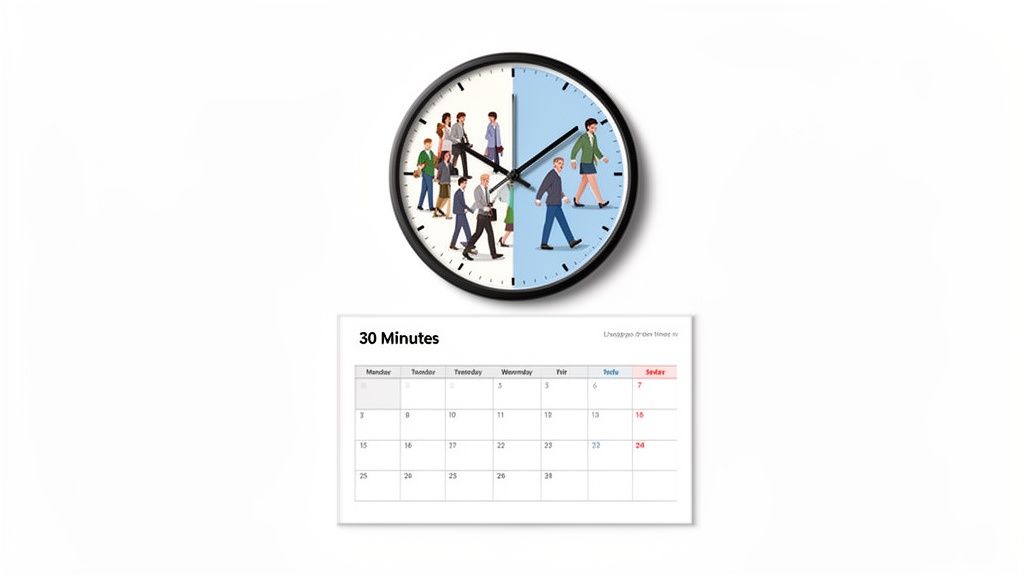
This rule is particularly vital in client-facing scenarios. A late start can erode a prospect's confidence before the call even begins, while running over time can be perceived as disorganized and disrespectful of their commitments.
Implementation Tips
Verbal Contract: State the time constraint at the very beginning. For example: "Thanks for joining. We have 30 minutes set aside, so my goal is to cover the agenda and leave the last 5 minutes for next steps. Sound good?"
Buffer Your Calendar: Schedule meetings for 25 or 50 minutes instead of the default 30 or 60. This builds in a natural transition buffer, ensuring you aren't late for your next call. Tools like Calendly and Google Calendar have settings to automate this.
Use a Timer: Set a visible timer or a silent alarm on your phone to go off 5 minutes before the scheduled end time. This is your cue to pivot the conversation toward decisions and finalizing the action items list.
Automate Note-Taking: Ending on time often means cutting off valuable discussion. Using an AI meeting assistant to automatically transcribe and summarize the call ensures no detail is lost. With tools like Glinky, you can focus on wrapping up while the platform captures everything. For more ideas on improving call efficiency, check out this guide on the best AI meeting assistant options available.
Example in Action: The sales team at HubSpot runs a high-volume pipeline by enforcing strict 30-minute discovery calls. This discipline allows them to connect with more prospects daily, maintaining a high velocity from initial contact to qualification. The non-negotiable end time forces reps to be concise and focused on the most critical qualifying questions.
2. One Speaker at a Time
Establishing a "one speaker at a time" policy is one of the most effective ground rules at meetings for ensuring clear communication. This approach prevents the confusion and lost details that arise from people talking over each other. For revenue teams conducting high-stakes discovery calls, demos, and client reviews, it creates a professional and respectful atmosphere that builds trust and ensures every voice is heard.
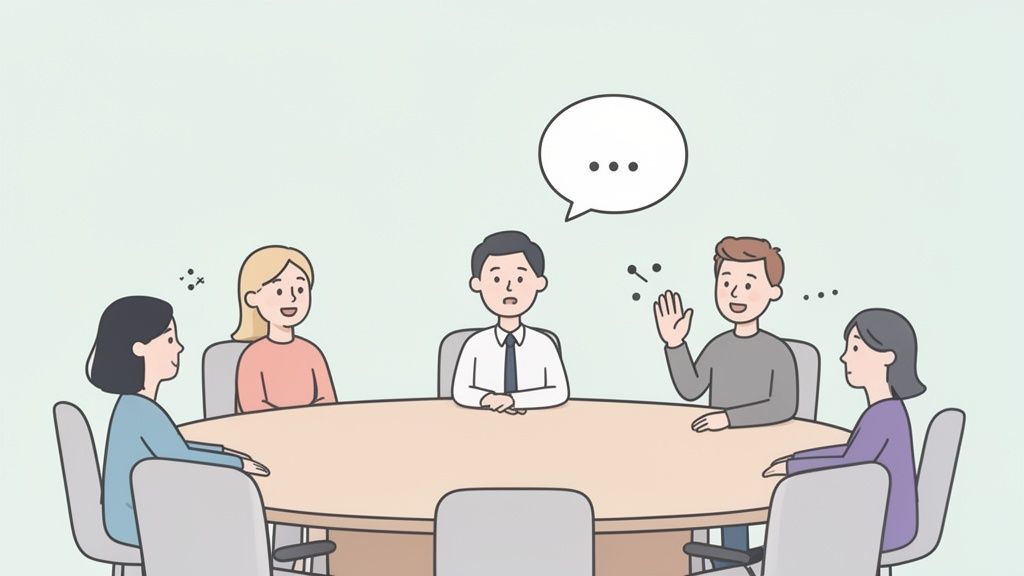
This rule is especially important when using speaker recognition technology to capture and attribute statements to specific individuals. When participants speak one at a time, tools like Glinky can produce clean, accurate transcripts where every comment is correctly assigned, making post-meeting review far more effective.
Implementation Tips
Use Virtual Hand-Raising: In larger meetings on platforms like Zoom, Teams, or Google Meet, encourage participants to use the "raise hand" feature. This creates an orderly queue for speakers.
Establish a Speaking Order: For panel discussions or group demos, agree on a speaking order before the call begins. This sets clear expectations and minimizes interruptions.
Set the Stage on Calls: Start discovery calls by creating a framework for active listening. You can say: "I want to make sure I capture everything accurately, so I’ll be taking notes as you share your challenges. Please feel free to go into detail."
Verify AI Attribution: After a meeting, review your Glinky transcript to confirm that statements were attributed to the correct speaker. This helps reinforce the one-speaker rule for future calls.
Example in Action: Law firms and consulting groups strictly enforce a single-speaker protocol during client consultations. This discipline ensures that every detail is captured accurately for meeting minutes and legal records, preventing costly misunderstandings and maintaining a high standard of professional conduct.
3. Stay Focused on the Agenda
Maintaining focus on predetermined topics is one of the most effective ground rules at meetings for ensuring productivity. A clear agenda acts as a roadmap, guiding the conversation, preventing detours into irrelevant topics, and guaranteeing that all objectives are met within the allocated time. For revenue teams, where every minute counts, agenda adherence directly impacts deal progression, team alignment, and overall pipeline velocity.
A well-defined agenda not only keeps participants on track but also helps AI tools like Glinky accurately extract the most relevant decisions and action items from calls. When conversations are structured, the resulting summaries and follow-ups are far more precise and useful for driving outcomes.
Implementation Tips
Circulate in Advance: Send the agenda via the calendar invite or a separate email at least 24 hours before the meeting. This gives everyone time to prepare their thoughts.
State the Plan: Kick off every discovery call by outlining the structure. For example: "Here's what I'd like to cover in our 30 minutes together..." This sets clear expectations from the start.
Create a "Parking Lot": When off-topic but important ideas arise, note them in a "parking lot" to be addressed later. This acknowledges the point without derailing the current discussion.
Timebox Agenda Items: Allocate specific time blocks for each section (e.g., 5 min intro, 15 min discovery, 10 min demo, 5 min next steps) to maintain pace.
Use Templates: For recurring meetings like team syncs or client check-ins, build a standard agenda template to save preparation time and ensure consistency. This also makes it easier to create a clear action items list post-meeting.
Example in Action: Stripe's partnership team often uses a tiered agenda for complex negotiations. Items are categorized as "must-cover" (non-negotiable topics), "should-cover" (important but can be deferred), and "nice-to-cover" (bonus items if time allows). This flexible structure ensures critical points are always addressed while allowing for natural conversation flow.
4. No Multitasking or Distractions
One of the most crucial ground rules at meetings is a commitment to single-tasking. This rule requires all participants to give their full, undivided attention by closing email, silencing notifications, and avoiding other applications. For revenue teams, full engagement during a discovery call or demo directly impacts deal quality, prospect perception, and the ability to gather accurate information. Distractions don't just reduce your own comprehension; they signal a lack of respect and professionalism that can undermine client relationships before they even begin.

This focus is a competitive advantage. The act of listening intently, without the pull of a notification, allows you to pick up on subtle buying signals and customer pain points that are easily missed. In an open office, a cacophony of background noise can make this focus nearly impossible. To truly tackle the battlefield of noise that kills concentration and prevents effective communication, consider integrating physical solutions like high-quality acoustic panels and pods.
Implementation Tips
Set the Tone: Open the meeting by modeling focus. Say, "To make sure I give you my full attention, I've closed everything else on my screen, and I'd appreciate it if we could all do the same."
Manage Digital Interruptions: Set your Slack or Teams status to "In a call—back in 30 min" to prevent interruptions from colleagues. For high-stakes calls, use a dedicated quiet space.
Embrace the 'Phone Stack': For internal team meetings, implement a "phone stack" rule where everyone places their phone face down in the center of the table until the meeting concludes.
Trust Your Tech: Rely on a meeting assistant to handle the administrative load. When you trust a tool like Glinky to capture notes and action items, you can close your CRM and email tabs and simply focus on the person you're speaking with.
Example in Action: McKinsey consultants are famous for taking handwritten notes in client meetings, forgoing laptops entirely. This simple act communicates total focus and respect, building immediate rapport. Similarly, top-performing SDRs at Outreach report higher conversion rates when they avoid multitasking during discovery calls, allowing them to engage more deeply with prospect needs.
5. Assume Good Intent
This ground rule creates psychological safety by asking participants to presume that everyone intends well, even when communication is unclear or disagreements arise. For revenue teams managing internal alignment and prospect relationships, assuming good intent prevents defensive reactions, reduces friction, and keeps conversations collaborative. It’s a core principle for productive ground rules at meetings, especially when discussing lost deals, missed forecasts, or conflicting priorities.
This approach stops conversations from devolving into blame games. Instead of questioning motives, the team can focus on understanding perspectives and solving the underlying problem. It fosters an environment where feedback is seen as a gift, not an attack, a concept championed by Kim Scott’s Radical Candor methodology.
Implementation Tips
Reframe Your Questions: When a team member misses a deadline, ask, "What roadblocks came up that we can help with?" instead of "Why didn't you do this?" Similarly, in a forecast review, phrase it as "Help me understand the delay on this deal" rather than "Why did you miss this forecast?"
Acknowledge Push-Back: If a colleague questions your decision, welcome the input. Respond with, "I appreciate you challenging this. Here’s my thinking..." This shows you value their perspective and are open to discussion.
Review Performance with a Learning Mindset: Use call recordings to analyze team performance collaboratively. With a tool like Glinky, you can review specific moments and ask, "What did we do well here? What could we try differently next time?" This frames the review as a coaching opportunity, not a critique.
Lead by Example: The most effective way to instill this rule is to practice it yourself. Be the first to admit your own mistakes or uncertainties, creating a safe space for others to do the same.
Example in Action: Google's Project Aristotle identified psychological safety, which is directly supported by assuming good intent, as the single most important predictor of high-performing teams. Revenue teams at companies like HubSpot use this principle during sales reviews to focus on process improvement and strategy refinement rather than assigning blame for deals that didn't close.
6. Respect Confidentiality and Data Privacy
Establishing trust is the foundation of any productive business relationship, and that trust is built on a commitment to confidentiality. This ground rule ensures that sensitive information shared during meetings remains secure, whether it's proprietary company strategy, prospect data, or contract terms. For teams handling sensitive customer details, especially with regulations like GDPR and HIPAA, making data privacy a core tenet of your meeting culture is non-negotiable for maintaining legal compliance and protecting your company's reputation.
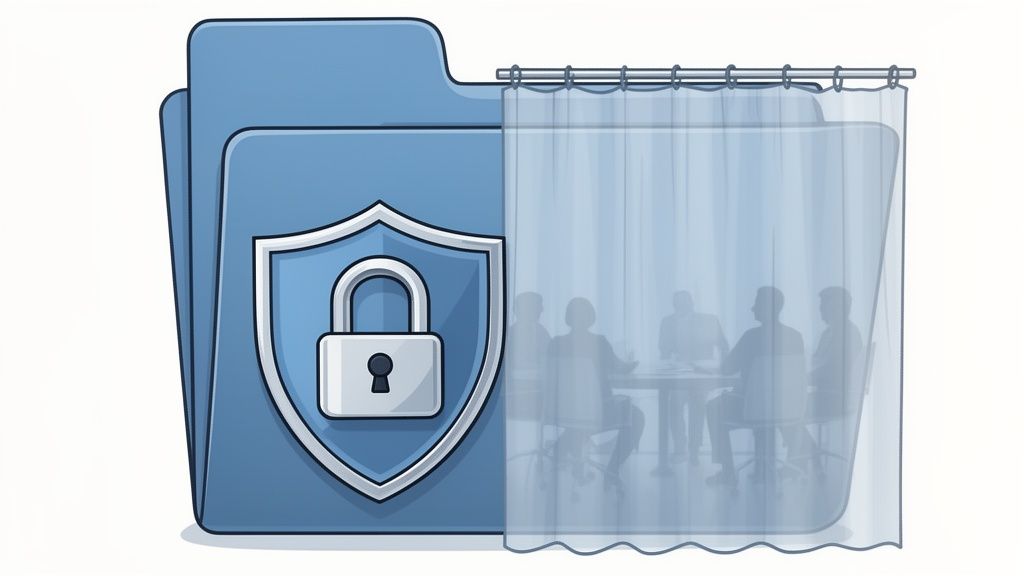
This rule is crucial for internal and external meetings alike. A casual mention of one client's pricing to another can destroy trust, while an internal leak of strategic plans can undermine competitive advantage. By formalizing confidentiality as one of your key ground rules at meetings, you create a safe environment for open and honest discussion.
Implementation Tips
Verbal Consent for Recording: Always get explicit consent. At the start of a recorded call, say: "Just so you know, this call is being recorded for quality and training purposes. Are you okay with that?" This is a legal and ethical requirement in many jurisdictions.
Set Clear Data Boundaries: Define who has access to what. For example, establish internal rules like "Prospect contact info from our lead database doesn't leave the sales team" or "Only sales leadership can view final contract terms."
Define Sharing Protocols: Before distributing meeting summaries or transcripts, confirm permission. A simple, "I'll be sharing this call summary with our internal team for accountability and follow-through. Is that okay with you?" builds transparency.
Use Access Controls: When using a tool like Glinky that records and stores call data, use its built-in access controls. You can limit who can view specific recordings or transcripts, ensuring sensitive information is only seen by relevant personnel.
Example in Action: A healthcare tech startup selling to hospitals must navigate strict HIPAA regulations. During sales calls, their reps always state their recording policy upfront and document consent. They use platform access controls to ensure that any patient information accidentally mentioned is restricted to a need-to-know group, protecting both the prospect and their own company from compliance risks.
7. Ask Questions and Seek Clarification
One of the most valuable ground rules at meetings is to create an environment where questions are encouraged, not suppressed. This rule empowers participants to seek clarification when something is unclear rather than silently nodding in agreement. For revenue teams, asking deep, probing questions is the foundation of consultative selling and prevents misalignment that can derail a deal. It shifts the dynamic from a one-way presentation to a two-way dialogue, surfacing hidden assumptions and ensuring true understanding.
In a discovery call, this means going beyond surface-level pain points to understand their real business impact. In an internal strategy session, it means challenging ambiguity to ensure everyone leaves with a shared vision and purpose. A culture of inquiry is a sign of a high-performing, psychologically safe team.
Implementation Tips
Prepare Key Questions: For client calls, prepare a list of discovery questions around budget, authority, timeline, and evaluation criteria specific to your ideal customer profile (ICP).
Use Follow-Up Prompts: Instead of moving on after a short answer, use phrases like "Tell me more about that" or "How is that affecting your team today?" to dig deeper.
Normalize Clarification: In internal meetings, make it a habit to say, "I want to make sure I understand correctly, are you saying X or Y?" This models the right behavior for the entire team.
Audit Question Quality: Use call reviews to analyze the quality and quantity of questions being asked. Glinky's question tracking can help identify if reps are consistently asking about critical deal elements like budget and decision-making authority. You can find more strategies in this guide to client communication best practices.
Example in Action: Top-performing SDRs at companies using consultative methodologies like MEDDIC prioritize asking questions over pitching features. Data shows they often ask 8-12 targeted discovery questions in a 20-minute call. This disciplined inquiry allows them to qualify prospects effectively and hand off a much clearer picture to the account executive, increasing the likelihood of a successful close.
8. Come Prepared and Do Your Homework
Arriving at a meeting unprepared is the fastest way to derail its purpose and disrespect everyone else’s time. This ground rule at meetings requires every participant to have completed their pre-work, reviewed the agenda, and gathered any necessary background information. For revenue teams, preparation is the foundation of every successful interaction, from reviewing a prospect's company details before a discovery call to understanding a deal’s history before an internal forecast review.
This rule is non-negotiable for anyone in a client-facing role. Showing up without context makes you look unprofessional and signals to the prospect that their business isn't a priority. An unprepared team member can quickly erode a buyer’s confidence and stall momentum.
Implementation Tips
Establish a Pre-Call Ritual: Block 15 minutes on your calendar before every external call specifically for research. Use this time to review the prospect's LinkedIn profile, company website, and recent news.
Use Lead Intelligence Tools: Before any outreach or discovery call, review the prospect's profile in a lead intelligence database. With Glinky, you can quickly find verified details like company size, industry, and role-specific context to tailor your approach from the first sentence.
Send Pre-Reading 24 Hours in Advance: For internal meetings, distribute the agenda and any required reading a full day ahead. Start the meeting by asking, “Any questions on the context I sent yesterday?” to set a precedent.
Create Simple Prep Templates: Standardize preparation with a simple template. For discovery, it could include: Company Context, Role Context, Goal for Call, and Key Questions. For deal reviews, include: Deal Stage, Recent Communications, and Next Steps.
Example in Action: Top-tier consulting firms like McKinsey are famous for their preparation standards, often creating extensive briefing books before major client workshops. This ensures every consultant enters the room with a deep understanding of the client’s business, challenges, and objectives, allowing them to provide immediate value rather than wasting the client's time on basic background questions.
8-Point Comparison of Meeting Ground Rules
Ground Rule | 🔄 Implementation Complexity | ⚡ Resource Requirements & Efficiency | ⭐ Expected Outcomes | 📊 Ideal Use Cases | 💡 Key Advantages / Tips |
|---|---|---|---|---|---|
Start and End on Time | Low — set clear durations and buffers | Low — calendar settings, reminders, minor integrations | ⭐ Improved punctuality and calendar flow | Back-to-back discovery/demo days; sales-heavy schedules | Use 25/50-min blocks, 5-min wrap reminders, leverage Glinky's auto-notes |
One Speaker at a Time | Moderate — norms + enforcement (moderator/tools) | Moderate — hand-raise tools, speaker-recognition tech | ⭐ Clear attribution and fewer misunderstandings | Large recorded calls, demos, cross-functional reviews | Use virtual hand-raise, assign note-taker, enables accurate Glinky speaker attribution |
Stay Focused on the Agenda | Moderate — requires prep and timeboxing | Moderate — agenda prep, facilitator time | ⭐ Higher decision velocity; fewer tangents | Complex deals, structured discovery, recurring syncs | Circulate agenda 24h prior, use parking lot, time-box items for Glinky to categorize |
No Multitasking or Distractions | Moderate — cultural enforcement and norms | Low–Moderate — status tools, device rules, training | ⭐ Better retention and richer meeting capture | High-stakes demos, discovery calls, stakeholder reviews | Announce focus at start, set statuses, close secondary apps so Glinky captures full context |
Assume Good Intent | Moderate — cultural change and training | Low — coaching and meeting norms | ⭐ Increased psychological safety and collaborative problem-solving | Forecast reviews, postmortems, cross-team conflict situations | Start with curiosity, train phrasing, use Glinky recordings for learning not punishment |
Respect Confidentiality & Data Privacy | High — policies, access controls, legal review | High — compliance tooling, training, access governance | ⭐ Legal compliance, trust protection, reduced leakage risk | Regulated industries, sensitive prospect/customer calls | Declare recordings upfront, use Glinky's access controls, require NDAs/consent where needed |
Ask Questions & Seek Clarification | Low — encourage norms and prompts | Low — prep question lists; may lengthen calls slightly | ⭐ Deeper discovery, fewer follow-ups, better alignment | Discovery calls, demos, technical discussions | Prepare core discovery questions, use open-ended prompts, audit with Glinky's question detection |
Come Prepared & Do Your Homework | Moderate — prep templates and discipline | Moderate — research tools, lead intel, prep time | ⭐ Higher meeting ROI and improved deal quality | Discovery calls, forecast reviews, demos | Use Glinky's lead data, create prep templates, block 15 min before calls for research |
Putting Your Ground Rules into Action
The journey from chaotic, unproductive meetings to focused, high-impact sessions begins with a simple but powerful tool: well-defined ground rules. Throughout this article, we’ve explored a collection of foundational principles, from the non-negotiable “Start and End on Time” to the culture-shaping “Assume Good Intent.” We’ve provided specific phrasing, enforcement tips, and even agenda templates to make these concepts immediately usable. The core message is clear: effective ground rules at meetings are not about rigid control but about creating a shared framework of respect, focus, and accountability.
Moving from knowledge to action is the critical next step. The most common mistake is attempting to implement too many changes at once. This often leads to overwhelm and a quick return to old, ineffective habits. Instead, focus on incremental progress.
Your Action Plan for Better Meetings
To make this transition smooth and sustainable, follow these concrete steps:
Select a Starting Point: Choose just one or two rules from this guide that would solve your most pressing meeting problem. Is time management the biggest issue? Start with "Start and End on Time." Are conversations constantly derailed? Implement "Stay Focused on the Agenda."
Communicate the ‘Why’: Before your next meeting, introduce the chosen rule(s) and briefly explain the intended benefit. Frame it as an experiment to improve everyone's experience. For instance, you could say, “To ensure every voice is heard and we don’t talk over each other, let’s try the ‘One Speaker at a Time’ rule for this call. It should help us capture ideas more clearly.”
Lead by Example: As the leader, your adherence to the ground rules sets the standard. Start the meeting on the dot. Gently guide conversations back to the agenda. If you commit to the process, your team is far more likely to follow suit.
Review and Refine: After the meeting, ask for quick feedback. A simple question like, “How did the new ground rule work for everyone?” can provide valuable insight. This collaborative approach builds buy-in and helps you adjust your strategy as you introduce more rules.
The Long-Term Impact of Consistency
Establishing strong ground rules at meetings does more than just save a few minutes here and there. It fundamentally reshapes your team’s communication culture. When meetings are consistently productive, they cease to be a source of dread and become a catalyst for progress. You build a team that is more engaged, a sales process that is more efficient, and a client relationship that is built on mutual respect and clear communication. The initial effort of setting and enforcing these rules pays long-term dividends in the form of accelerated decision-making, higher team morale, and, ultimately, stronger revenue growth. This isn’t just about fixing meetings; it’s about building a more effective organization from the inside out.
Ready to enforce your new ground rules without adding more administrative work to your plate? Glinky automatically records, transcribes, and captures action items from your calls, ensuring no key decisions are missed even while you focus on moderating the discussion. See how you can run disciplined, productive meetings and automate your follow-ups by trying Glinky today.
People also read
10 Sales Enablement Best Practices to Unify Your Revenue Engine in 2026
Productivity
Mar 13, 2026

How to Manage Sales Pipeline for Predictable Revenue Growth
Productivity
Mar 14, 2026

How to Qualify Leads in Sales Without Wasting Time
Productivity
Mar 17, 2026

What is Conversation Intelligence? A Practical Guide for Sales Teams
Productivity
Mar 18, 2026

Top 10 Sales Discovery Questions That Close More Deals
Productivity
Mar 25, 2026
Taking Minutes of Meeting: A Guide to Transforming Chaos into Action
Productivity
Feb 16, 2026
Action Items List: A Practical Guide to Drive Real Results
Productivity
Feb 19, 2026
Master the summary of a meeting for clear decisions and follow-ups
Productivity
Feb 22, 2026

Track Action Items: A Practical Guide to Using AI for Flawless Follow-Up
Productivity
Feb 17, 2026
Unlock: How to Take Notes on a Computer for Peak Productivity in 2026
Productivity
Feb 26, 2026
How to Record Google Meet: A Complete Guide for 2026
Productivity
Mar 4, 2026
12 Best AI Note Taking App Choices for 2026: The Definitive Guide
Productivity
Mar 6, 2026
How to Improve Customer Retention: Practical Tips to Boost Loyalty
Productivity
Mar 8, 2026
10 Client Communication Best Practices to Master in 2026
Productivity
Mar 7, 2026
The 12 Best AI Meeting Assistant Tools for 2026: A Deep Dive
Productivity
Mar 15, 2026

Your Guide to the Ultimate AI Email Writer
Productivity
Feb 27, 2026
10 Essential Customer Success Best Practices for 2026
Productivity
Mar 1, 2026

Your Guide to Sales Call Recording Software in 2026
Productivity
Mar 2, 2026
How to Take Better Meeting Notes and Drive Real Results
Productivity
Mar 5, 2026

Top 10 Picks for best crm for small business
Productivity
Mar 3, 2026

What is an Ideal Customer Profile: A Guide to Driving Growth
Productivity
Mar 9, 2026
Automated meeting minutes: Turn talks into actionable notes
Productivity
Mar 11, 2026

The Top 12 AI Powered Sales Tools to Boost Revenue in 2026
Productivity
Mar 16, 2026
AI Note Taking For Meetings: Fast, Smart AI Notes That Drive Collaboration
Productivity
Mar 19, 2026
Understanding Transcription Service Cost: A 2026 Guide
Productivity
Mar 20, 2026
Master Your Meetings With The Note Taking Charting Method
Productivity
Feb 18, 2026
The Ultimate 2026 Guide: 8 Meeting Follow Up Email Template Scenarios
Productivity
Feb 20, 2026
Master the Art of Taking Meeting Notes for Actionable Outcomes
Productivity
Feb 25, 2026

12 Best Sales Lead Generation Tools to Boost Your Pipeline in 2026
Productivity
Mar 10, 2026

Translation Vs Transcription: Which Service Do You Really Need?
Productivity
Mar 12, 2026
Mastering the goals of a meeting to drive decisions and boost team alignment
Productivity
Mar 23, 2026

The 12 Best Free AI Email Writer Tools for 2026
Productivity
Mar 22, 2026
A Guide to AI Sales Enablement Platforms in 2026
Productivity
Mar 21, 2026

Automate Follow Up Emails: Actionable Insights for Boosting Sales & Efficiency
Productivity
Mar 26, 2026

Follow Up Email Subjects That Convert: Increase Opens and Replies
Productivity
Feb 17, 2026

Your Playbook for Outbound Lead Generation in 2026
Productivity
Feb 28, 2026
Your Essential Meeting Action Items Template to Drive Results
Productivity
Feb 23, 2026
Your Guide to Using an Email Writer AI for Maximum Impact
Productivity
Feb 23, 2026

Otter.ai vs Glinky
Productivity
Feb 5, 2026
AI Tools for Startup Founders [2026]
Productivity
Feb 4, 2026
Best AI Tools for Startups [2026]
Tools
Feb 3, 2026
Sales Call Notes: How to Capture Every Detail Without Losing the Deal
How to
Feb 2, 2026
How to Take Meeting Notes: 7 Methods That Actually Work [2026]
How to
Jan 14, 2026
![AI Meeting Minutes | Free Forever [2026]](https://framerusercontent.com/images/zYQGRjgLX63tiouLTK65LvCcjK8.png?width=402&height=263)
AI Meeting Minutes | Free Forever [2026]
How to
Jan 13, 2026
![How to Record Zoom Meetings Without a Bot [2026] 3 Easy Methods](https://framerusercontent.com/images/gGoQV8bPb9zR5weVruinbjaxO0.png?width=402&height=263)
How to Record Zoom Meetings Without a Bot [2026]
How to
Jan 9, 2026
Bot-Free AI Meeting Notes: We Tested the 6 Best Tools in 2026
Tools
Jan 8, 2026
Glinky vs Fireflies.ai
Tools
Jan 7, 2026
15 Best AI Tools to Boost Your Productivity in 2026
Productivity
Jan 6, 2026