
Nov 13, 2025
Productivity
How to Manage Sales Pipeline for Predictable Revenue Growth
A sales pipeline is far more than a simple list of leads. It’s a visual, data-driven process for turning potential opportunities into a predictable growth engine for your business. Effective management means focusing your team's energy on the deals they can actually win by tracking opportunities through clear sales stages, keeping your data pristine, and using the right metrics to forecast revenue you can count on.
Your Sales Pipeline Is Your Most Important Growth Engine
Let's be real—managing sales in a spreadsheet is a recipe for chaos. We’ve all seen it: deals falling through the cracks, wildly inaccurate revenue forecasts, and a constant feeling of reacting to problems instead of getting ahead of them. If that sounds familiar, learning how to manage your sales pipeline will be a game-changer.
The first mental shift is to stop seeing your pipeline as just a tracking tool. Think of it as the central nervous system of your sales operation. When you have proactive control, you're not micromanaging; you're building a clear, repeatable process that gives you a true pulse on the health of your business. This moves your team from reactive problem-solving to strategic, forward-looking execution.
To get there, you need a solid framework. These are the five core pillars that turn a messy list of deals into a high-performance sales machine.
The 5 Pillars of Effective Sales Pipeline Management
Pillar | Objective | Actionable Tip |
|---|---|---|
1. Define Your Stages & Criteria | Create a clear, universally understood sales process. | Map stages to buyer commitments, not just rep activities (e.g., "Discovery Completed," not "Demo Scheduled"). |
2. Qualification & Prioritization | Focus sales efforts exclusively on high-potential deals. | Implement a qualification framework like BANT or MEDDIC and score leads based on their answers. |
3. Pipeline Hygiene & Maintenance | Keep your CRM data clean, accurate, and up-to-date. | Schedule a 15-minute "Pipeline Tune-Up" every Friday to review stale deals and next steps. |
4. KPIs, Metrics & Forecasting | Measure what matters to predict future revenue reliably. | Track leading indicators like Sales Velocity and Pipeline Coverage, not just historical win rates. |
5. Optimize with Automation & Workflows | Use technology to remove friction and automate grunt work. | Automate call logging and activity tracking to free up reps to focus on selling, not data entry. |
Mastering these five areas is the difference between a pipeline that’s a source of stress and one that’s a source of predictable revenue. Now, let's look at exactly why this effort pays off.
Why Pipeline Management Matters
A well-managed pipeline does more than just keep you organized. It has a direct, measurable impact on your bottom line by creating predictability and making your entire sales motion more efficient.
The core benefits really boil down to three things:
Higher Win Rates: When you focus on properly qualified leads and build momentum, your team naturally spends its time on opportunities that are far more likely to close.
Shorter Sales Cycles: Clear stages and defined next steps remove friction from the buying journey, helping prospects move forward without stalling out.
Accurate Revenue Forecasting: With clean data and true visibility into deal progression, you can predict future income with genuine confidence. No more guesswork.
Of course, you can't manage a pipeline that doesn't exist. Grasping the fundamentals of how to build a sales pipeline is the essential first step that sets the stage for everything we'll cover here.
The move from manual tracking to smart pipeline management is no longer optional. Industry data shows that AI-powered sales tools can increase win rates by 15-20 percent and slash sales cycles by up to 30 percent. This is especially true for startups and small businesses that don't have a dedicated RevOps team to lean on.
A pipeline isn't just a list of deals; it's a reflection of your sales process's health. If your pipeline is messy, your revenue will be unpredictable.
For example, having a unified timeline that centralizes every single interaction—every call, email, and internal note—gives you a complete, chronological history for every deal in your pipeline. This provides instant context and eliminates the need for reps to hunt for information across different apps.
This kind of visual, automated approach makes manual data entry obsolete, which is one of the biggest reasons pipeline reporting becomes inaccurate in the first place. It turns your CRM into a reliable source of truth that you can actually trust.
Building Your Pipeline Foundation by Defining Sales Stages
If your sales pipeline has stages like "Contacted," "In-Progress," or "Following Up," I have some bad news. You’re flying blind. Those are activity-based labels, not outcome-based milestones. They tell you what your reps are doing, but they reveal absolutely nothing about where the buyer actually is in their decision.
This is the critical difference between a messy data silo and a true revenue engine. A properly structured pipeline should mirror your buyer’s journey, with each stage marking a real, tangible step forward. Instead of guessing what "In-Progress" means this week, you know exactly what has to happen for any deal to advance.
The proof is in the numbers: companies with a formal, defined sales process see 18% more revenue growth than those that don't. It all starts with a solid foundation.
This is what it looks like to go from sales chaos to a structured engine for growth.
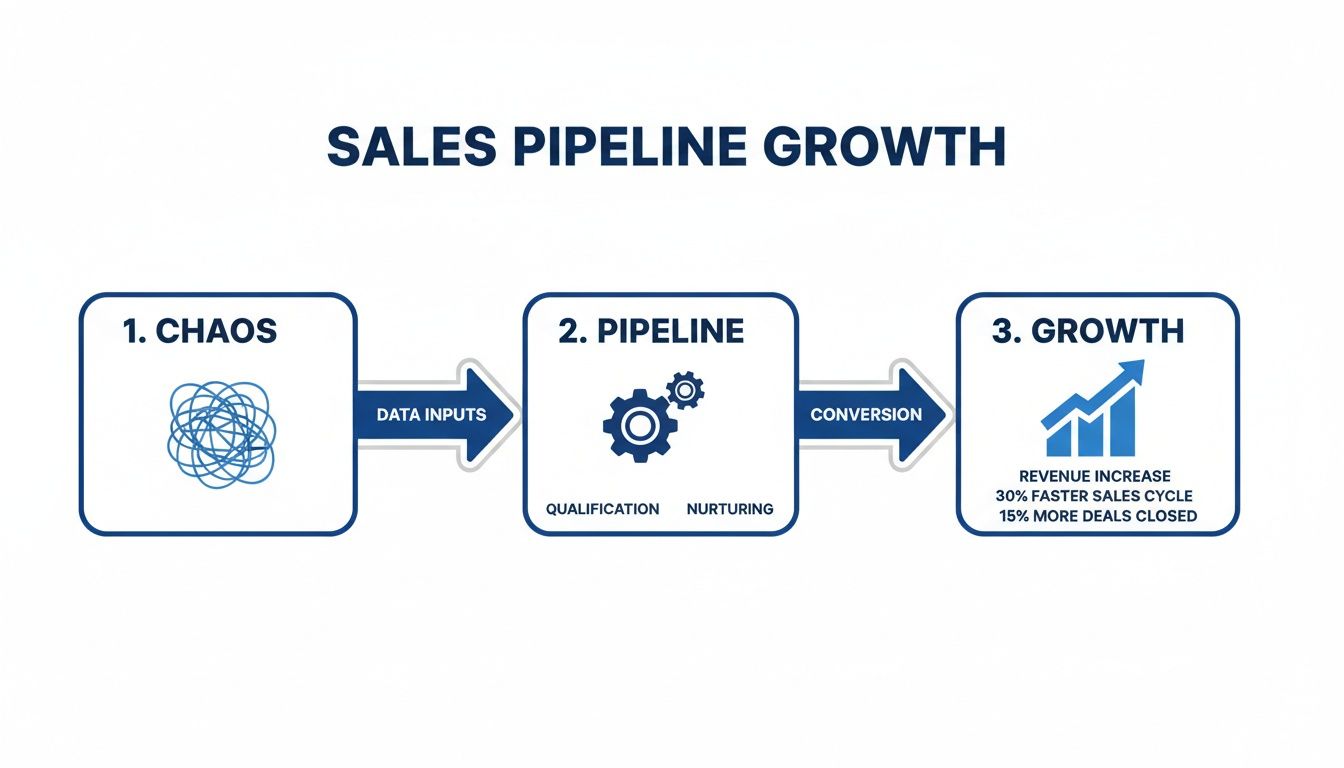
The big takeaway here? Structure isn’t about restriction. It's about building a repeatable path from total chaos to predictable revenue.
From Vague Labels to Granular Milestones
Let's walk through a real-world example. I once worked with a B2B SaaS startup whose pipeline was a black box: Lead > Contacted > Demo > Closing. Their sales manager spent half his day chasing reps for "the real status" because the CRM was totally useless for forecasting.
We tore it down and rebuilt it around buyer commitments—tangible actions that proved the prospect was moving forward. The entire mindset shifted from "What did we do?" to "What did the buyer agree to?"
Here’s a side-by-side of their old, generic stages versus the new, buyer-centric ones we implemented:
Generic (Old) | Buyer-Centric (New) | What It Represents |
|---|---|---|
Lead | New Opportunity | A contact fits your ICP, but no meaningful two-way conversation has occurred yet. |
Contacted | First Meeting Booked | The prospect has committed their time and agreed to a specific meeting date. |
Demo | Discovery Call Completed | You've had the initial call, identified a core business pain, and confirmed a need. |
Closing | Proposal Sent | You've delivered a formal, priced solution based on the needs uncovered in discovery. |
Closed | Negotiation/Contracting | The prospect is now actively reviewing the specific terms, legal details, and pricing with stakeholders. |
The new structure gave them instant clarity. A deal in "First Meeting Booked" is now objectively further along than one in "New Opportunity." It’s a simple change on the surface, but it makes the entire pipeline dramatically more valuable.
Establishing Clear Entry and Exit Criteria
Just defining the stages isn't enough. This is where most teams fail. To make it work, every single stage needs crystal-clear entry and exit criteria. These are the non-negotiable rules governing when a deal can move forward. They kill ambiguity and force every rep to manage their deals consistently.
Your pipeline stages are worthless without strict, verifiable exit criteria. This is what transforms your CRM from a messy notebook into a reliable forecasting tool.
Let's stick with our SaaS startup. We didn't just give them new stage names; we gave them rules.
Stage: First Meeting Booked
Entry Criteria: A discovery call is officially on the calendar with a specific date and time.
Exit Criteria: The discovery call actually happened, and the rep has confirmed the prospect’s primary business pain point.
Stage: Discovery Call Completed
Entry Criteria: The rep has confirmed that primary business pain.
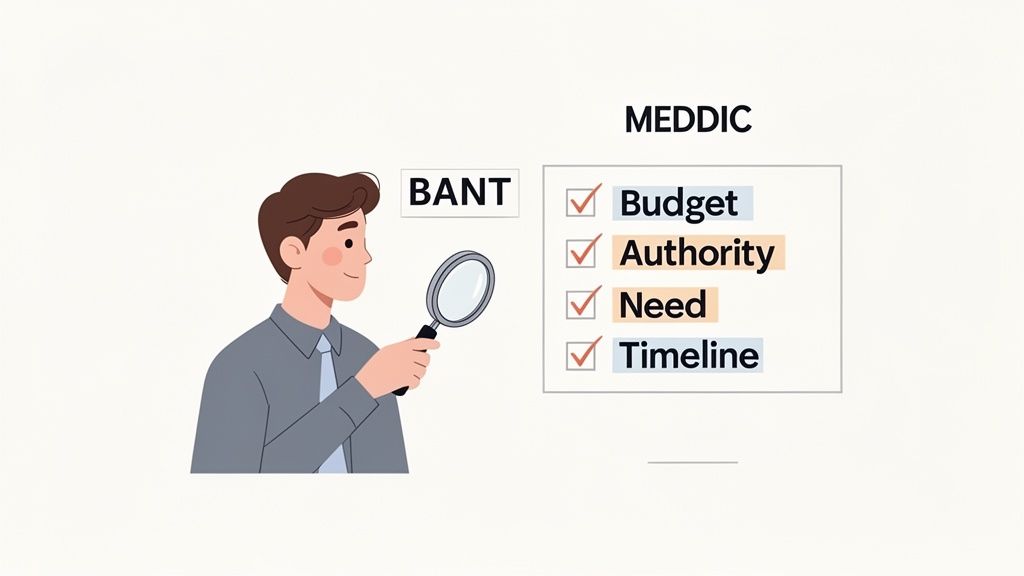
Exit Criteria: The lead has been qualified with basic BANT (Budget, Authority, Need, Timeline) and a follow-up summary email has been sent.
Stage: Proposal Sent
Entry Criteria: The rep has confirmed the decision-maker and built a proposal tailored to the prospect's stated needs.
Exit Criteria: The proposal has been formally presented (or sent), and a follow-up review meeting is booked.
These rules create a system of checks and balances. A rep can't just drag a deal to "Proposal Sent" on a whim. They have to do the work. This discipline is what makes your pipeline data trustworthy. Of course, the quality of leads you feed into this process matters, too. As you build your stages, it's a great time to refine your strategy for outbound lead generation, ensuring you're starting with the right prospects.
Mapping Your Stages in a Modern CRM
Once you have your stages and criteria locked down, the final piece is building them into your CRM. Any modern CRM worth its salt will let you create custom deal pipelines with just a few clicks.
As you set this up, keep these best practices in mind:
Use Automation to Enforce Rules: If you can, set up workflows that trigger tasks automatically. For example, when a deal moves to "Proposal Sent," create a task for the rep to follow up in three days. This automates compliance.
Keep It Visual: A clean, Kanban-style view of your pipeline is non-negotiable. It lets you and your team see deal flow at a glance, spot bottlenecks, and understand where your opportunities are sitting.
Integrate Communications: The best pipeline management happens when your CRM automatically logs every call, email, and meeting. When a rep sees the entire conversation history inside the deal record, they have all the context they need to meet the exit criteria for that stage.
By taking the time to build this rock-solid foundation, you stop guessing and start managing your sales process with confidence backed by real data.
Mastering Lead Qualification to Prevent Revenue Leaks
A full pipeline can feel great. But if it’s clogged with low-intent prospects and tire-kickers, it’s a vanity metric that’s actively killing your revenue. Your sales team is burning precious energy on deals that will never, ever close.
This is the single biggest source of missed targets and team burnout I see. It turns your revenue engine into a leaky bucket.
The problem is way bigger than most leaders realize. Lead qualification failure is the largest revenue leak in B2B pipelines, with an absolutely staggering 85% drop-off between the Marketing Qualified Lead (MQL) and Sales Qualified Lead (SQL) stages. Think about that. For every 100 leads marketing sends over, only 15 are deemed worth a sales rep's time.
To stop chasing unwinnable deals, you have to shift your team's mindset from volume to signal. This means arming them with structured qualification frameworks and the right tools to apply them consistently.
Weave Qualification Frameworks into Discovery
Frameworks like BANT (Budget, Authority, Need, Timeline) and MEDDIC (Metrics, Economic Buyer, Decision Criteria, etc.) are a great start. But their real power isn't in a rigid checklist. The best reps weave these concepts into natural discovery conversations.
Your goal isn’t to interrogate prospects; it’s to guide a conversation that uncovers these critical buying signals. A great discovery call should feel like a consultation, not an audit.
Here are some actionable questions, inspired by these frameworks, you can work into your calls:
To Uncover Need:
"What triggered you to start looking for a solution for [problem] right now?"
"If you didn't solve this, what's the real-world impact on the business in six months?"
To Identify Authority:
"Besides yourself, who else on the team is involved when you evaluate new tools like this?"
"What does the typical decision-making process look like for a purchase of this size?"
To Gauge Timeline:
"Is there a specific go-live date you're working towards?"
"What other projects are competing for your attention right now?"
To Approach Budget:
"Have you allocated a budget for this, or are you still in the exploration phase?"
"Typically, solutions like ours are priced based on [X]. Does that align with the range you were anticipating?"
These questions open up the dialogue and reveal a prospect's true intent. Of course, this all assumes you're talking to the right people in the first place. Make sure you learn more about building your Ideal Customer Profile to target the right audience from day one.
From Manual Notes to Automated Intelligence
One of the biggest hurdles in qualification is relying on a rep's memory or their messy, unstructured call notes. Critical details about budget, decision-makers, and timelines get lost in the shuffle. This leads to weak follow-ups and wildly inaccurate deal assessments.
This is where modern tools are completely changing the game. Instead of expecting reps to manually tag every bit of information, Meeting Intelligence platforms can listen to the conversation and automatically surface key qualification signals for you.
This screenshot shows exactly how a tool like Glinky can pull key information—like budget mentions, decision-makers, and core needs—directly from a sales call.
The power here is that it turns a qualitative conversation into structured, quantitative data. Sales leaders can quickly review deal health without listening to every single call recording, ensuring qualification standards are being met across the entire team.
Identifying Qualification Red Flags
Just as important as finding green lights is learning to spot red flags—early. Catching these warning signs stops your team from sinking time into deals that are dead on arrival.
A huge part of managing a sales pipeline effectively is knowing when to disqualify a deal. Letting go of a bad-fit prospect is a strategic move that frees up your team to focus on opportunities they can actually win.
Here are some common red flags to train your team to watch for during discovery:
No Access to Power: The contact is unwilling or unable to get you in front of the person who actually holds the purse strings or makes the final call.
Vague Timeline: They can't give you even a rough idea of when they need a solution (e.g., "sometime next year"). This is a classic sign of a non-urgent problem.
Pain Isn't a Priority: The problem you solve is a "nice-to-have" for them, not a "must-have" that's tied to a major business objective or KPI.
Unwilling to Share Information: They're cagey about their current process, their biggest challenges, or what other solutions they're looking at.
When you hit these red flags, it doesn't always mean an instant disqualification. But it does mean the deal shouldn't advance to a later pipeline stage until those gaps are filled. By enforcing this discipline, you ensure your pipeline reflects real, qualified opportunities, making your entire sales process more predictable and effective.
Building Pipeline Hygiene That Sticks
Let's be honest: a messy sales pipeline is a forecast killer. It’s a swamp of bad data, ghost deals, and wasted effort that makes revenue completely unpredictable. We've all heard the advice to "update your CRM," but that's not a strategy—it's nagging.
Real pipeline hygiene isn't about adding more chores to your reps' plates. It's about building simple, repeatable habits that transform data integrity from a burden into a competitive advantage. When your pipeline is clean, you get a clear, trustworthy view of the business, and your reps can finally focus their energy on deals that will actually close.
Set The Ground Rules for Deal Health
First things first: you have to kill the ambiguity. Your team needs a shared, objective definition of what a "stale" or "zombie" deal actually is. Without firm rules, reps will cling to dead-end opportunities out of pure optimism, and your forecast will pay the price.
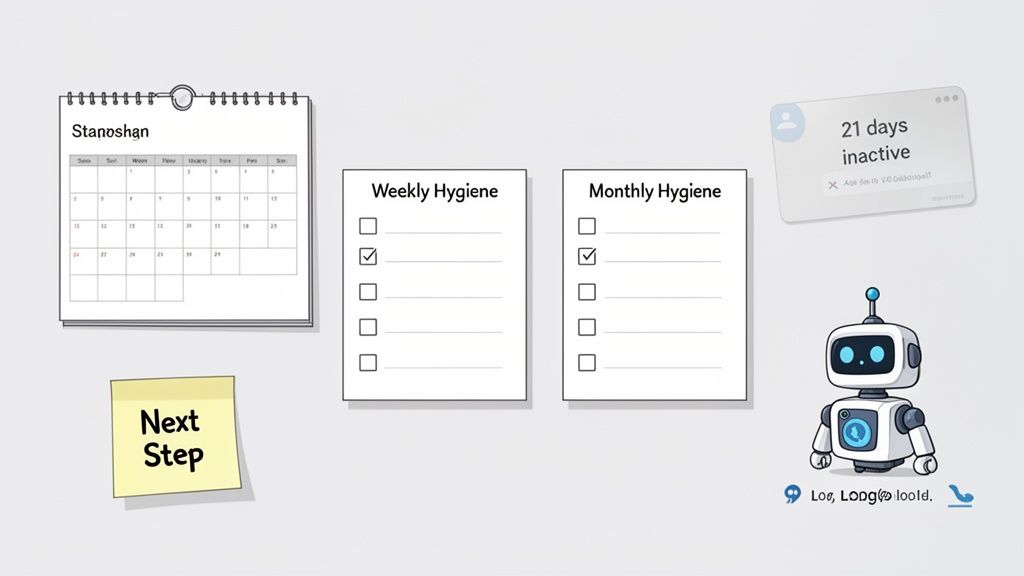
A simple but incredibly effective rule is to define a "stale" deal as any opportunity with no meaningful back-and-forth engagement for 21 days. This isn’t about how many emails a rep sent into the void; it's about a lack of replies, meetings, or any real forward momentum. Once a deal hits that 21-day mark, it needs to be flagged for review. Period.
Another non-negotiable rule should revolve around deal value. The initial estimate is always a bit of a guess. Mandate that reps must update a deal's potential value right after the discovery call. Once you’ve actually diagnosed the prospect's needs and scope, that number needs to reflect reality. This one habit alone can dramatically sharpen your forecasting accuracy.
Create Simple Hygiene Checklists
To turn this into a real habit, you need to make it dead simple. Forget abstract goals and give your team a concrete set of actions. This isn't admin work; it's a weekly tune-up to keep their personal sales engine running at peak performance.
Your 15-Minute Friday Tune-Up:
Tackle Stale Deals: Look at everything flagged for inactivity. Is there one last, genuine attempt you can make, or is it time to move on and close it out?
Lock In "Next Steps": Scan every single active deal. Does each one have a specific, scheduled next action (like "Follow-up call scheduled for Tuesday at 10 AM")? Vague notes like "follow up next week" don't count.
Stage Check: Make sure every deal is in the right stage based on the criteria you've set. If you completed discovery, move it forward. Simple.
Your 30-Minute End-of-Month Review:
Pipeline Coverage: Do you still have enough in the pipe to hit your goals for the next period? Check your pipeline-to-quota ratio (e.g., 3x your quota).
Lost Deal Autopsy: Briefly review the deals you lost this month. Spot any patterns? This is free intel to adjust your strategy.
Forecast Gut Check: Look at the deals you’ve committed. Based on the last few weeks of activity, do the close dates and values still feel real? Be honest with yourself.
Automate the Grunt Work
Ultimately, most pipeline chaos stems from one single problem: manual data entry. Your reps are paid to sell, not to spend hours logging every call, email, and meeting note. That's the work that always gets pushed aside, and it's why your data goes bad. Research has found that 44% of reps give up on a prospect after a single follow-up, often because they simply lose track.
This is where having a single, unified platform changes everything.
When you automate the logging of every call, email, and meeting, you don't just fix the symptoms—you eliminate the disease. Pipeline hygiene stops being a manual chore and becomes an automatic outcome.
For instance, a platform like Glinky can automatically record and transcribe sales calls, log them against the right opportunity in your CRM, and sync all email threads into a single timeline. Suddenly, your CRM is always current, and nobody had to lift a finger to make it happen. Reps get a perfect history of every interaction, and you get a real-time view of pipeline health you can actually trust. When the grunt work is gone, your team can get back to what they do best: building relationships and closing deals.
Using Your Pipeline for Accurate Sales Forecasting
A well-kept pipeline is more than just a list of deals. It's your crystal ball for future revenue.
When your data is clean and your stages actually mean something, you can finally stop making hopeful guesses and start producing forecasts backed by real numbers. This is the moment your pipeline transforms from a simple tracking sheet into a strategic growth engine.
It all boils down to focusing on the metrics that predict what's going to happen, not just reporting on what already did. By calculating a few key numbers, you get a forward-looking view that informs everything from one-on-one coaching to company-wide goals. It’s time to turn that pipeline data into actionable intelligence.
Calculating Your Core Pipeline Metrics
To forecast with any real confidence, you have to understand the basic math behind your sales motion. Think of these metrics as the building blocks for any reliable revenue prediction. They tell you not just what's in your pipeline, but how efficiently it’s all moving.
Here’s a quick rundown of the essential metrics you need to track to understand your pipeline's health and forecast revenue.
Key Sales Pipeline Metrics and Formulas
Metric | Formula | What It Measures |
|---|---|---|
Average Deal Size | Total Value of Won Deals / Number of Won Deals | The typical revenue you generate from a single closed-won deal. |
Win Rate | (Number of Won Deals / Total Number of Deals) x 100 | The percentage of all your created opportunities that you actually win. |
Sales Cycle Length | Total Days to Close All Won Deals / Number of Won Deals | The average time it takes for a deal to go from initial creation to closed. |
These numbers are your starting point for smarter forecasting.
For example, if you know your average win rate is 25% and your average deal size is $10,000, you now have a powerful piece of information. It means for every four qualified deals that enter your pipeline, you can realistically expect to close one and bring in $10,000 in revenue.
Moving from Lagging to Leading Indicators
Win rates and deal sizes are great, but they are lagging indicators—they tell you a story about the past. To actually forecast the future, you need leading indicators that signal what's coming down the road.
Two of the most powerful leading indicators are sales velocity and pipeline coverage.
Sales Velocity is all about momentum. It measures how quickly deals are moving through your pipeline and turning into actual cash. It’s a single, powerful number that gives you a snapshot of your sales engine's health.
The Formula: (Number of Opportunities x Average Deal Size x Win Rate) / Sales Cycle Length (in days)
A higher velocity means you're generating more revenue, faster. If you see this number start to dip, it’s an early warning sign that your revenue will be down in the coming months—even if your current pipeline value looks solid.
Pipeline Coverage Ratio is your safety net. This metric tells you if you have enough fuel in the tank to hit your revenue target. It compares the total value of all your open opportunities against your quota.
The Formula: Total Value of Open Pipeline / Revenue Quota
Most healthy sales teams aim for a coverage ratio between 3x and 5x. So, if your quarterly quota is $250,000, you should be aiming for $750,000 to $1.25 million in your active pipeline at all times. This buffer is crucial because it accounts for the deals that will inevitably get pushed, stall out, or be lost. Without it, your team is playing from behind before the quarter even starts.
Running Forward-Looking Pipeline Reviews
The single biggest mistake leaders make is running pipeline reviews that are just historical inspections. A meeting spent asking, "So, what happened with this deal last week?" is a complete waste of everyone's time.
Your pipeline reviews should be strategic, forward-looking coaching sessions.
Your weekly pipeline meeting isn't for status updates; it's for strategy. Focus on a few key deals and ask, "What needs to happen to move this forward?" and "What's the biggest risk to this deal closing?"
Instead of going through every single deal on the list, focus on the extremes:
High-Value Opportunities: What’s the plan to de-risk your biggest deals? Do you have a champion? Are you connected with multiple decision-makers?
Stalled Deals: Why has this opportunity gone quiet? Is it a bad fit, or is there a specific blocker you can help your rep push through?
Late-Stage Deals: What's the exact closing plan? Is there a verbal "yes" on the budget and a firm timeline for getting the contract signed?
This approach immediately shifts the meeting from a boring report-out to an active problem-solving session that actually helps close deals faster.
Ultimately, your pipeline is the data source, but a great CRM is the engine that brings it all to life. As you start refining your process, you might realize your current tools are what’s holding you back. If you're managing a growing team, you can check out our guide on the best CRM for small business to find a platform built for this kind of data-driven approach.
By combining the right metrics with disciplined, forward-looking reviews, you can finally build a sales process that delivers predictable, scalable growth.
Answering the Tough Questions: Real-World Pipeline Management
Even the most well-designed sales pipeline strategy runs into friction in the real world. Day-to-day execution brings up nagging questions that can stall momentum. Let's tackle some of the most common sticking points I see sales leaders and reps grapple with, and give you the straight, actionable answers you need.
How Many Sales Stages Should My Pipeline Really Have?
There's no single magic number, but for most B2B sales motions, the sweet spot is between 5 and 7 stages. The absolute key is that each stage must represent a genuine milestone from the buyer's perspective, not just a task your rep checked off a list.
Having too few stages—like a vague "Prospect," "In-Progress," and "Closed"—tells you nothing about deal health. On the flip side, getting too granular with 10 or more stages just creates a management nightmare that reps will hate updating.
The goal of your pipeline stages is clarity, not complexity. Start by mapping out the major commitments a buyer has to make in your sales process, and build your stages from there.
A solid starting point for most teams usually revolves around these key buyer commitments:
Meeting Booked: The prospect has agreed to invest their time with you.
Discovery Completed: You’ve successfully identified a qualified business pain they need to solve.
Proposal Presented: A formal solution, with pricing, has been officially delivered.
Negotiation Started: Key stakeholders are actively reviewing and discussing specific terms.
You can always add or refine these later as you collect more data on what actually drives your deals forward.
What’s the Best Way to Handle Stale Deals?
Stale deals—those "zombie" opportunities lingering in your pipeline—are poison. They kill your forecast's accuracy, create a false sense of security, and drain your team's mental energy. The only effective approach is to be disciplined and decisive.
First, you need a clear "Stale Deal Rule." A simple but powerful one is to automatically flag any deal that has seen zero meaningful engagement for 21 days. This takes the guesswork and subjectivity out of it, creating a consistent standard for everyone.
Once a deal gets flagged, have your rep try one final, direct follow-up. If you still hear crickets, move it to "Closed-Lost" with a specific reason like "Went Dark." This isn't admitting defeat; it's practicing good pipeline hygiene. It keeps your active pipeline clean and focuses your team's precious time on deals they can actually win. You can always resurrect the opportunity if they re-engage down the road.
How Can I Get My Team to Actually Use the CRM?
Let's be honest: low CRM adoption is almost always a symptom of high friction. If your CRM feels like a chore that creates more admin work than it solves, your reps will find every excuse to avoid it. The only way to truly improve adoption is to make the CRM work for them.
This is where modern revenue platforms completely change the game by automating the most soul-crushing parts of data entry. You need a tool that can automatically:
Log every call and email to the right opportunity without manual entry.
Create structured, summarized notes from every single conversation.
Sync every interaction into a single, unified deal timeline.
When the system does the grunt work for your reps instead of creating more of it, adoption skyrockets. You also have to lead by example. Run all of your pipeline reviews and 1-on-1s directly from the CRM. This reinforces that it’s the single source of truth for your entire sales operation, demonstrating its value and making consistent use non-negotiable.
Ready to stop juggling disconnected tools and finally get a clear, automated view of your revenue? Glinky unifies meeting intelligence, lead discovery, outreach, and CRM workflows into a single AI-native platform. See how Glinky can build you a pipeline you can trust.
People also read
10 Sales Enablement Best Practices to Unify Your Revenue Engine in 2026
Productivity
Mar 13, 2026

How to Qualify Leads in Sales Without Wasting Time
Productivity
Mar 17, 2026

What is Conversation Intelligence? A Practical Guide for Sales Teams
Productivity
Mar 18, 2026

Top 10 Sales Discovery Questions That Close More Deals
Productivity
Mar 25, 2026

Taking Minutes of Meeting: A Guide to Transforming Chaos into Action
Productivity
Feb 16, 2026
Action Items List: A Practical Guide to Drive Real Results
Productivity
Feb 19, 2026
Master the summary of a meeting for clear decisions and follow-ups
Productivity
Feb 22, 2026

Track Action Items: A Practical Guide to Using AI for Flawless Follow-Up
Productivity
Feb 17, 2026

Unlock: How to Take Notes on a Computer for Peak Productivity in 2026
Productivity
Feb 26, 2026

How to Record Google Meet: A Complete Guide for 2026
Productivity
Mar 4, 2026

12 Best AI Note Taking App Choices for 2026: The Definitive Guide
Productivity
Mar 6, 2026
How to Improve Customer Retention: Practical Tips to Boost Loyalty
Productivity
Mar 8, 2026

10 Client Communication Best Practices to Master in 2026
Productivity
Mar 7, 2026

The 12 Best AI Meeting Assistant Tools for 2026: A Deep Dive
Productivity
Mar 15, 2026

Your Guide to the Ultimate AI Email Writer
Productivity
Feb 27, 2026

10 Essential Customer Success Best Practices for 2026
Productivity
Mar 1, 2026
Your Guide to Sales Call Recording Software in 2026
Productivity
Mar 2, 2026
How to Take Better Meeting Notes and Drive Real Results
Productivity
Mar 5, 2026
Top 10 Picks for best crm for small business
Productivity
Mar 3, 2026

What is an Ideal Customer Profile: A Guide to Driving Growth
Productivity
Mar 9, 2026
Automated meeting minutes: Turn talks into actionable notes
Productivity
Mar 11, 2026

The Top 12 AI Powered Sales Tools to Boost Revenue in 2026
Productivity
Mar 16, 2026

AI Note Taking For Meetings: Fast, Smart AI Notes That Drive Collaboration
Productivity
Mar 19, 2026
Understanding Transcription Service Cost: A 2026 Guide
Productivity
Mar 20, 2026
Master Your Meetings With The Note Taking Charting Method
Productivity
Feb 18, 2026
The Ultimate 2026 Guide: 8 Meeting Follow Up Email Template Scenarios
Productivity
Feb 20, 2026
Master the Art of Taking Meeting Notes for Actionable Outcomes
Productivity
Feb 25, 2026

12 Best Sales Lead Generation Tools to Boost Your Pipeline in 2026
Productivity
Mar 10, 2026

Translation Vs Transcription: Which Service Do You Really Need?
Productivity
Mar 12, 2026
Mastering the goals of a meeting to drive decisions and boost team alignment
Productivity
Mar 23, 2026

The 12 Best Free AI Email Writer Tools for 2026
Productivity
Mar 22, 2026
A Guide to AI Sales Enablement Platforms in 2026
Productivity
Mar 21, 2026

Automate Follow Up Emails: Actionable Insights for Boosting Sales & Efficiency
Productivity
Mar 26, 2026

Follow Up Email Subjects That Convert: Increase Opens and Replies
Productivity
Feb 17, 2026

Your Playbook for Outbound Lead Generation in 2026
Productivity
Feb 28, 2026
Your Essential Meeting Action Items Template to Drive Results
Productivity
Feb 23, 2026

Your Guide to Using an Email Writer AI for Maximum Impact
Productivity
Feb 23, 2026
8 Essential Ground Rules at Meetings to Maximize Productivity in 2026
Productivity
Mar 24, 2026

Otter.ai vs Glinky
Productivity
Feb 5, 2026
AI Tools for Startup Founders [2026]
Productivity
Feb 4, 2026
Best AI Tools for Startups [2026]
Tools
Feb 3, 2026
Sales Call Notes: How to Capture Every Detail Without Losing the Deal
How to
Feb 2, 2026
How to Take Meeting Notes: 7 Methods That Actually Work [2026]
How to
Jan 14, 2026
![AI Meeting Minutes | Free Forever [2026]](https://framerusercontent.com/images/zYQGRjgLX63tiouLTK65LvCcjK8.png?width=402&height=263)
AI Meeting Minutes | Free Forever [2026]
How to
Jan 13, 2026
![How to Record Zoom Meetings Without a Bot [2026] 3 Easy Methods](https://framerusercontent.com/images/gGoQV8bPb9zR5weVruinbjaxO0.png?width=402&height=263)
How to Record Zoom Meetings Without a Bot [2026]
How to
Jan 9, 2026
Bot-Free AI Meeting Notes: We Tested the 6 Best Tools in 2026
Tools
Jan 8, 2026
Glinky vs Fireflies.ai
Tools
Jan 7, 2026
15 Best AI Tools to Boost Your Productivity in 2026
Productivity
Jan 6, 2026